




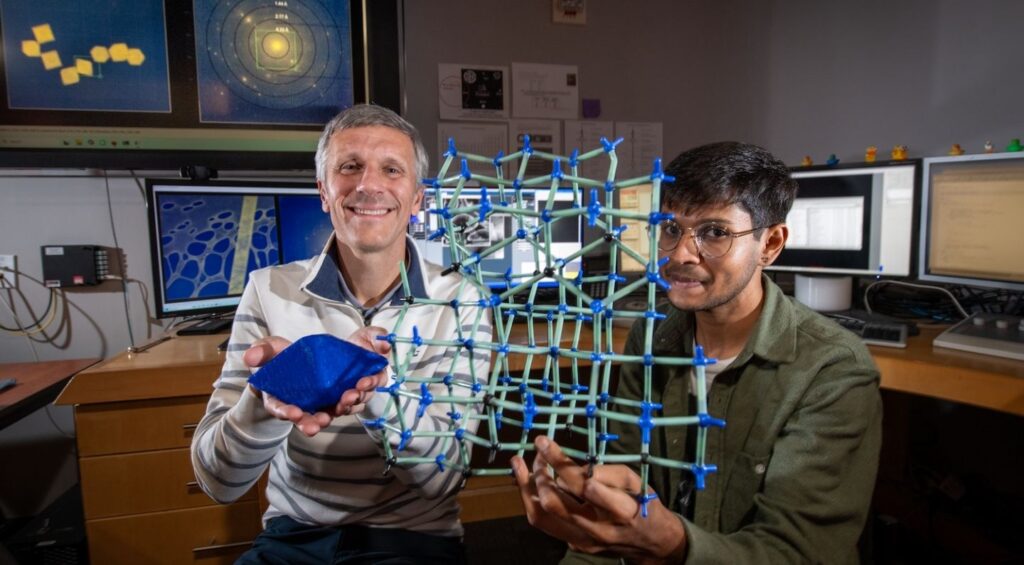
Omar Yaghi, a distinguished figure in the field of chemistry, has been awarded the 2025 Nobel Prize in Chemistry for his pioneering work on metal-organic frameworks (MOFs). Yaghi, who holds the James and Neeltje Tretter Chair at UC Berkeley’s College of Chemistry and is affiliated with Lawrence Berkeley National Laboratory (Berkeley Lab), has significantly advanced the design and synthesis of MOF structures, a field now known as “reticular chemistry.”
MOFs, developed in the 1990s, are innovative hybrid materials created by binding metal atoms or clusters to organic molecules in a repeating pattern, forming porous crystal structures. These materials can be customized to selectively capture and separate gases and liquids, paving the way for technologies such as next-generation batteries, targeted drug delivery systems, and water-harvesting devices.
The Science Behind MOFs
MOFs are renowned for their exceptional surface area; a single gram can have a surface area of up to 4,000 square meters. This characteristic allows MOFs to store large quantities of gas or liquid in a compact space. For instance, a MOF the size of a sugar cube could cover an entire football field if its surface were unfolded and laid flat.
Since their inception, over 100,000 different MOFs have been synthesized and studied, each offering a range of potential applications. The field of reticular chemistry continues to expand, driven by Yaghi’s foundational research conducted at institutions such as Arizona State University and the University of Michigan, before his tenure at Berkeley Lab.
Fueling Fundamental Research
Yaghi’s groundbreaking work in reticular chemistry has been supported by the DOE Office of Science’s Basic Energy Sciences (BES) program, which funds fundamental scientific research. Notably, Yaghi’s 1999 Nature study, which introduced the first stable MOF, was a pivotal moment in the field, opening the door for subsequent advancements.
Since joining UC Berkeley and Berkeley Lab in 2012, Yaghi has directed the Molecular Foundry, a nanoscience user facility. His work has been instrumental in the development of MOFs, with significant contributions from facilities like the Advanced Light Source (ALS) and the Stanford Synchrotron Radiation Laboratory.
Real-World Applications of MOFs
The potential of MOFs extends beyond theoretical research. At Berkeley Lab, researchers are leveraging MOF technology to tackle global challenges. For example, Yaghi’s team at the ALS has engineered MOFs to efficiently harvest water from the air, a promising solution for water scarcity.
Meanwhile, another team led by Jeffrey Long has explored how flexible MOFs can enhance the storage of natural gas, potentially extending the range of natural gas vehicles. Additionally, international collaborations have led to the development of MOFs that capture toxic gases like sulfur dioxide, which poses environmental and health risks.
Materials scientists at UC Berkeley have also improved the electrical conductivity of MOFs, expanding their use in advanced batteries and energy storage devices. These innovations highlight the versatility of MOFs in addressing diverse technological needs.
Expert Insights and Future Directions
“MOFs are of interest for an extraordinarily broad range of potential applications, including gas separations and storage, catalysis, drug delivery, and chemical sensing,” said Jeffrey Long, a senior scientist at Berkeley Lab. “We utilize DOE-supported national laboratories to probe how small molecules interact with MOFs, providing powerful insights into their mechanisms and potential improvements.”
Long’s group continues to develop new MOFs, relying on computational resources at the National Energy Research Scientific Computing Center (NERSC) to simulate interactions and optimize synthesis processes. Recently, they designed a MOF capable of extracting oxygen from air at room temperature, a breakthrough that could reduce the cost and energy of oxygen production.
“Omar Yaghi’s Nobel Prize illustrates how fundamental research, empowered by the capabilities of the DOE national labs, can translate into real-world impact,” said Jeff Neaton, Associate Laboratory Director for Energy Sciences at Berkeley Lab. “The discovery of MOFs and other reticular materials unlocks entirely new realms of possibility.”
Implications and Looking Ahead
The recognition of Yaghi’s work underscores the importance of fundamental research in driving technological innovation. As the field of reticular chemistry continues to evolve, MOFs are poised to play a critical role in addressing environmental and energy challenges.
With ongoing support from DOE national laboratories and collaboration among scientists worldwide, the future of MOFs looks promising. Researchers are poised to explore new applications and refine existing technologies, ensuring that MOFs remain at the forefront of scientific advancement.
As Yaghi’s pioneering contributions continue to inspire new generations of scientists, the potential for MOFs to revolutionize industries and improve lives remains vast and compelling.