



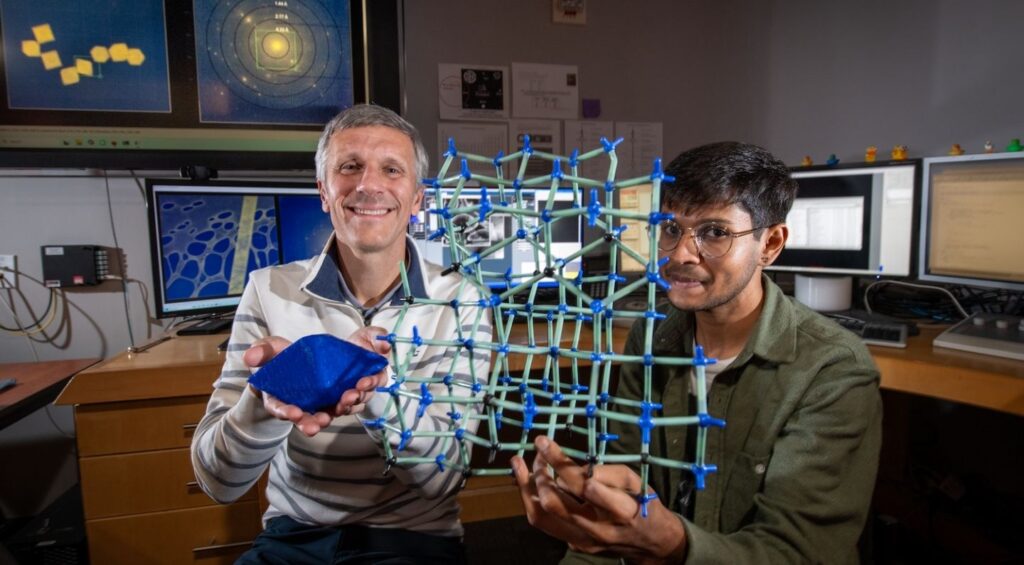
Omar Yaghi, a prominent figure in the field of chemistry, has been awarded the 2025 Nobel Prize in Chemistry. Yaghi, the James and Neeltje Tretter Chair in UC Berkeley’s College of Chemistry and an affiliate at Lawrence Berkeley National Laboratory (Berkeley Lab), received this honor for his pioneering work in the development of metal-organic frameworks (MOFs) and the techniques for designing and synthesizing new MOF structures—a field he coined as “reticular chemistry.”
MOFs, first developed in the 1990s, are hybrid materials formed by binding metal atoms or clusters to organic molecules in repeating patterns, creating porous crystal structures. These structures can be fine-tuned to selectively capture and separate gases and liquids, opening doors to a wide array of emerging technologies. Applications range from next-generation batteries and supercapacitors to platforms for targeted drug delivery, low-cost water-harvesting systems, and devices for recovering critical minerals from wastewater. Additionally, MOFs are being engineered as durable catalysts for energy technologies and sophisticated electric devices.
The Genesis and Growth of MOFs
The structure of MOFs provides them with exceptionally large surface areas, allowing them to hold vast amounts of gas or liquid in a compact volume. A notable example from Yaghi’s lab boasts approximately 4,000 square meters of surface area per gram of material. To put this in perspective, a sugar cube-sized MOF, if unfolded and laid flat, would cover an entire football field.
Since their inception, over 100,000 different MOFs have been synthesized and studied, with the field of reticular chemistry continuing to expand. Yaghi’s foundational work in this area was conducted at Arizona State University, the University of Michigan, and UCLA before he joined Berkeley Lab. Several key papers cited by the Nobel committee were funded by the DOE Office of Science’s Basic Energy Sciences (BES) program, which supports fundamental scientific research that lays the groundwork for new energy technologies.
From Laboratory to Real-World Applications
Building on his Nobel Prize-winning work, researchers at Berkeley Lab and its DOE user facilities are pushing MOF technology to tackle significant global challenges. At the Advanced Light Source (ALS), Yaghi’s team has engineered MOFs to harvest water from the air more efficiently, a crucial step in addressing future water shortages. This technology is being commercialized through Waha, Inc., and is being applied to in-building technologies and industrial applications.
Meanwhile, another team led by Jeffrey Long, a joint scientist at Berkeley Lab and UC Berkeley, is studying how flexible MOFs can store natural gas, potentially increasing the driving range of adsorbed-natural-gas vehicles. An international team has also used the ALS to study a MOF that traps toxic sulfur dioxide gas at record concentrations, a pollutant harmful to human health and the environment.
Expanding the Boundaries of MOF Technology
Materials scientists at UC Berkeley and the Molecular Foundry have developed a technique to significantly improve the electrical conductivity of certain MOFs, expanding their potential applications. This unprecedented combination of porosity and conductivity could lead to advancements in batteries, energy storage devices, fuel cells, and gas-to-fuel technology. Additionally, Molecular Foundry researchers have created a self-assembling MOF capable of extracting gas emissions and converting them into useful chemicals and fuels.
“MOFs are of interest for an extraordinarily broad range of potential applications, including gas separations and storage, catalysis, drug delivery, and chemical sensing,” said Jeffrey Long, a senior scientist in Berkeley Lab’s Materials Sciences Division. “We are often able to use X-rays and neutrons provided by DOE-supported national laboratories to directly probe how small molecules engage with the pores within the structure.”
Long’s group continues to develop new MOFs, relying on computing resources at the National Energy Research Scientific Computing Center (NERSC) to simulate interactions and model synthesis processes. Recently, they designed a MOF that can capture oxygen from air at room temperature, potentially reducing the cost and energy required for industrial and medical oxygen production.
The Future of MOFs and Their Global Impact
Omar Yaghi’s Nobel Prize underscores the transformative potential of fundamental research, as demonstrated by the capabilities of DOE national labs. The discovery and development of MOFs and other reticular materials have unlocked new realms of possibility, paving the way for innovative solutions to global challenges.
“We’re thrilled to see this recognition of Omar’s pioneering work and proud to continue building on the foundation in this important materials class he helped create,” said Jeff Neaton, Associate Laboratory Director for Energy Sciences at Berkeley Lab.
As the field of reticular chemistry continues to grow, the groundbreaking work of Yaghi and his colleagues promises to drive further advancements in technology and sustainability, offering hope for addressing some of the world’s most pressing issues.