

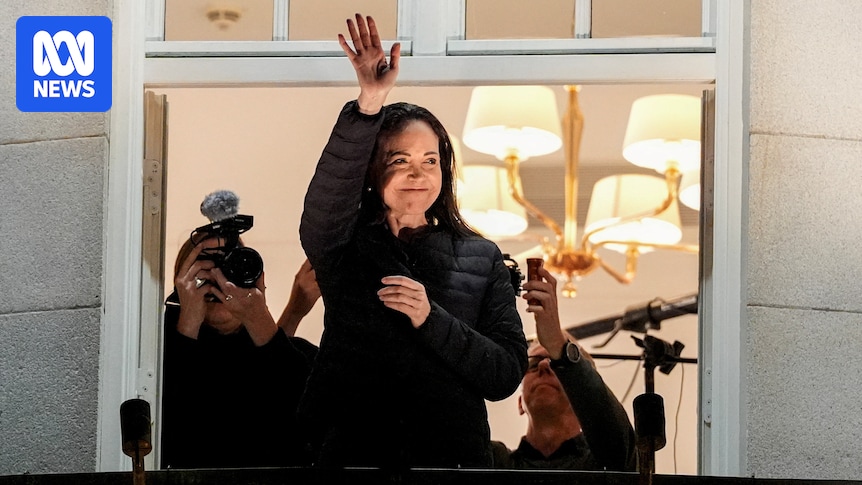
Above the twinkling Christmas lights of Oslo’s Grand Hotel, Maria Corina Machado emerged through a small white doorway onto a balcony, where a crowd of supporters erupted into cheers. The Venezuelan opposition leader and Nobel Peace Prize laureate appeared in public on Thursday for the first time in almost a year, smiling widely and pressing her palms together in gratitude.
Dressed in jeans and a black puffer jacket, the 58-year-old Machado pressed one hand to her chest and joined the crowd in singing the Venezuelan national anthem, Gloria al Bravo Pueblo—Glory to the Brave People. Despite the late hour and the chilly 4 degrees Celsius temperature, people lined the street to catch a glimpse of her.
Within minutes, Machado descended from the balcony to greet the crowd with hugs and waves, accompanied by her family. “I want you all back in Venezuela,” she declared as supporters lifted their phones to capture the moment. The crowd responded with chants of “gracias Maria”—a message of thanks, “libertad”—freedom, and her political slogan “hasta el final,” meaning “until the end.”
Machado’s Defiance and Escape
Machado had been living in hiding in Venezuela since January, fearing for her safety under the regime of President Nicolás Maduro Moros. She secretly left Venezuela in defiance of a decade-long travel ban imposed by the Maduro government, which threatened to label her a “fugitive” if she traveled to Oslo to accept the Nobel Peace Prize.
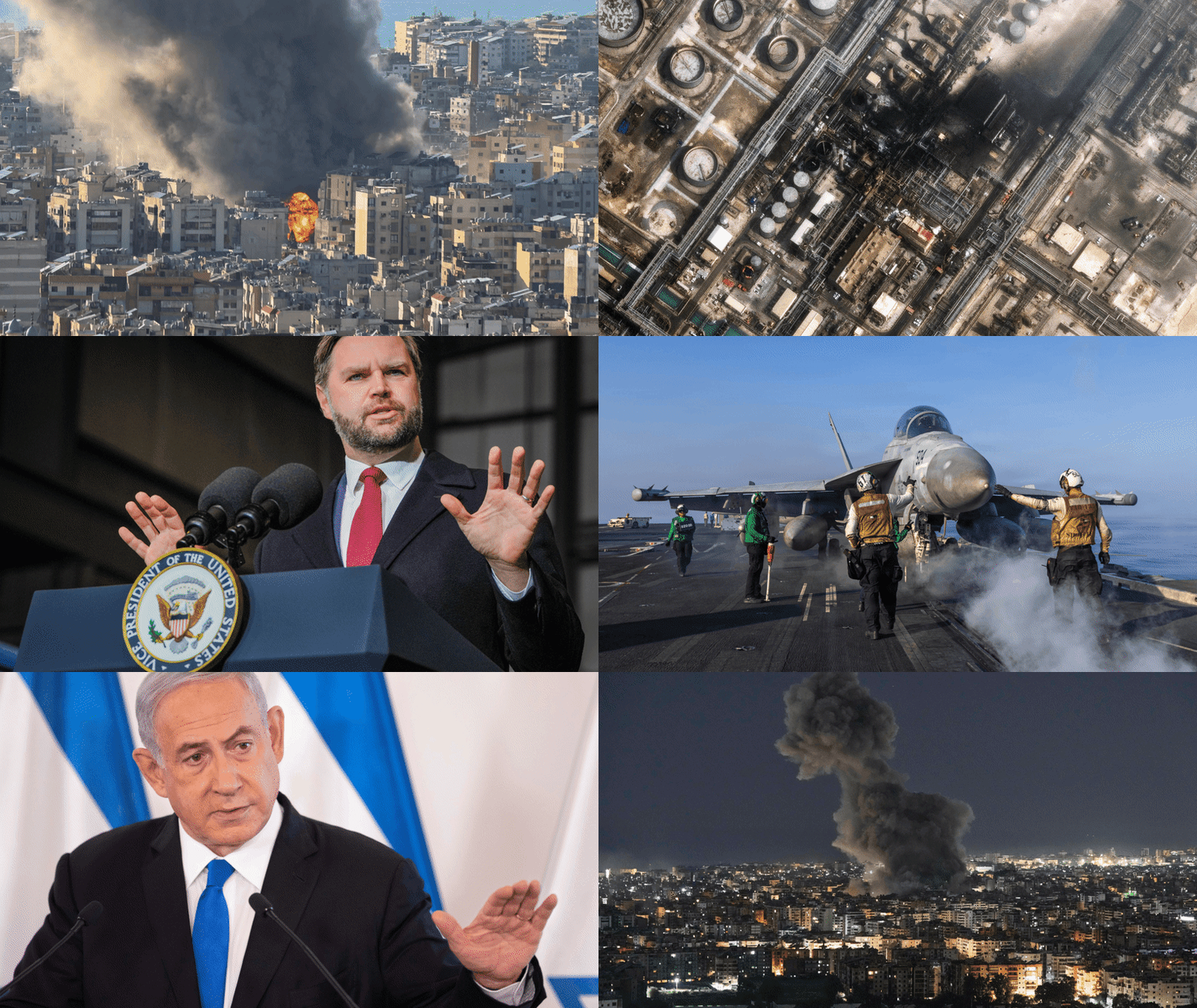
During her time in exile, tensions between Maduro and the United States escalated. US President Donald Trump ordered a massive military build-up in the Caribbean Sea, including the deployment of the world’s largest aircraft carrier, ostensibly to combat drug trafficking.
For days, Machado’s whereabouts were shrouded in mystery after members of the Nobel Committee and her political party, Vente Venezuela, announced her plans to travel to Oslo. While in hiding, she communicated with her supporters through short political messages on the party’s YouTube channel or live news programs, always in front of a nondescript white background.
“It reminds the world that democracy is essential to peace,” Machado said in her Nobel acceptance speech, read by her daughter Ana Corina Sosa.
The Journey to Oslo
Machado has been seen in public only once since going into hiding in August last year—during a brief appearance in January at a protest rally ahead of Maduro’s inauguration, where she was briefly detained. Ahead of the Nobel award ceremony, the Nobel Institute was unaware of her whereabouts or whether she would be in Oslo to accept the prize.
According to Reuters, Machado managed to leave Venezuela by boat on Tuesday, crossing the 65-kilometer stretch of the Caribbean Sea to Curaçao. She then traveled to Oslo on a private jet, landing after a stop in Bangor, Maine.
Support and Solidarity
Prominent Latin American political figures attended the award ceremony, including Argentine President Javier Milei, Ecuadorian President Daniel Noboa, Panamanian President José Raúl Mulino, and Paraguayan President Santiago Peña. The Nobel Committee announced Machado as the Peace Prize recipient on October 10, with chairperson Jørgen Watne Frydnes describing Venezuela as “a brutal authoritarian state” and calling Machado “one of the most extraordinary examples of civilian courage in recent Latin American history.”
The honor followed Machado’s victory in an opposition primary election in 2023, where she intended to challenge Maduro in the 2024 presidential election. However, the government barred her from running for office. She then hand-picked former diplomat Edmundo González Urrutia to stand in her place. Despite claims from the opposition that González defeated Maduro with at least 70% of the vote, Venezuela’s National Electoral Council declared Maduro the winner. González fled to Spain, seeking asylum, and Machado went into hiding shortly after attending protest rallies.
Implications for Venezuela
Machado’s emergence in Oslo not only highlights her personal courage but also underscores the ongoing struggle for democracy in Venezuela. Her defiance of the travel ban and her public appearance serve as a powerful symbol of resistance against authoritarianism.
The international community continues to watch Venezuela closely, with Machado’s Nobel Prize drawing renewed attention to the country’s political crisis. As she stands on the global stage, Machado’s message of peace and democracy resonates, offering hope to those fighting for change in Venezuela.
As Machado returns to the public eye, the world waits to see how her actions will influence the political landscape in Venezuela and beyond. Her journey from hiding to the Nobel stage is a testament to the enduring power of the human spirit in the face of oppression.