




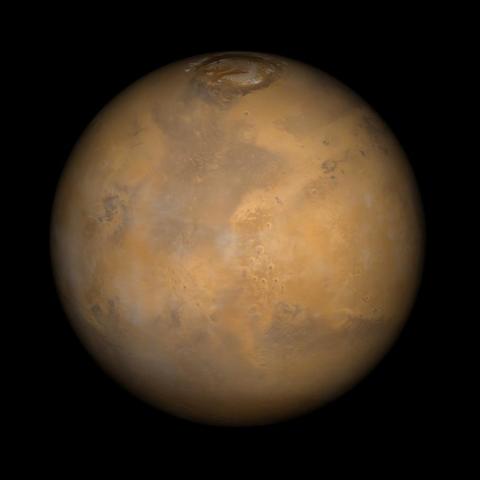
Acidalia and Chryse Plains, Mars
Ask someone on Earth for the time, and they can give you an exact answer, thanks to our planet’s intricate timekeeping system, built with atomic clocks, GPS satellites, and high-speed telecommunications networks. However, as Albert Einstein demonstrated, clocks don’t tick at the same rate across the universe. The strength of gravity in their environment causes clocks to run slightly faster or slower, complicating synchronization across the vast solar system. As humanity eyes a long-term presence on Mars, scientists are faced with a pressing question: What time is it on Mars?
Physicists at the National Institute of Standards and Technology (NIST) have calculated a precise answer for the first time. On average, clocks on Mars will tick 477 microseconds (millionths of a second) faster than on Earth per day. However, Mars’ eccentric orbit and the gravitational influence of its celestial neighbors can increase or decrease this amount by as much as 226 microseconds a day over the course of the Martian year. These findings, published in The Astronomical Journal, build on a 2024 paper where NIST physicists developed a plan for precise timekeeping on the Moon.
Understanding Martian Time
Knowing how clocks will tick on Mars is a stepping stone for future space missions, according to NIST physicist Bijunath Patla. As NASA plans Mars exploration missions, understanding time on our planetary neighbor will help synchronize navigation and communication across our solar system.
“The time is just right for the Moon and Mars,” Patla said. “This is the closest we have been to realizing the science fiction vision of expanding across the solar system.”
Mars Time Zone
Martian days and years are longer than those on Earth. The planet’s day, or full rotation on its axis, is 40 minutes longer than Earth’s, and it takes 687 days to complete its orbit around the Sun, compared with Earth’s 365 days. But scientists needed to know how fast or slow each second passes on Mars compared with Earth.
If you were to land on the surface of Mars with an atomic clock, it would still tick the same way it would on Earth. However, when compared with a clock on Earth, they will be out of sync. The challenge is determining how much Mars’ time is offset from Earth’s, akin to calculating a time-zone difference.
That task proved more complex than NIST physicists anticipated. Einstein’s theory of relativity posits that the strength of gravity affects the passage of time. Clocks tick slower where gravity is stronger and faster where it is weaker. Additionally, the velocity of a planet’s orbit impacts clock rates.
NIST chose a point on the Martian surface to act as a reference, similar to sea level at the equator on Earth. Thanks to years of data from Mars missions, Patla and fellow NIST physicist Neil Ashby could estimate gravity on the Martian surface, which is five times weaker than Earth’s.
The Challenges of Cosmic Timekeeping
However, Mars’ gravity wasn’t the only factor to consider. The solar system’s massive bodies exert gravitational pulls on each other. The Sun alone accounts for more than 99% of the solar system’s mass. Mars’ position in the solar system—its distance from the Sun, and its neighbors like Earth, the Moon, Jupiter, and Saturn—pulls it into a more eccentric, elongated orbit. While the Earth’s and Moon’s orbits are relatively constant, time on the Moon is consistently 56 microseconds faster than on Earth.
“But for Mars, that’s not the case. Its distance from the Sun and its eccentric orbit make the variations in time larger. A three-body problem is extremely complicated. Now we’re dealing with four: the Sun, Earth, the Moon, and Mars,” Patla explained. “The heavy lifting was more challenging than I initially thought.”
After considering all these effects—Martian surface gravity, Mars’ eccentric orbit, and the influence of the Sun, Earth, and Moon—Patla and Ashby arrived at their answer.
Paving the Way for Solar System Internet
While 477 millionths of a second may seem negligible, accounting for tiny time differences is crucial for developing communications networks. For instance, 5G networks require accuracy within a tenth of a microsecond.
Currently, communications between Earth and Mars experience delays ranging from four to 24 minutes, sometimes more. Patla likens it to pre-telegram communications, where people delivered handwritten letters to ships, which crossed the ocean, and then waited weeks or months for a reply.
“If you get synchronization, it will be almost like real-time communication without any loss of information. You don’t have to wait to see what happens,” Patla said.
Although such networks are far from reality, and long-term human and robotic Mars missions remain distant, Ashby emphasized the importance of studying these issues now. Understanding these variables prepares scientists for future challenges.
“It may be decades before the surface of Mars is covered by the tracks of wandering rovers, but it is useful now to study the issues involved in establishing navigation systems on other planets and moons,” Ashby said. “Like current global navigation systems like GPS, these systems will depend on accurate clocks, and the effects on clock rates can be analyzed with the help of Einstein’s general theory of relativity.”
Beyond practical applications, this knowledge holds scientific value, Patla added. Understanding how clocks tick on distant planets enhances our grasp of Einstein’s theories of special and general relativity.
“It’s good to know for the first time what is happening on Mars timewise. Nobody knew that before. It improves our knowledge of the theory itself, the theory of how clocks tick and relativity,” he said. “The passage of time is fundamental to the theory of relativity: how you realize it, how you calculate it, and what influences it. These may seem like simple concepts, but they can be quite complicated to calculate.”
With this groundbreaking research, NIST physicists have not only answered a fundamental question about Mars but also laid the groundwork for future space exploration and communication systems that could one day span our solar system.