




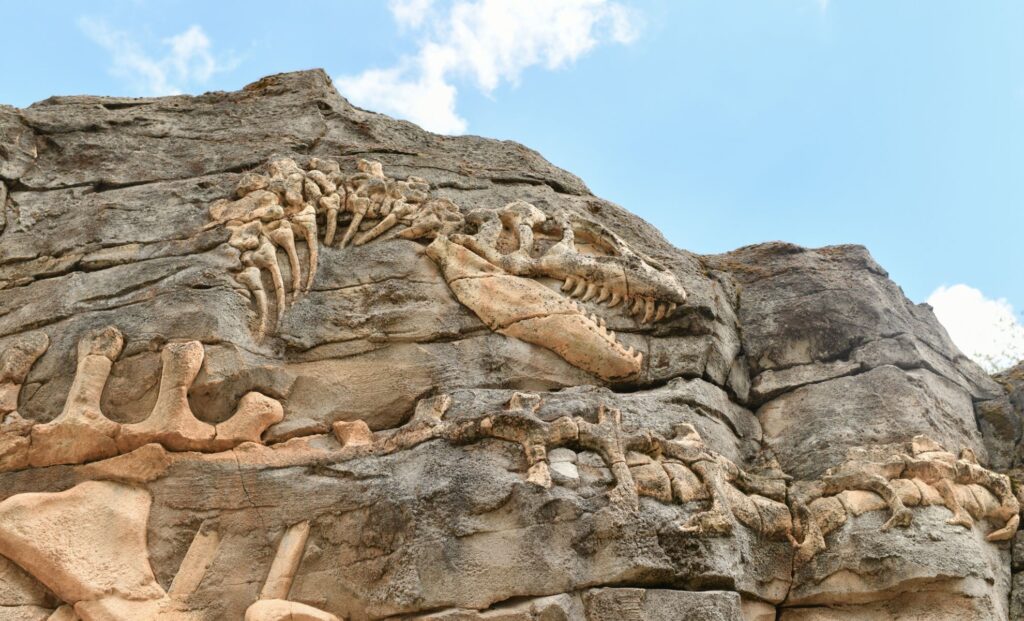
An international team of paleontologists has unveiled a remarkable discovery: a nine-ton dinosaur with a peculiar duck-like face, named Ahshiselsaurus wimani. This revelation follows a re-examination of fossils initially unearthed in New Mexico in 1916. The findings, recently published in the Bulletin of the New Mexico Museum of Natural History and Science, reveal that Ahshiselsaurus is part of a broader group of herbivorous dinosaurs that once thrived in North America’s Western Interior Basin.
The announcement comes as researchers from Penn State and the New Mexico Museum of Natural History have reclassified the fossil, which was originally thought to belong to the Kritosaurus genus. The new classification underscores significant anatomical differences identified in the skull and vertebrae, leading to the recognition of Ahshiselsaurus as a distinct genus.
Revisiting an Old Fossil
The fossil of Ahshiselsaurus was first classified as a species of Kritosaurus in 1935. However, recent analysis by D. Edward Malinzak, an assistant professor of biology at Penn State, and his team has revealed that the fossil represents a separate genus. The newly identified species, Ahshiselsaurus wimani, adds a crucial piece to the puzzle of the hadrosaurid family, which includes notable members like Parasaurolophus and Edmontosaurus.
The specimen used to define this new species comprises an incomplete skull and several isolated bones. The team’s comparative analysis with other hadrosaurid fossils demonstrated that Ahshiselsaurus possessed unique features, justifying its reclassification and overturning decades of previous assumptions.
The Role of Ahshiselsaurus in Its Ecosystem
Ahshiselsaurus wimani was a massive herbivore, estimated to have measured over 35 feet in length and weighed around nine tons. Its presence in late Cretaceous New Mexico would have been significant, contributing to the region’s ecological dynamics. Unlike some of its hadrosaurid relatives, such as Parasaurolophus, Ahshiselsaurus lacked the distinctive head crest, further distinguishing it from other species.
In its ecosystem, Ahshiselsaurus coexisted with an array of other dinosaurs, including armored ankylosaurids and the horned Navajoceratops. This discovery sheds light on the complexity of ancient ecosystems and the diverse roles different dinosaur species played in shaping their environments.
Insights into Dinosaur Migration and Evolution
The study of Ahshiselsaurus also offers valuable insights into the migration patterns of dinosaurs across North America. Researchers believe that Ahshiselsaurus and similar species migrated from the southwestern part of the continent to other areas, including Canada and South America. According to Malinzak and his colleagues, this migration was likely part of a broader pattern of dinosaur dispersal, driven by environmental changes.
“The discovery of Ahshiselsaurus wimani not only enhances our understanding of hadrosaurid diversity but also provides a window into the migratory behaviors of dinosaurs during the late Cretaceous period,” said Malinzak.
This development follows ongoing research into how dinosaurs adapted to shifting climates and landscapes, offering a glimpse into the evolutionary pressures that shaped their existence.
Implications and Future Research
The identification of Ahshiselsaurus wimani as a new genus has significant implications for paleontology, particularly in understanding the diversity and adaptation of hadrosaurids. As researchers continue to explore the fossil record, they anticipate uncovering more about the evolutionary history of these fascinating creatures.
Future studies may focus on the ecological interactions between Ahshiselsaurus and other contemporary species, as well as further analysis of its migratory patterns. These investigations could provide deeper insights into the resilience and adaptability of dinosaurs in the face of environmental challenges.
As paleontologists delve deeper into the mysteries of the past, discoveries like Ahshiselsaurus wimani continue to illuminate the rich tapestry of life that once existed on Earth, offering a profound understanding of our planet’s ancient history.