
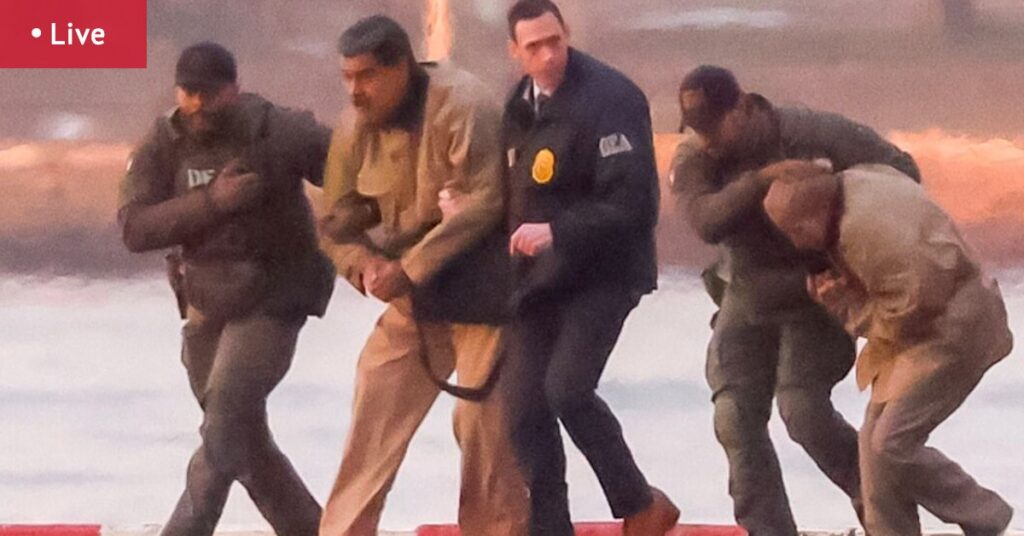
Ousted Venezuelan leader Nicolás Maduro, alongside his wife Cilia Flores, made a dramatic appearance in a New York court, pleading not guilty to drug and weapons charges. The courtroom scene unfolded early Tuesday morning, marking a significant moment in international politics as the United Nations condemned the US military strike that led to their capture.
Maduro, shackled at the ankles, declared his innocence to District Judge Alvin Hellerstein, stating, “I am innocent, I am not guilty. I am a decent man.” He further claimed, “I’m the president of the republic of Venezuela … I am here kidnapped,” before being interrupted by the judge. As he exited the courtroom, a spectator labeled him an “illegitimate” president, to which Maduro responded, “I am a kidnapped president. I am a prisoner of war.”
Flores also pleaded not guilty, with her legal team highlighting injuries sustained during her capture. The court proceedings have been adjourned to March 17, with Maduro’s defense planning extensive pretrial filings to challenge the legality of his capture.
International Reactions and Legal Implications
The capture of Maduro and Flores, executed by US forces in a meticulously planned operation, has stirred international debate. US President Donald Trump hinted at further military actions in Colombia and Greenland, while the United Nations expressed concern over the potential breach of international law by the US.
Meanwhile, a flotilla of oil tankers has reportedly left Venezuelan waters, defying US sanctions. According to Reuters and TankerTrackers.com, these vessels, now sailing without flags or safety documentation, highlight the complexities of enforcing international embargoes.
“The government of Colombia has let the US government know … that we are going to keep coordinating and cooperating in the fight against drug trafficking,” stated Colombian Interior Minister Armando Benedetti.
Global Political Dynamics
British Prime Minister Keir Starmer and other European leaders have voiced opposition to Trump’s renewed interest in acquiring Greenland, a move reminiscent of historical US expansionism. Danish Prime Minister Mette Frederiksen urged Trump to “stop the threats,” emphasizing Greenland’s autonomy.
In the US, Trump’s actions have sparked a political debate, with Democrats questioning the implications of his foreign policy. Bruce Wolpe, a senior fellow at the University of Sydney, noted the potential for Trump’s strategy to backfire domestically as Democrats struggle to mount a unified response.
Historical Context and Future Prospects
Trump’s approach echoes the Monroe Doctrine, a 19th-century policy opposing European colonialism in the Americas. His administration’s focus on the western hemisphere could reshape US foreign policy, potentially leading to nation-building efforts similar to those he previously criticized.
“He’s deeply concerned about malicious influence in our neighbourhood,” said Victoria Coates, Trump’s former deputy national security adviser, highlighting concerns over Russian and Chinese activities in the region.
The situation remains fluid, with potential repercussions for global oil markets, particularly affecting China’s access to Venezuelan crude. The US strategy may also alter alliances, as nations reassess their geopolitical positions.
Domestic and International Responses
In Australia, Health Minister Mark Butler called for diplomatic solutions, urging the US to clarify the legal basis for its actions. Opposition leader Sussan Ley supported Maduro’s capture, citing the need for justice against dictators.
As the world watches, the unfolding events in Venezuela and the US’s assertive foreign policy continue to generate significant international discourse. The upcoming court proceedings in March will likely provide further insights into the legal and political ramifications of this high-stakes situation.