



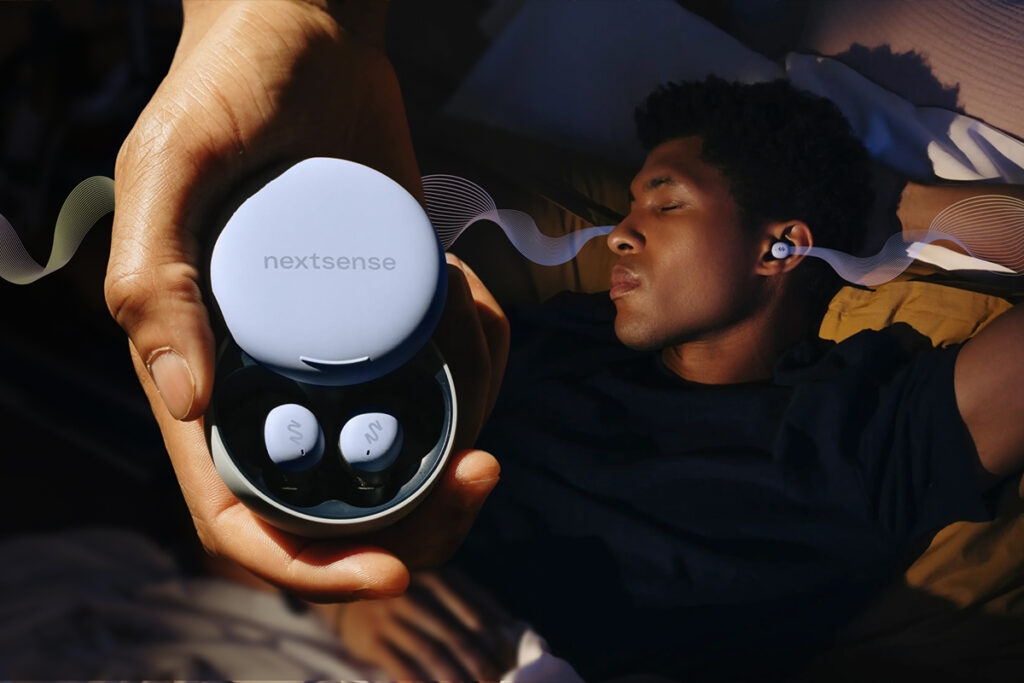
NextSense has launched its groundbreaking Smartbuds, brain-sensing earbuds that promise to move sleep technology beyond mere tracking and into the realm of real-time intervention. These earbuds, now available to consumers, utilize in-ear EEG sensors to both measure and modulate sleep, representing a significant leap in consumer sleep technology.
For years, consumer sleep technology has focused primarily on observation. Devices like rings, watches, and bedside monitors have become adept at converting restless nights into data, yet they rarely influence the underlying biology. NextSense’s Smartbuds aim to change that by offering a proactive approach to sleep improvement.
From Observation to Intervention
The Smartbuds’ approach is deceptively simple yet revolutionary. Unlike traditional devices that infer sleep stages from movement or heart rate, these earbuds use six electroencephalography (EEG) sensors inside the ear canal to directly detect neural activity. When the system identifies transitions between sleep stages, it delivers precisely timed audio stimulation to reinforce slow-wave activity, the phase most associated with recovery and memory consolidation.
According to Jonathan Berent, founder and CEO of NextSense, the company was born from the need to shift from passive monitoring to active sleep support. “Sleep shapes how we show up in the world,” Berent stated. “Smartbuds go beyond passive monitoring to actively improve sleep, unlocking true recovery.”
EEG Technology: From Lab to Bedroom
Electroencephalography has long been the gold standard for sleep staging, yet its use has been largely confined to clinical settings. By embedding EEG sensors into an earbud form factor, NextSense aims to make neural data collection both comfortable and habitual, gathering information night after night.
During beta testing, Smartbuds demonstrated increases in slow-wave activity over more than 100 nights, with nearly half of participants reporting subjective improvements in sleep quality. This positions NextSense’s dataset among the largest in-ear sleep EEG collections outside formal trials.
Challenges and Opportunities
Retailing at $399.99, with an early launch price of $249, Smartbuds require a subscription for regular ear tip replacements. Currently compatible only with recent iPhones, the product enters the market with the typical frictions of first-wave neurotechnology. This positions Smartbuds firmly within a premium market, despite sleep deprivation disproportionately affecting lower-income and older populations.
The tension between innovation and accessibility is not unique to NextSense. As sleep interventions move from general advice to personalized support, questions of equity become increasingly central to the conversation.
The Future of Sleep Technology
Sleep has always been a challenging test case for healthspan technology: it is universal, biologically essential, and resistant to quick fixes. Technologies like Smartbuds will require patience and evidence to prove their efficacy. Whether Smartbuds signify a lasting shift toward neural modulation or remain an elegant experiment is yet to be seen.
What is clear is that sleep technology is evolving. No longer content to be measured passively, sleep demands active attention and intervention. As NextSense continues to gather data and refine its technology, the potential for Smartbuds to transform sleep health remains promising.
Photographs courtesy of NextSense