


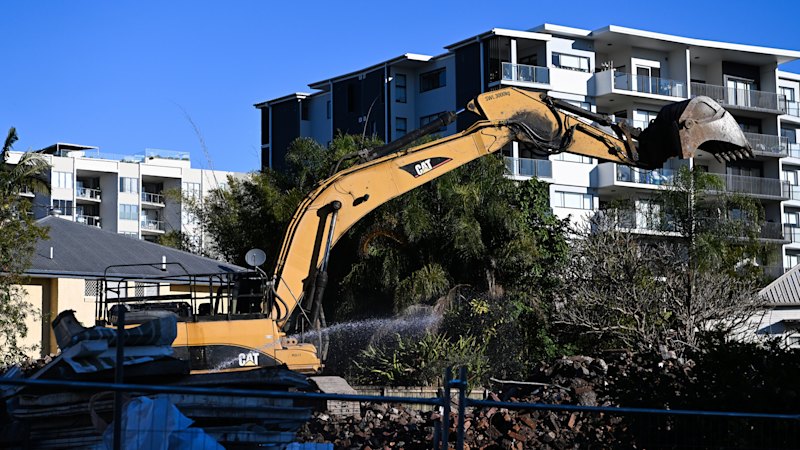
A million new homes could be delivered across Australia’s five largest capital cities by allowing property owners to subdivide their land, according to new research. This strategy, known as “gentle density,” could ease housing price pressures and expand living options for Australians.
The Committee for the Economic Development of Australia (CEDA) is set to present findings on Tuesday advocating for default approval of dual occupancies. This approach would alleviate the need for high-rise developments while optimizing the use of existing infrastructure.
Currently, the federal government is trailing by 60,000 homes in its goal to construct 1.2 million properties by 2029. This shortfall is compounded by a surge in house prices, fueled by the Reserve Bank’s interest rate cuts since February. Recent figures revealed that Sydney’s median house value has reached a record $1.584 million, with Canberra and Brisbane also surpassing the $1 million mark.
Learning from Auckland’s Success
CEDA’s research draws inspiration from planning reforms implemented in Auckland, New Zealand’s largest city, which have significantly enhanced affordability and housing supply. The pivotal change involved allowing property owners to subdivide with minimal restrictions.
Danika Adams, a senior CEDA economist and co-author of the report, highlighted that if just 25% of standalone lots were converted into dual occupancies, housing supply could increase by 9%, equating to approximately 1 million homes. In Sydney, this could result in a 12% rise, while Melbourne could see a 15% increase, particularly in areas near employment and transport hubs.
“But gentle density can deliver more housing in middle-ring neighbourhoods where people want to live, while making better use of existing infrastructure and transport networks,” Adams explained.
The Auckland reforms, introduced when its property values were climbing as rapidly as those in Sydney and Melbourne, led to a 50% increase in building consents within five years. Consequently, house prices were estimated to be 15 to 27% lower than they might have been otherwise.
Comparative Strategies and Proposals
In Melbourne, CEDA estimates that redeveloping over 1,000 strata-titled sites within 15 kilometers of the CBD could yield an additional 100,000 homes. This proposal echoes a recent suggestion by the Grattan Institute, which called for the construction of three-storey apartments and townhouses in capital cities without special planning permissions.
The Grattan Institute projected that Melbourne could accommodate an extra 431,000 homes within 15 kilometers of the city center, while Sydney could potentially add up to 1 million homes feasibly.
Adams emphasized the necessity for comprehensive national reforms, despite ongoing efforts by the NSW and Victorian governments. She advocated for a culture of “yes if,” promoting speed and predictability to expedite housing development in amenity-rich neighborhoods.
Government Incentives and Future Directions
To further stimulate housing supply, CEDA suggests that state governments should incentivize councils that meet housing targets and penalize those that do not. The federal government has already allocated $500 million to assist councils in providing essential infrastructure for new homes, primarily benefiting suburban and regional local governments.
Additionally, $1 billion has been directed to state governments to support infrastructure development or planning reforms that could accelerate housing projects.
The anticipated increase in housing supply is expected to moderate a property market poised for an over 8% nationwide price surge this year.
As Australia grapples with its housing crisis, adopting successful models like Auckland’s could offer a viable pathway to achieving sustainable growth and affordability in the housing sector.