



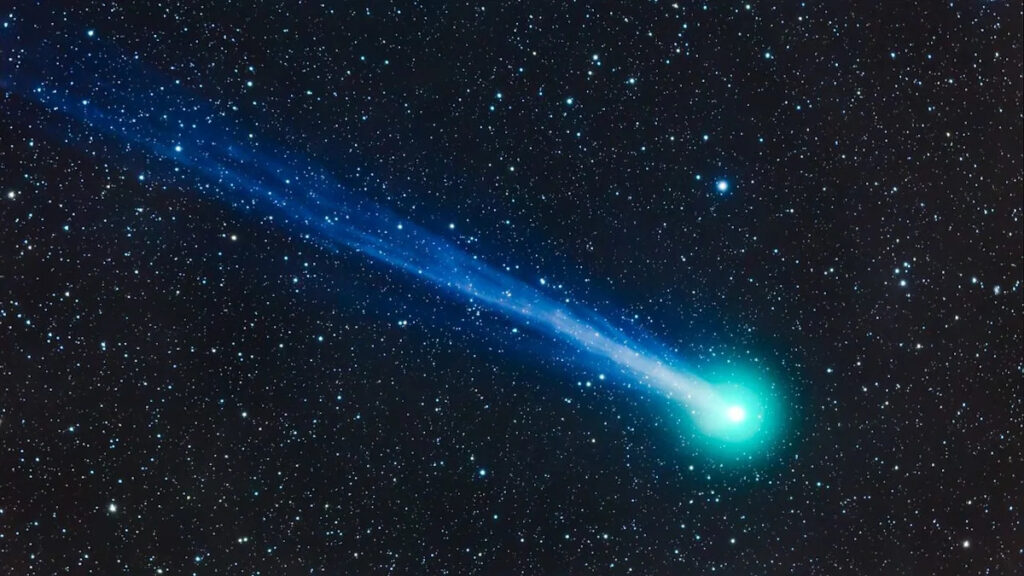
Astronomers have recently discovered a potentially spectacular “sungrazing” comet, C/2026 A1 (MAPS), which is set to have a dangerously close encounter with the sun in less than two months. Experts are hopeful that this icy traveler could become bright enough to be visible to the naked eye during daylight hours—provided it can withstand the intense solar forces it will soon face.
The comet was identified on January 13 by a team of French astronomers at the AMACS1 Observatory in Chile’s Atacama Desert. Measuring approximately 1.5 miles (2.4 kilometers) in diameter, C/2026 A1 was first spotted at a distance more than twice that of Earth’s from the sun, according to Sky & Telescope magazine.
The Kreutz Family of Sungrazers
C/2026 A1 is part of the Kreutz family, a group of over 3,500 comets with orbits that bring them perilously close to the sun, within 850,000 miles (1.4 million km). These comets are believed to be remnants of a massive comet that disintegrated near the sun approximately 1,700 years ago, as reported by Space.com.
The comet will reach its closest approach to the sun, known as perihelion, on April 4. At this point, it will come within about 500,000 miles (800,000 km) of the solar surface, or roughly 70 times closer than Mercury. This proximity will subject C/2026 A1 to extreme gravitational forces, soaring temperatures, and intense solar radiation.
“At such close quarters, the comet will travel at speeds exceeding 2 million mph (3.2 million km/h), facing a formidable test of its structural integrity.”
Will C/2026 A1 Survive?
The survival of C/2026 A1 is uncertain, as most sungrazing comets disintegrate under similar conditions. However, if it endures, the comet could transform into an extraordinarily bright celestial object, potentially visible even during the day.
This comet hails from a notable subgroup of Kreutz sungrazers, believed to be fragments of the “Great Comet of 1106.” Historical members of this subgroup include Comet Ikeya-Seki, which outshone the full moon in 1965, and Comet Lovejoy, which became famous in 2011 after partially disintegrating.
As these comets approach the sun, they often release vast amounts of gas, enhancing their brightness and sometimes developing striking “broom-like” tails. C/2026 A1 could exhibit similar behavior, according to Sky & Telescope.
Potential Brightness and Observability
While it is too early to predict the exact brightness of C/2026 A1, some researchers speculate it could surpass the full moon’s brightness, making it visible to the naked eye during the day, as noted in The Conversation. However, this dazzling display hinges on the comet surviving its solar flyby.
Typically, smaller sungrazing comets are discovered only days before their closest solar approach and often disintegrate during the encounter. For instance, a tiny sungrazer was detected just hours before vanishing during the total solar eclipse of April 2024.
Viewing Opportunities
Should C/2026 A1 survive, it is expected to reach maximum brightness a few days post-perihelion as it approaches Earth later in April. Sky & Telescope suggests that observers in the Southern Hemisphere will have the best views, though those in the Northern Hemisphere may also catch a glimpse low on the southwestern horizon at sunset.
Even if the comet disintegrates, it will remain visible with telescopes or binoculars from late March onwards.
Upcoming Celestial Events
April will also see another promising comet, C/2025 R3 (PanSTARRS), nearing its perihelion on April 20. This comet, previously dubbed the “Great Comet of 2026,” could also become visible to the naked eye.
As the astronomical community eagerly awaits these celestial events, the fate of C/2026 A1 remains uncertain. Its journey may either culminate in a spectacular daytime display or a quiet dissolution, leaving astronomers and skywatchers alike poised for a dramatic conclusion.