




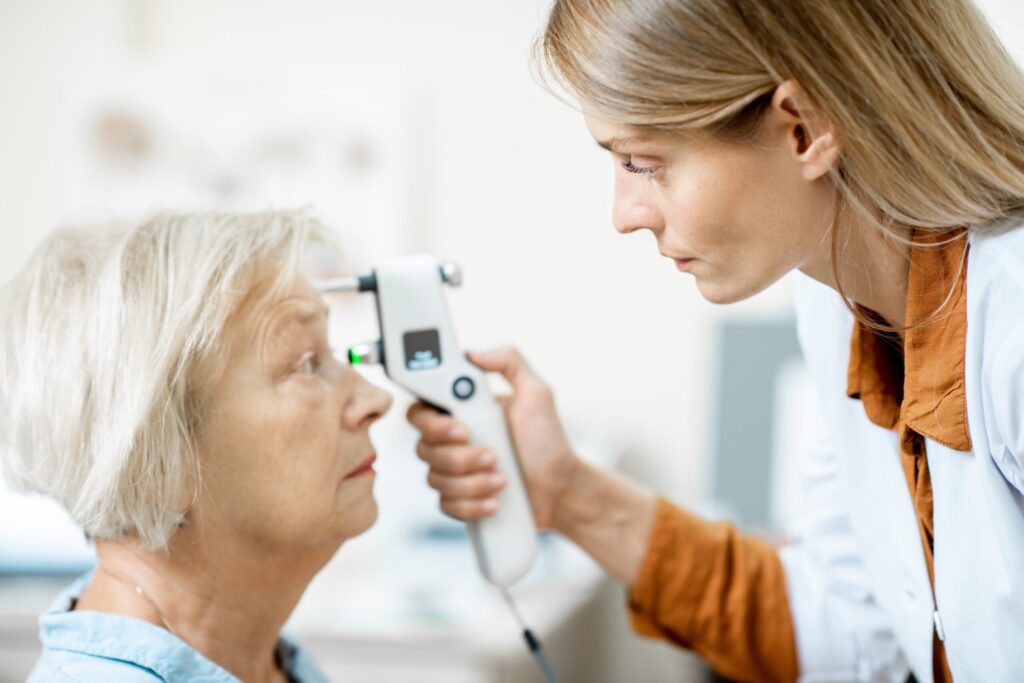
Female ophthalmologist measuring the eye pressure with modern tonometer to a senior patient in the medical office
New research published in JAMA Ophthalmology this month has sparked a call for change in the way glaucoma is treated, challenging the long-standing reliance on the intraocular pressure (IOP) threshold of 22 mm Hg. Despite advancements in clinical understanding, many ophthalmologists continue to use this historical benchmark as a primary guide for treatment decisions.
The study, titled ‘Influence of Intraocular Pressure on Clinical Decision-Making in Glaucoma Management’, analyzed over 1.86 million clinic encounters across seven U.S. academic eye centers. It found that while clinicians treat IOP as a continuous risk factor, there is a significant increase in intervention when a patient’s IOP hits the 22 mm Hg mark.
Key Findings and Implications
According to the research led by Dr. Ashley Polski from the John A. Moran Eye Center at the University of Utah, clinicians were notably more inclined to initiate or escalate therapy once a patient’s IOP reached 22 mm Hg. At this point, the odds of starting treatment increased by 23% (OR 1.23) compared to lower pressures.
“Clinicians were significantly more likely to initiate or increase therapy when a patient’s IOP reached 22 mm Hg,” the study noted.
The historical “normal” range of 10 to 21 mm Hg was set decades ago based on population averages. However, the study highlights that current understanding acknowledges glaucoma can occur with “normal” pressures, and some individuals with “high” pressures may not experience damage. This suggests that the binary threshold may act as a “decisional shortcut” in managing complex clinical data.
Moving Towards Individualized Treatment
The researchers propose that these findings underscore the necessity for improved clinical decision support systems. Such tools could assist clinicians in moving away from historical thresholds, focusing instead on individualized “target” pressures considering factors like optic nerve health, visual field testing, and family history.
“The future of glaucoma care is moving beyond fixed pressure cutoffs toward more individualized, risk-based treatment decisions that better reflect our understanding of the disease,” Dr. Polski stated.
Dr. Brian Stagg, a glaucoma specialist and public health researcher with Moran’s Alan S. Crandall Center for Glaucoma Innovation, emphasized the need for advanced decision-support tools in clinics. These tools could help the field transition from a heavy reliance on a single threshold number to a more nuanced approach.
“Improved decision-support tools can aggregate patient data to help physicians better use continuous eye pressure and other factors to inform treatment, rather than relying on a single cutoff number,” Dr. Stagg explained.
Historical Context and Future Directions
The reliance on the 22 mm Hg threshold has deep roots in ophthalmology, dating back to when population averages were the primary method for establishing “normal” ranges. However, as the understanding of glaucoma evolves, so too must the methods for its treatment. This study represents a significant step towards a more personalized approach to glaucoma management.
As the medical community continues to embrace data-driven decision-making, the development and implementation of sophisticated clinical decision support systems could revolutionize how glaucoma is treated. This shift could lead to more effective management strategies, reducing the risk of vision loss for patients worldwide.
In conclusion, the study calls for a paradigm shift in glaucoma treatment, urging clinicians to move beyond traditional thresholds and adopt a more individualized, risk-based approach. As the field progresses, these changes could significantly enhance patient outcomes and redefine standards of care in ophthalmology.