


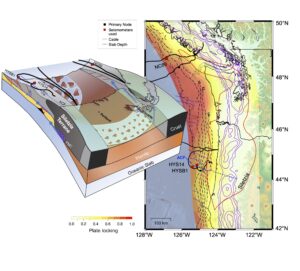
The Cascadia Subduction Zone, a massive fault line stretching over 600 miles from Canada to California, has long been a source of intrigue for scientists due to its unusual silence. Unlike other megathrust faults that sporadically rumble as tectonic plates scrape past each other, Cascadia remains eerily quiet, leading to assumptions that the plates are locked together by friction. However, a groundbreaking study by researchers at the University of Washington challenges this notion, suggesting that the fault may not be as dormant as previously thought.
Published in the journal Science Advances on February 27, the study is the first to monitor strain offshore over an extended period. Using 13 years of ground motion data from sensors placed in various regions, the researchers discovered that while the northern portion of the fault remains locked and quiet, the central region shows more activity. Signs of a shallow, slow-motion earthquake and pulses of fluid flowing through subterranean channels were detected, potentially relieving pressure from the fault.
Unlocking the Mysteries of the Subduction Zone
The Cascadia Subduction Zone is notoriously difficult to study due to its location miles offshore and deep underwater. Most data collection has traditionally been conducted onshore, limiting the scope and quality of observations. The lack of seismic activity further complicates efforts to understand the fault’s behavior and structure.
Marine Denolle, a co-author of the study and an associate professor of Earth and space science at the University of Washington, explained the significance of these findings.
“It’s preliminary, but we think that variable fluid pathways in Cascadia will change the behavior of large earthquakes on the fault,”
she said. This revelation could alter expectations of how the area will respond to a large earthquake, as similar features in other regions have been known to halt ruptures that might have otherwise continued along an entire fault line.
Understanding the Dynamics
The Juan de Fuca plate moves toward the North American plate at a rate of approximately 4 centimeters per year. The plates are currently stuck together, generating pressure that will eventually exceed their tolerance, causing an earthquake to spread along the boundary. Megathrust earthquakes, which occur at these boundaries, have historically rocked the Pacific Northwest approximately every 500 years. The last significant event was in 1700, and estimates suggest a 10 to 15% chance of a magnitude 9 earthquake occurring within the next fifty years.
While the study’s results do not alter these odds, they may influence the severity of an eventual earthquake. A recent seafloor survey revealed that the fault can be divided into at least four geologically distinct segments, each potentially insulated from ruptures in other regions. Researchers analyzed data from three monitoring stations, one near Vancouver Island and two off the coast of Oregon, to gain deeper insights.
Seismic Velocity and Fluid Dynamics
Lead author Maleen Kidiwela, a doctoral student of oceanography at the University of Washington, highlighted the importance of understanding strain changes in different offshore regions.
“We used the seismometers to measure how the seismic velocity varies underneath each station,”
Kidiwela explained. Seismic velocity, which describes the rate at which ambient noise travels through a material, offers a window into the processes occurring beneath the ocean floor.
The study observed a steady increase in seismic velocity at the northern site, indicating that the rock was compacting and supporting the theory that the plates are locked in place. In contrast, the central region exhibited a decrease in seismic velocity for two months in 2016, attributed to a slow-motion earthquake on the shallow edge of the oceanic plate that relieved some fault pressure.
Implications and Future Research
Other drops in seismic velocity recorded between 2017 and 2022 were linked to fluid dynamics. Subduction squeezes liquid out of rocks, pushing it toward the surface. The study found that other faults running perpendicular to the subduction zone might act as pathways for releasing trapped fluid.
“During a megathrust rupture, one of the ways that an earthquake propagates is through fluid pressure. If you have a way to release these fluids, it could help improve the stability of the fault, and potentially impact how the region behaves during a large earthquake,”
Kidiwela said.
The research team, pulling data from just three sites, observed complex dynamics that might have previously gone unnoticed. Future work will greatly expand this effort, as University of Washington researchers received $10.6 million in 2023 to build an underwater observatory in the Cascadia Subduction Zone.
William Wilcock, a co-author and professor of oceanography at the University of Washington, emphasized the uniqueness of the findings.
“Finding this link between fluids coming to the shallow subduction zone is pretty unique, as is the evidence that the fault is not completely locked,”
he said.
“It suggests that we need more instruments there, because there may be more going on than people have been able to figure out before.”
The study, funded by the Jerome M. Paros Endowed Chair in Sensor Networks at the University of Washington and the National Science Foundation, also included contributions from Kuan-Fu Feng of the University of Utah. As research continues, the scientific community eagerly anticipates further revelations that could reshape our understanding of this enigmatic fault line.