




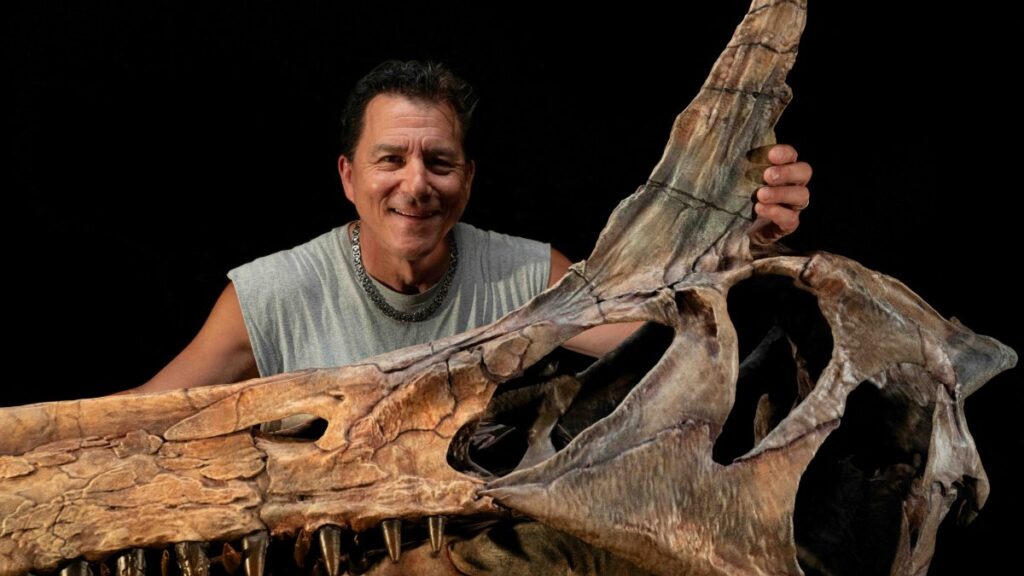
In a groundbreaking discovery, scientists working in Niger’s remote Sahara desert have unearthed fossils of a previously unknown Spinosaurus species. This colossal carnivorous dinosaur, distinguished by a scimitar-shaped head crest and interlocking teeth, was adapted for hunting massive fish. The findings offer new insights into the life of one of the largest meat-eating dinosaurs that roamed the Earth approximately 95 million years ago.
The newly identified species, named Spinosaurus mirabilis, prowled a forested inland environment, often venturing into rivers to catch sizable fish, much like a modern-day wading bird. Measuring around 40 feet (12 meters) in length and weighing between 5 to 7 tons, this “hell heron,” as described by researchers, presented a striking profile in the Cretaceous Period landscape of Africa.
Distinctive Features and Habitat
The dinosaur’s most notable feature is its bony cranial crest, which stood about 20 inches (50 cm) tall and resembled a curved sword. In addition to this, it possessed a large sail-like structure on its back and an elongated crocodile-like snout. The species name “mirabilis,” meaning “astonishing,” refers to its unique crest, a characteristic that sets it apart from its relative, Spinosaurus aegyptiacus, discovered in Egypt in 1915.
While Spinosaurus is the only known semiaquatic dinosaur predator, it shares the stage with other giant carnivores such as Tyrannosaurus and Giganotosaurus. The two Spinosaurus species, contemporaneous in their existence, shared a similar body plan, including long dorsal spines and a skull adapted for piscivory. However, Spinosaurus mirabilis boasts a more elongated snout, teeth more widely spaced, and longer hind limbs compared to its Egyptian counterpart.
Purpose of the Crest
Researchers suggest that the crest of Spinosaurus mirabilis was likely used for display rather than combat. Despite being solid bone, it appears too fragile to serve as a weapon. The crest, possibly sheathed in keratin like a bull’s horns, might have been vividly colored, playing a role in sexual or territorial competition.
“It’s about love and life – attracting a mate, defending your hot feeding shallows,” said University of Chicago paleontologist Paul Sereno, lead author of the research published in the journal Science.
Adaptations for Aquatic Life
The retracted location of Spinosaurus mirabilis‘ nostrils allowed it to submerge most of its snout underwater while breathing, enabling it to stalk prey efficiently. Its interdigitated teeth formed a ‘fish trap’, adept at capturing slippery fish without letting them escape.
“Their large conical teeth without serrations that interdigitate form a ‘fish trap’ that is very good at piercing and trapping slippery fish in the jaws,” said paleontologist and study co-author Daniel Vidal.
While fossils of Spinosaurus aegyptiacus were found near the Cretaceous coastline of the Tethys Sea, the Spinosaurus mirabilis fossils were located far inland, suggesting it was a shallow-water predator rather than a fully aquatic one. This discovery challenges previous hypotheses about Spinosaurus’ aquatic lifestyle.
“The Spinosaurus mirabilis discovery is the coup de grâce for the aquatic hypothesis,” Sereno stated.
The Expedition and Its Significance
The fossils were discovered in Jenguebi, a remote Sahara locality with fossil-rich sandstone outcrops. The 2022 expedition, which involved a three-day off-road journey from Agadez, resulted in the discovery of parts of three Spinosaurus mirabilis skulls and other bones, alongside fossils of other creatures.
Long overshadowed by the more famous T. rex, Spinosaurus is now gaining recognition for its unique adaptations and lifestyle.
“It’s a dino-happening,” Sereno remarked, highlighting the significance of the discovery.
This new understanding of Spinosaurus mirabilis not only enriches our knowledge of dinosaur diversity but also provides a clearer picture of the ecological dynamics in prehistoric Africa. As researchers continue to study these fascinating creatures, the story of Spinosaurus is sure to captivate both scientists and the public alike.