




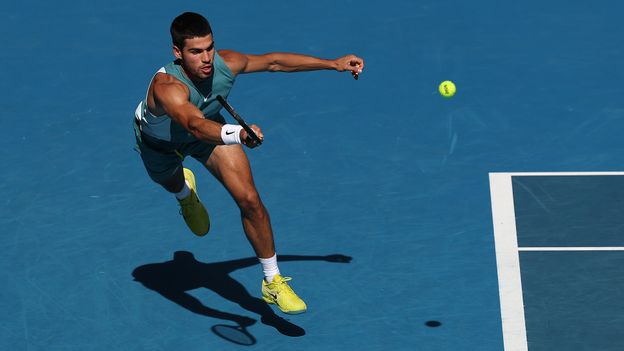
An unusual tennis competition that pits amateurs against professionals in one-point matches is launching at the Australian Open. This innovative format raises the question: Could an unknown player really take down one of the world’s best?
The opportunity for a sporting upset like no other is being dangled at this year’s Australian Open tennis Grand Slam. Running in parallel to the usual tournament will be the One Point Slam, where each “match” hinges on just a single point played on court. This competition is open to amateurs as well as professional players, offering a tantalizing A$1 million (£490,000/$672,000) prize fund for those who can win just five or six points.
The Unpredictability of the One Point Format
The One Point Slam will feature 48 competitors, including 24 professional players, eight amateur winners from earlier state championship rounds across Australia, eight players from qualifying rounds, and eight wildcards—celebrities and invited personalities. Among the pros lined up to take part are men’s world number one and two, Carlos Alcaraz and Jannik Sinner, as well as Australian fan-favorite Nick Kyrgios. On the women’s side, Iga Swiatek and Coco Gauff, ranked second and third in the world respectively, are also due to compete.
The single point format clearly increases the chance of an upset, allowing an objectively worse player to potentially beat a better player. This is because a single point provides less opportunity for the better player to assert their dominance, introducing more chances for a simple mistake or blind luck to influence the outcome. The organizers are betting that this unpredictability is exactly what spectators will find thrilling.
Skill vs. Luck: The Mathematics Behind the Game
Sports fans typically prefer to see skill triumph over luck, enjoying matches where the best players showcase their abilities in the later stages of a tournament. The more points played, the greater the chances of the better player winning. A simple mathematical rule supports this: as the number of points increases, so does the probability of the better player winning.
Consider a scoring system where the first player to reach a predefined number of points wins. In fencing, for example, the format is first-to-15 based on touches landed. If players are evenly matched, a mathematical formula can predict the likelihood of the better player winning as the number of points increases. This probability increases with their advantage and also with the number of points played, as illustrated by the formula:
“The probability of triumph increases as the square root of the number of points needed for victory.”
To ensure the winner is determined by skill, a sizeable number of points is required for victory. Sports like table tennis, squash, and badminton break matches into games, with the first player to win a fixed number of games declared the winner. By reducing both the number of points per game and the number of games to their lowest possible value of one, the One Point Slam aims to maximize unpredictability.
Historical Comparisons and the Role of Luck
This is not the first time a sport has adjusted its scoring system to enhance excitement for spectators. In 2001, the International Table Tennis Federation altered the scoring system from games of 21 points to 11 points, increasing the number of games needed to win a match to four. This change maintained the skill-to-luck ratio while making matches more engaging.
The principle of balancing skill and luck extends beyond sports. In law, larger juries can make a correct majority more likely, while in medicine, multiple tests can refine diagnostic accuracy. The key is increasing the number of trials or components to reduce the role of luck.
In tennis, the skill-to-luck balance is determined by the number of points to win a game, multiplied by the number of games to win a set, and further multiplied by the number of sets to win a match. This is why there is more variability in the winners of women’s Grand Slams compared to men’s, as women play first to two sets, increasing the chance for less favored players to win.
The Potential for Upsets and the Thrill of the Game
The One Point Slam is a world away from a traditional five-set Grand Slam match. With such a significant gap between amateurs and pros, it is unlikely that an amateur could prevail over a full match or even a single game. However, playing a single point against the world’s top tennis players offers the best chance of an upset.
Even if an amateur does not claim victory over someone like Carlos Alcaraz, they can still boast of taking the men’s world number one to match point. And that’s quite the bragging right.
If you enjoyed this story, sign up for The Essential List newsletter—a handpicked selection of features, videos, and can’t-miss news, delivered to your inbox twice a week. For more science, technology, environment, and health stories, follow us on Facebook and Instagram.