
The cost of the new recycling plant in Hume, set to replace the facility destroyed by the 2022 Boxing Day fire, has surged to nearly $37 million. This figure, revealed in a development application, is $11 million higher than previously announced. The original estimate for the Materials Recovery Facility (MRF) was $26 million, funded by both the ACT and Federal governments.
The revised cost will be covered by Veolia, a leading waste management company. In January 2025, Veolia signed an $850 million agreement with the ACT Government to design, build, and operate the advanced MRF. This contract will see Veolia managing the plant for a period of 20 years.
Financial Structure and Government Involvement
A government spokesperson clarified that the project is being executed through a Build-Own-Operate-Transfer model, with Veolia shouldering the delivery phase costs. The $26 million represents the Capital Contribution from the Territory, inclusive of the Commonwealth’s share, rather than the total project cost.
“The remainder of the overall delivery phase cost will be funded by Veolia,” the spokesperson explained. “In turn, the Territory will provide monthly service payments to Veolia during the 20-year operating period, which cover both operating and a recovery of capital costs.”
The construction cost detailed in the development application pertains to the facility’s construction and essential service fit-outs, excluding plant and equipment. Construction is slated to commence in 2026, pending planning approvals, with operations expected by 2028.
Design and Technological Advancements
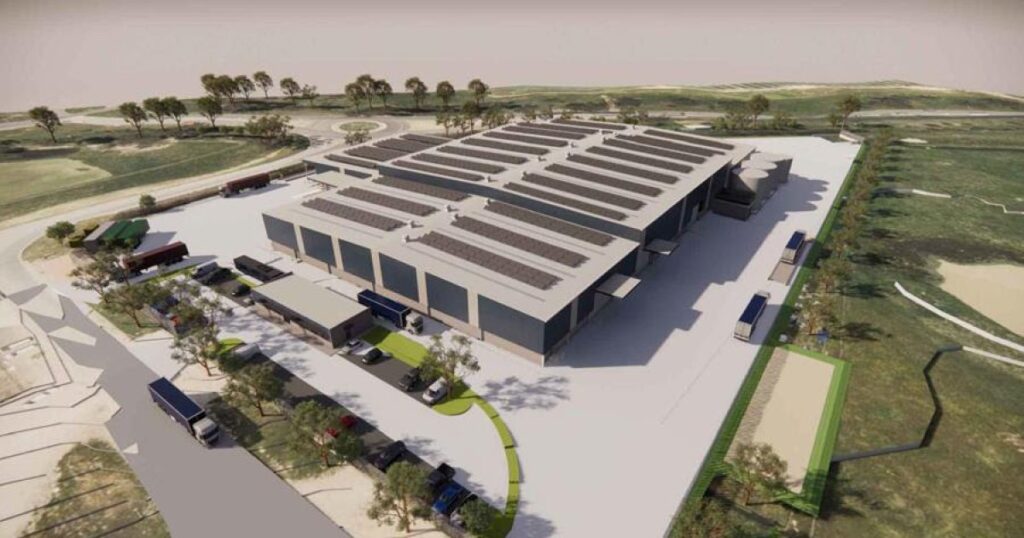
The new MRF, to be erected on the site of the former facility in Hume, will feature processing and support buildings, landscaping, internal roads, and essential infrastructure. An education building for community and school engagement, along with parking facilities and utility works, are also included. The total cost is listed at $36,972,799.
Equipped with cutting-edge technology, the facility will sort various materials, including paper, cardboard, glass, plastic, steel, and aluminum. This will enhance recovery rates and produce higher-quality recyclables. The technology includes a glass purification plant, automatic recognition systems, paper separation screens, laser optical identification with air jets for plastics, and powerful magnets for metal extraction.
The new MRF will process up to 115,000 tonnes of mixed recyclables annually, an increase of 50,000 tonnes compared to the previous facility. Currently, the ACT sends 46,000 tonnes of recyclables interstate for processing each year.
Safety and Employment Impact
Designed with advanced fire detection, mitigation, and control systems, the facility aims to prevent incidents like the 2022 fire, which was triggered by a lithium battery. The Hume site was cleared starting September last year, with demolition of fire-damaged structures taking several months.
More than 100 jobs will be created during the construction phase, with an estimated 24 permanent positions once the facility is operational. The project has faced criticism, particularly from the Canberra Liberals, who argued that the business case was flawed and that interstate recycling would be more cost-effective. However, the government has countered these claims, asserting that the Liberals misrepresented the business case.
As the project progresses, it remains a focal point of debate, reflecting broader discussions about sustainable waste management and infrastructure investment. The completion of the MRF is poised to significantly enhance the region’s recycling capabilities, marking a pivotal step in the ACT’s environmental strategy.