

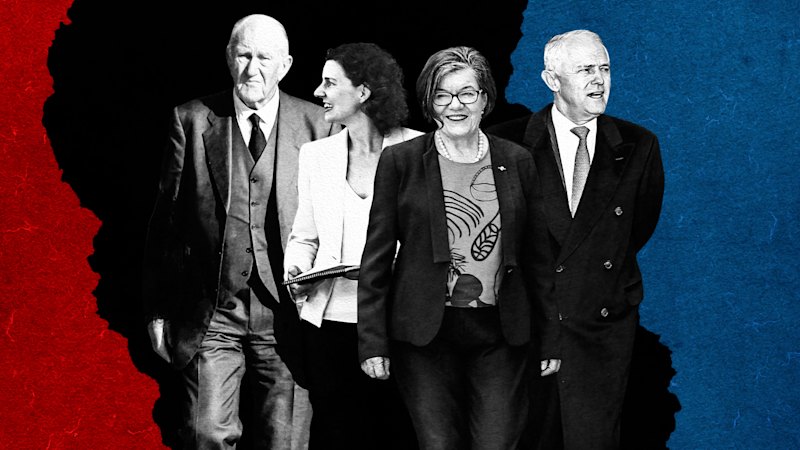
To the day he died in 2015, Malcolm Fraser was working on a plan to start a new political party. The former Liberal prime minister had become convinced the party he once led no longer represented the liberal tradition he believed in. For more than four years, he convened meetings, drafted a statement of values, and canvassed donors for what was to be called Renew Australia—a movement grounded in social justice, ethical politics, climate action, and what he described as “genuine liberal values.”
The project stalled after his death. But the impulse behind it—the sense that the Liberal Party had ceased to be the natural home of the centre—never disappeared. Now, nearly a decade later, that idea is resurfacing with a new urgency. Over the past six months, a series of discussions and approaches—some structured, some spontaneous, all rather informal—have taken shape across Sydney, Melbourne, and Adelaide. They involve former Liberal moderates, ex-Coalition staffers, teal MPs, retired Labor figures, community-backed organisers, and donors who once funded the Liberal Party’s business wing.
The Rise of a New Political Force?
No one is claiming leadership. No manifesto has been launched. Those most closely involved do not want to be identified. Some are in roles where public non-partisanship is expected. If asked, most people deny any knowledge or involvement. But all are working from the same diagnosis: the Liberal Party may no longer be capable of reclaiming its centre-right identity. All are worried about what happens to democracy when governments—state or federal—lack effective opposition.
Former prime minister Malcolm Turnbull sharpened that argument recently when he warned the party was heading down a cul-de-sac. “The right-wing element has taken over the Liberal Party,” he told Capital Brief. “There are very few moderates left in the party room. That’s why the talk of a split misses the point.”
Turnbull did not dismiss the idea of a new political force. A centre or centre-right movement combining disaffected Liberals and teal independents, he said, was “not inevitable but certainly possible.”
Recent polling suggests many voters have already moved. According to this masthead’s Resolve Political Monitor, the Liberal Party’s primary vote has slumped to the mid-20s, while One Nation has climbed into the high teens. More than 40 percent of voters are now looking to non-major parties.
Potential Models and Historical Parallels
March’s state election in South Australia could, many believe, become a tipping point where informal talks harden into something more concrete. A model emerging from the group borrows heavily from the teal experience: a Senate-first strategy, selective lower-house contests, climate credibility paired with pro-business economics, and deep local organising.
Self-styled centrist independents have already demonstrated the potency of that approach. In 2019 and 2022, community-backed candidates shattered Liberal strongholds including: Warringah, Mackellar, North Sydney, and Wentworth in Sydney; Goldstein and Kooyong in Melbourne; and Curtin in Perth. In 2025, independents again reshaped contests, winning Bradfield in Sydney and finishing second in five Labor-held seats—Watson in Sydney, Franklin in Tasmania, Calwell in Melbourne, Fremantle in WA, and Bean in the ACT.
The yet unnamed grouping is also borrowing from the newly established Prosper UK—a movement attached to Britain’s Conservative Party to drag it back to the centre—and Faculty AI, the start-up hired to work with political guru Dominic Cummings on the Vote Leave campaign.
Challenges and Opportunities
The introduction of new federal political donation laws on July 1 has become a complicating factor. The regime caps individual donations at $50,000, lowers the disclosure threshold to $5000, and imposes spending limits of $800,000 per electorate and $90 million nationally. Several teal independents have criticised the Labor government’s changes, with Zoe Daniel, the former independent member for Goldstein, and Rex Patrick, the former independent senator for South Australia, challenging the legislation in the High Court.
Graeme Orr, a law professor at the University of Queensland, says the reforms cut both ways. “There are swings and roundabouts,” Orr says. “It’s not like the limits are really low. It’s like $90 million in electioneering for a party.”
Cathy McGowan, who won Indi in Victoria from the Liberals in 2013 with a “kitchen table conversation” campaign, says communities are increasingly organising to fill a representational gap. “I think Australians are incredibly disappointed with the failure of the opposition to articulate alternative policy positions for the country,” McGowan says.
Future Prospects and Political Landscape
Lucy Wicks, who held the NSW bellwether seat of Robertson from 2013 to 2022, says Australia does not need a new centrist party so much as a Liberal Party willing to rediscover its core purpose. “It needs a Liberal Party brave enough to remember what, and who, it stands for, once again,” she says.
Wicks traces her political faith to learning in her 20s about “reward for effort, individual opportunity and the belief that your dreams aren’t limited by your birthplace or socio-economic status.” She says the party’s rejection by communities like Robertson reflects a loss of connection rather than an appetite for a new movement.
John Roskam, a senior fellow at the Institute of Public Affairs, argues the teals’ success was built on independence—and that formalising an alliance would undercut their appeal. “The attraction of the teals as independent community-minded advocates would be very substantially reduced if they were formed into some sort of national party,” Roskam says.
For moderates inside the Liberal Party, Roskam says the calculus is complex. Leaving risks surrendering influence inside one of the country’s two governing vehicles. “It would require a massive infrastructure effort,” he says, “and while third parties have succeeded in the short term, they rarely last.”
Labor now occupies much of the centre-left. One Nation has carved out a durable slice of the right. And the Liberals have lost the cosmopolitan, urban voters (and their donors) who once balanced their Coalition. In between sits a substantial group of voters—economically moderate, socially progressive, and deeply climate-conscious—who feel politically homeless. Some in the party aren’t interested in winning them back.
When Don Chipp walked out on the Liberals in 1977 and started the Democrats, many dismissed it as a footnote. It wasn’t. It reshaped a generation of politics. When Malcolm Fraser quietly tried to build an alternative decades later, few paid attention. Today, their diagnosis looks less like a curiosity and more like a warning.
And for the first time in decades, the question of whether a new centrist force could emerge is no longer academic. It is live.