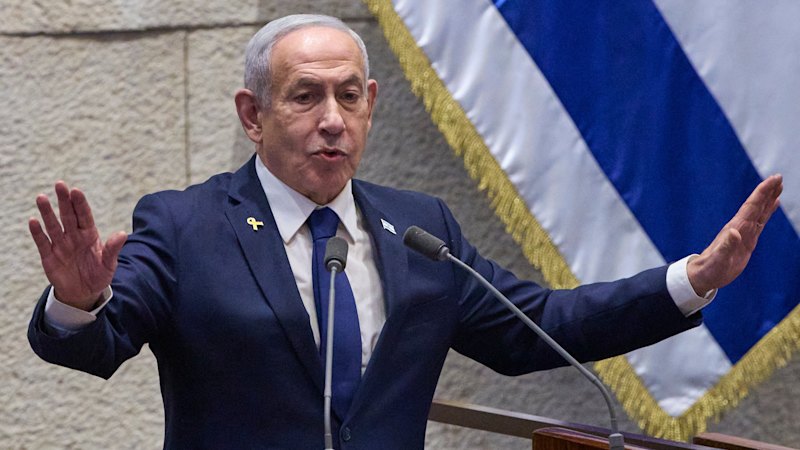
Israeli Prime Minister Benjamin Netanyahu has formally requested a pardon from President Isaac Herzog, aiming to put an end to his protracted corruption trial that has sharply divided the nation. The request, submitted on November 30, was described by Herzog’s office as an “extraordinary request” with “significant implications.”
This development follows a notable intervention by former U.S. President Donald Trump, who, during an Israeli parliament appearance in October, suggested that Herzog consider pardoning Netanyahu. Trump remarked, “Cigars and champagne, who the hell cares about that?” referring to some of the allegations against Netanyahu.
Netanyahu, the first sitting Israeli prime minister to stand trial, faces charges of fraud, breach of trust, and accepting bribes in three separate cases. Despite the ongoing trial, he has not been convicted of any charges. In a video statement, Netanyahu argued that the trial was “undermining national unity” and suggested that a pardon could help Israel seize new opportunities with the U.S.
Understanding the Charges Against Netanyahu
The charges against Netanyahu are consolidated into a single trial that commenced in 2020. He has consistently denied all allegations, claiming they are part of a politically motivated “witch-hunt.”
Case 4000: The Bribery Allegation
The most significant of the cases, known as Case 4000, involves allegations of bribery linked to Bezeq Israeli Telecommunications Corporation Ltd. and its former controlling shareholder, Saul Elovitch. The prosecution claims that Netanyahu and Elovitch engaged in a “give and take” relationship, where Elovitch provided favorable media coverage in exchange for regulatory benefits.
“The Elovitchs made great efforts to fulfill demands for more positive coverage of the Netanyahus, and the prime minister used his authority to promote Elovitch’s business interests.”
Netanyahu has argued that seeking positive media coverage is standard practice and denies offering any favors in return. Despite indications from judges that the bribery charge may be difficult to prove, the prosecution has maintained its position.
Other Cases: 1000 and 2000
In Case 1000, Netanyahu is accused of accepting luxurious gifts from Hollywood producer Arnon Milchan and Australian billionaire James Packer, allegedly in exchange for political favors. The gifts, including cigars and champagne, are valued at approximately 690,000 shekels ($319,000). Netanyahu disputes the quantities and motives behind these gifts, claiming a personal friendship with Milchan.
Case 2000 involves allegations of fraud and breach of trust, where Netanyahu purportedly promised benefits to Arnon Mozes, owner of Yedioth Ahronoth, in exchange for favorable media coverage. Recordings of meetings between Netanyahu and Mozes, discovered during an unrelated investigation, form the crux of this case.
Political Repercussions and Coalition Dynamics
Netanyahu’s trial has had significant political ramifications in Israel, contributing to a period of instability with five general elections between 2019 and 2022. After the 2022 election, Netanyahu formed a government with ultra-orthodox and hardliner nationalist parties, marking the most right-wing administration in Israel’s history.
The trial has also fueled efforts to weaken Israel’s Supreme Court and legal establishment, sparking mass protests and concerns over democratic erosion. Some security officials believe these internal conflicts emboldened Hamas to launch its October 2023 attack on Israel.
The Path to a Pardon
While Trump has advocated for a pardon, the process is complex. In Israel, presidential pardons are typically granted post-conviction. A preemptive pardon is rare, with only one precedent involving Shin Bet officials in the 1980s. Netanyahu has rejected calls to resign and previously declined a plea bargain that would have barred him from politics for seven years.
“Netanyahu has stood tall for Israel in the face of strong adversaries and long odds, and his attention cannot be unnecessarily diverted,” Trump wrote to Herzog.
Netanyahu has announced plans to run in the next election, scheduled by October 2026, despite his coalition’s declining public support.
Looking Ahead: Trial and Political Future
Netanyahu’s trial is expected to continue for several more years, with cross-examinations and hearings still pending. The legal proceedings may extend beyond his current term, and there is no precedent for the trial or conviction of a sitting Israeli prime minister.
Should Netanyahu be convicted of a crime involving “moral turpitude,” his term would be automatically terminated, transitioning the government until a new one is formed. However, the outcome remains uncertain as the trial progresses.