




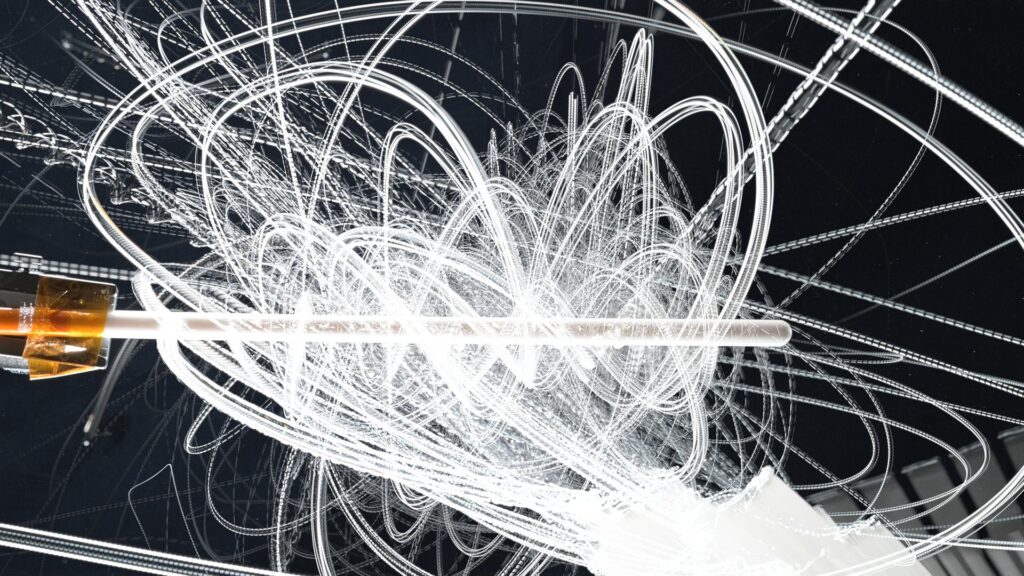
In a captivating demonstration of electrostatic forces, NASA astronaut Don Pettit has used charged water droplets and a Teflon knitting needle to reveal the intricate dance of attraction and repulsion. The experiment, conducted on February 19, 2025, aboard the International Space Station, offers a vivid illustration of how charged particles from the Sun interact with Earth’s magnetic field, much like the forces at play in Pettit’s experiment.
This innovative experiment showcases the unique properties of Teflon and charged droplets, drawing parallels to the natural phenomena that create the aurora borealis. When highly energetic particles from space collide with atoms and molecules in Earth’s atmosphere, they produce the stunning light displays known as the northern lights.
The Science of Opportunity
Pettit, who has a penchant for turning everyday objects into scientific tools, refers to this approach as the “science of opportunity.” By leveraging the unique environment of space, he is able to conduct experiments that would be impossible on Earth. The recent demonstration is part of a series of experiments that Pettit has conducted to explore fundamental scientific principles in the microgravity environment of space.
According to Pettit, the experiment not only provides a visual representation of electrostatic forces but also serves as an educational tool to help people understand the complex interactions between solar particles and Earth’s magnetic field. “It’s a way to bring abstract scientific concepts to life,” Pettit explained in a recent interview.
Understanding the Aurora Borealis
The aurora borealis, or northern lights, is a natural light display predominantly seen in high-latitude regions. It occurs when charged particles emitted by the Sun, known as solar wind, interact with Earth’s magnetosphere. This interaction energizes particles in the atmosphere, causing them to emit light and create the vibrant colors associated with the aurora.
“The aurora borealis is a spectacular reminder of the dynamic relationship between our planet and the Sun,” said Dr. Laura Petrov, a space physicist at the University of Alaska Fairbanks.
Dr. Petrov further elaborated that Pettit’s experiment provides a microcosm of these interactions, allowing scientists and the public alike to visualize the forces that drive such phenomena.
Implications for Space Exploration
The insights gained from Pettit’s experiment have broader implications for space exploration and understanding space weather. As humanity ventures further into space, understanding how solar particles interact with spacecraft and planetary atmospheres becomes increasingly important. This knowledge can help in designing better protective measures for astronauts and equipment.
Moreover, the experiment underscores the importance of continued research in space science and the benefits of conducting experiments in the unique environment of space. It also highlights the role of astronauts as both explorers and educators, bringing the wonders of space down to Earth.
“Experiments like these are crucial for advancing our understanding of space weather and its effects on both technology and human activity,” noted Dr. James Lee, a senior researcher at NASA’s Goddard Space Flight Center.
Looking Ahead
As NASA and other space agencies continue to push the boundaries of exploration, the “science of opportunity” approach championed by Pettit will likely play a significant role in future missions. By utilizing the International Space Station as a platform for innovative experiments, astronauts can continue to make groundbreaking discoveries that enhance our understanding of the universe.
In the coming years, Pettit’s work may inspire new generations of scientists and engineers to explore the possibilities of space-based research, ensuring that the spirit of discovery remains at the forefront of human endeavor.