



At the heart of our galaxy lies a dense cluster of stars surrounding a supermassive black hole. NASA’s Nancy Grace Roman Space Telescope is set to provide the deepest-ever view of this enigmatic region, unveiling stars, planets, and unique cosmic phenomena that defy conventional classification. The mission, informed by global astronomers, aims to transform our understanding of the universe.
The Roman Space Telescope will dedicate three-quarters of its five-year primary mission to conducting three groundbreaking surveys. These surveys promise to revolutionize astronomy by addressing longstanding questions about dark matter, dark energy, and exoplanets—planets outside our solar system. Among these, the Galactic Bulge Time-Domain Survey will focus on the densely populated region around the Milky Way’s center, known as the galactic bulge.
Unveiling the Galactic Bulge
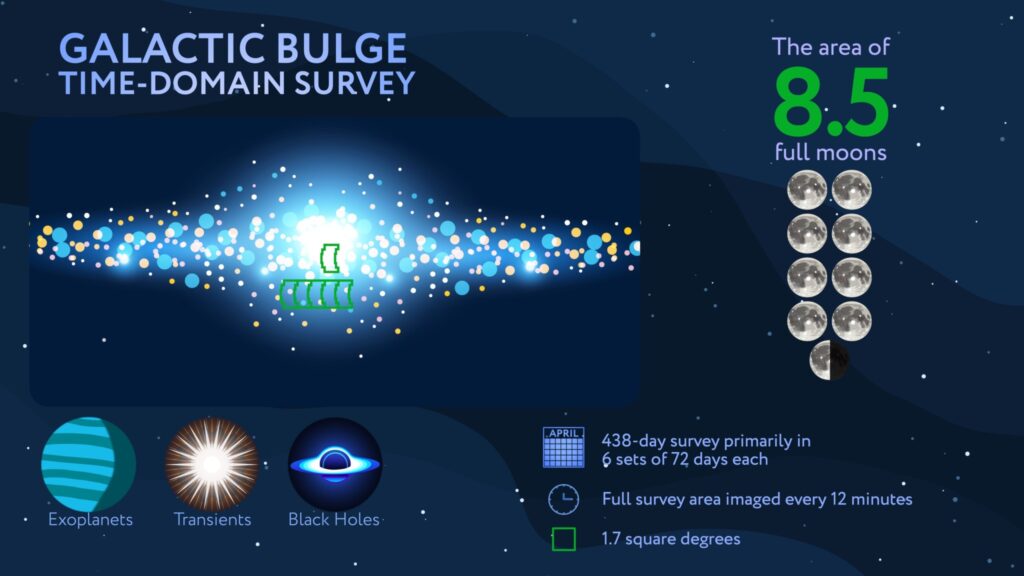
The survey will meticulously observe six sections of the galactic bulge, including the center and five adjacent areas, every 12 minutes over a total of 438 observational days. These observations will be divided into six “seasons” across five years. By concentrating on a relatively small sky area, the mission will track changes in the motion and brightness of hundreds of millions of stars and their orbiting planets over extended periods, embodying the “time-domain” aspect of the survey.
“This survey will be the highest precision, highest cadence, longest continuous observing baseline survey of our galactic bulge, where the highest density of stars in our galaxy reside,” said Jessie Christiansen of Caltech/IPAC, co-chair of the committee defining the Galactic Bulge Time-Domain Survey.
Exoplanet Discovery Through Microlensing
The Roman Telescope will employ microlensing to search for exoplanets, a technique that has so far identified just over 200 exoplanets, compared to more than 4,000 discovered via the transit method out of the over 6,000 confirmed. Scientists anticipate discovering over 1,000 new planets orbiting other stars using microlensing alone, potentially increasing the number of exoplanets identified by this method more than fivefold.
A microlensing event occurs when a foreground object, such as a star and its planet, slightly warps the light from a distant background star. This gravitational lensing bends the space fabric through which light travels, focusing it like a magnifying glass. While the transit method excels at identifying exoplanets close to their stars, microlensing can reveal planets orbiting at greater distances and in systems farther from Earth than previously studied.
“For the first time, we will have a big picture understanding of Earth and our solar system within the broader context of the exoplanet population of the Milky Way galaxy,” Christiansen remarked. “We still don’t know how common Earth-like planets are, and the Roman Galactic Bulge Time-Domain Survey will provide us with this answer.”
Expanding the Frontiers of Astronomy
The vast amount of observing time and data generated by the Galactic Bulge Time-Domain Survey will advance not only exoplanet microlensing but also other astronomical fields. “There is an incredibly rich diversity of science that can be done with a high-precision, high-cadence survey like this one,” said Dan Huber of the University of Hawaii, co-chair of the survey.
The survey is optimized for microlensing and observing brightness changes from brief blips to long-term trends. This capability allows astronomers to discover and characterize transiting planets, red giant stars, stellar-mass black holes, and eclipsing binaries, offering deeper insights into star formation and evolution.
“The stars in the bulge and center of our galaxy are unique and not yet well understood,” Huber noted. “The data from this survey will allow us to measure how old these stars are and how they fit into the formation history of our Milky Way galaxy.”
Preparing for Launch
Roman will observe hundreds of millions of stars every 12 minutes during the survey period, providing an unprecedented volume of data for astronomers to analyze. The Roman Science Support Center at Caltech/IPAC in Pasadena, California, will oversee high-level science data processing for the Galactic Bulge Time Domain Survey, including exoplanet microlensing and general community outreach for Roman exoplanet science.
The Science Support Center’s automated monitoring will detect microlensing and variable events within the data, helping scientists understand features like star brightness changes or the presence of nearby planets. The number of stars and observation frequency make Roman’s data ideal for identifying such sources. All Roman observations will be publicly available after a short processing period.
The mission is scheduled to launch no later than May 2027, with the team on track for a fall 2026 launch. The Nancy Grace Roman Space Telescope is managed at NASA’s Goddard Space Flight Center in Greenbelt, Maryland, with participation from NASA’s Jet Propulsion Laboratory in Southern California; Caltech/IPAC in Pasadena, California; the Space Telescope Science Institute in Baltimore; and a science team comprising scientists from various research institutions. The primary industrial partners are BAE Systems Inc. in Boulder, Colorado; L3Harris Technologies in Rochester, New York; and Teledyne Scientific & Imaging in Thousand Oaks, California.