



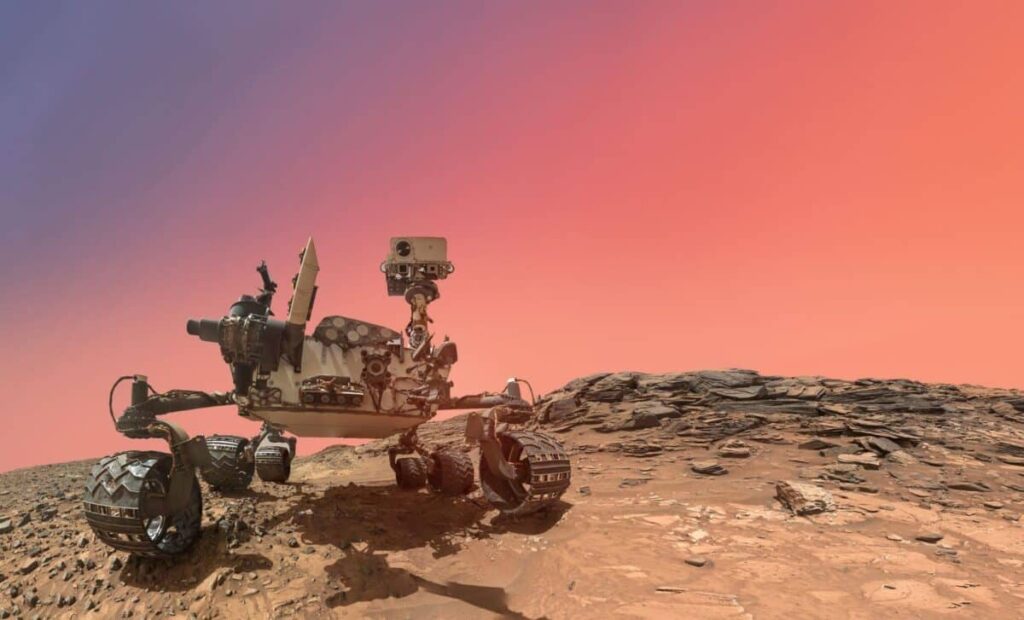
NASA’s Perseverance rover has uncovered compelling evidence of an ancient Martian shoreline, a discovery that could reshape our understanding of the Red Planet’s history. Found within the Jezero crater, these findings include rocks sculpted by wave action and altered by underground water, suggesting that life-supporting conditions may have existed on Mars far earlier than previously believed.
Researchers from Imperial College London led the study, which highlights how an area known as the Margin unit reveals unmistakable geological signs of both subsurface water activity and shoreline processes. This discovery suggests that Mars might have experienced a more stable and wetter climate over extended periods than was previously understood.
A Dual-Origin Terrain Reshaped by Water
Before this groundbreaking study, scientists were divided over whether the Margin unit was formed by sediment deposition along an ancient lake or as volcanic rock later altered by water. According to findings published in the Journal of Geophysical Research: Planets, high-resolution images captured by Perseverance confirm both theories.
The unit’s structure suggests it likely originated as igneous rock, potentially from a magma chamber or lava lake within Jezero. Over time, carbon dioxide-rich water circulating underground chemically transformed olivine crystals into iron- and magnesium-rich carbonates.
“This transformation… indicates that water circulated below the surface of the Margin unit, altering the rock over vast timescales,” said Professor Sanjeev Gupta of Imperial’s Department of Earth Science and Engineering.
These changes are reminiscent of hydrothermal systems on Earth, which are known to support microbial life, making them valuable targets in the search for ancient biosignatures.
Unmistakable Traces Of A Martian Shoreline
In the lower regions of the Margin unit, researchers discovered layered sandstone embedded with rounded grains of olivine and carbonate, structures typically formed by wave action at a shoreline. “We are looking at what was once a beach,” noted Alex Jones, Ph.D. researcher and lead author of the study. According to Jones, waves from the Jezero lake reshaped local volcanic rock, rounding particles and depositing them into a sandy layer.
The positioning of this ancient beach, beneath the delta deposits fed by an ancient river, indicates that calm, stable lake conditions existed at Jezero even earlier than the delta itself, extending the timeline of habitable surface environments on Mars.
Jezero: A Lake That Kept Changing Over Time
This research builds upon previous findings from the same team, which reported evidence of a younger, dammed lake in a region feeding into Jezero. In the Bright Angel formation, they discovered mudstone layers, indicating long-standing water coverage in parts of the valley.
Together, these studies provide a more nuanced view of Mars’s hydrological past, suggesting the Red Planet experienced repeated and prolonged periods of water presence, both on the surface and below it. As Jones elaborated:
“Jezero crater continues to prove it is the ideal place to investigate past habitability on Mars, and to help answer the question of whether life ever emerged.”
Implications for Future Mars Exploration
The discovery of an ancient shoreline on Mars has significant implications for future exploration missions. Understanding the history of water on Mars is crucial in the search for past life and in determining the planet’s potential for supporting human life in the future.
As NASA and other space agencies plan upcoming missions, the Jezero crater’s rich geological history makes it a prime target for further study. The rover’s findings could guide future missions in selecting landing sites and research focuses, ultimately contributing to the broader goal of unraveling the mysteries of Mars.
As scientists continue to analyze the data from Perseverance, the possibility of uncovering more about Mars’s past climate and habitability remains tantalizingly within reach. The ongoing exploration of Jezero crater is poised to offer even more insights into the planet’s enigmatic history.