



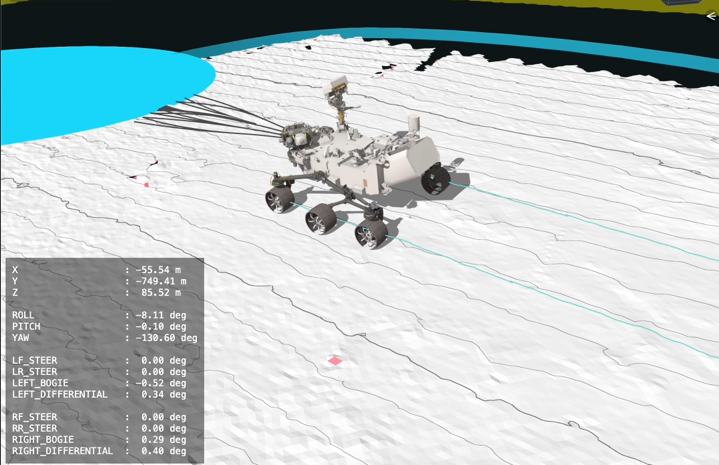
NASA’s Perseverance rover has taken a significant leap in its mission on Mars by utilizing artificial intelligence to plan its path during a recent drive on the rim of Jezero Crater. This advancement was visualized through an animation created with the Caspian visualization tool, showcasing the rover’s 807-foot (246-meter) journey on December 10, 2025, marking the 1,709th Martian day, or sol, of its mission.
The animation provides insight into the rover’s autonomous decision-making process, highlighting why it selected a specific route over others. This drive, alongside another on December 8, was one of the first instances where generative AI was employed for route planning. The AI utilized high-resolution imagery from the HiRISE camera aboard NASA’s Mars Reconnaissance Orbiter and terrain-slope data from digital elevation models to identify critical terrain features such as bedrock, outcrops, hazardous boulder fields, and sand ripples.
AI-Driven Exploration on Mars
The integration of AI in Perseverance’s navigation represents a groundbreaking step in extraterrestrial exploration. By analyzing complex terrain data, the AI generated a continuous path with waypoints, which are fixed locations where the rover receives new instructions. This capability allows the rover to adapt to the Martian landscape in real-time, enhancing its ability to conduct scientific research and exploration.
The animation depicts the rover’s journey with pale blue lines marking the tracks of its wheels, while black lines show the various path options considered by the rover. The white terrain in the animation is a height map created from data collected during the drive, and a pale blue circle near the end indicates a waypoint.
Technological Innovations and Challenges
NASA’s Jet Propulsion Laboratory, managed by Caltech, is responsible for building and operating the Perseverance rover. The use of AI in such missions is not just a technological feat but also a response to the challenges of exploring a planet with a vastly different environment from Earth. The AI’s ability to process and analyze data quickly is crucial for the success of these missions, where communication delays with Earth can hinder real-time decision-making.
Dr. Sarah Johnson, a planetary scientist at Johns Hopkins University, commented on the significance of this development:
“The use of AI in space exploration is a game-changer. It allows for more efficient and safer navigation of unknown terrains, which is essential for the success of missions like Perseverance.”
Historical Context and Future Implications
The use of AI in space exploration is not entirely new but has evolved significantly over the years. Earlier missions relied heavily on pre-programmed instructions and human intervention. In contrast, Perseverance’s ability to autonomously navigate using AI marks a new era in robotic exploration, potentially paving the way for future missions to more distant destinations.
The implications of this technology extend beyond Mars. As NASA and other space agencies plan missions to the Moon, asteroids, and eventually Mars, the ability to autonomously navigate and conduct scientific research will be crucial. The success of Perseverance’s AI-driven journey could influence the design and operation of future exploratory missions.
Looking Ahead
As Perseverance continues its mission on Mars, the integration of AI in its operations will likely become more sophisticated. The data and insights gained from these AI-driven explorations will not only enhance our understanding of Mars but also improve the technology used in future missions.
For more information about the Perseverance mission, visit NASA’s official site.