




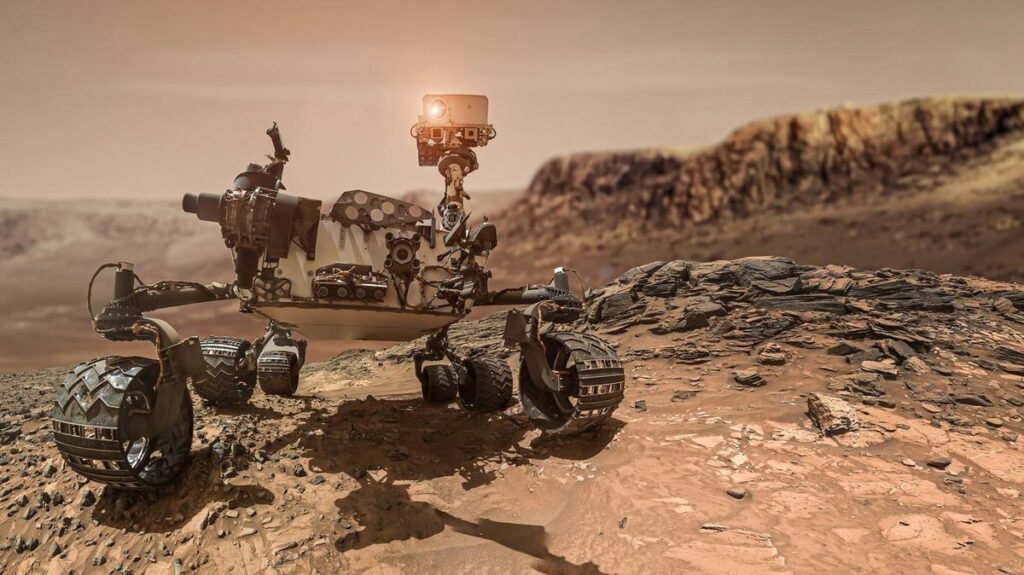
NASA has unveiled a groundbreaking autonomous technology that enhances the capabilities of the Mars Rover, enabling unprecedented exploration of the Red Planet. This development marks a significant leap in our understanding of Mars and its potential to host life.
For years, scientists have been piecing together information about our solar system, uncovering clues about the planets and their connections to Earth. Notably, the discovery of matter on Mars suggested the planet once had water and possibly supported life. However, much remains unknown, prompting NASA to upgrade the Mars Rover for deeper exploration.
Introducing Mars Global Localization
The new feature, known as Mars Global Localization, allows the Perseverance Rover to determine its precise location autonomously. This advancement eliminates the need for human intervention, which has been a critical component of the Rover’s navigation since its launch.
For five years, the Mars Rover operated without maps, GPS, or direct guidance from Earth. Now, thanks to NASA’s Jet Propulsion Laboratory (JPL) in Southern California, the Rover can autonomously navigate using an algorithm that matches panoramic images from its navigation cameras with onboard orbital terrain maps. According to NASA, this process takes approximately two minutes, enabling the Rover to chart its course efficiently.
Enhancing Auto-Navigation Capabilities
The technology significantly bolsters the Rover’s auto-navigation features, allowing it to re-route around obstacles during its journey. Known as AutoNav, this system permits Perseverance to travel to virtually unlimited destinations before needing to return to base.
“This is kind of like giving the rover GPS. Now it can determine its own location on Mars,” said JPL’s Vandi Verma, chief engineer of robotics operations for NASA’s Mars mission. “It means the rover will be able to drive for much longer distances autonomously, so we’ll explore more of the planet and get more science. And it could be used by almost any other rover traveling fast and far.”
The Role of the Helicopter Base Station
A crucial component of Mars Global Localization is the Rover’s Helicopter Base Station (HBS), which previously facilitated communication with the Ingenuity Mars Helicopter. The HBS operates over 100 times faster than the Rover’s main computers, which were designed to withstand Mars’ radiation-heavy environment and are based on hardware from 1997.
This technological leap means the Rover can undertake extensive journeys, mapping Mars independently. The implications for future missions are profound, as this technology could be adapted for other rovers, enhancing their ability to explore distant celestial bodies.
Implications and Future Prospects
The introduction of Mars Global Localization represents a pivotal moment in space exploration. By enabling the Rover to navigate autonomously, NASA can gather more data and insights about Mars, potentially unlocking secrets about its past and its capacity to support life.
Looking ahead, this technology could revolutionize how we explore other planets, paving the way for more ambitious missions. As NASA continues to innovate, the possibilities for discovery are boundless, promising a new era of exploration that could redefine our understanding of the universe.
As the Perseverance Rover embarks on its enhanced mission, the scientific community eagerly anticipates the wealth of information it will uncover, bringing us closer to answering fundamental questions about our place in the cosmos.