

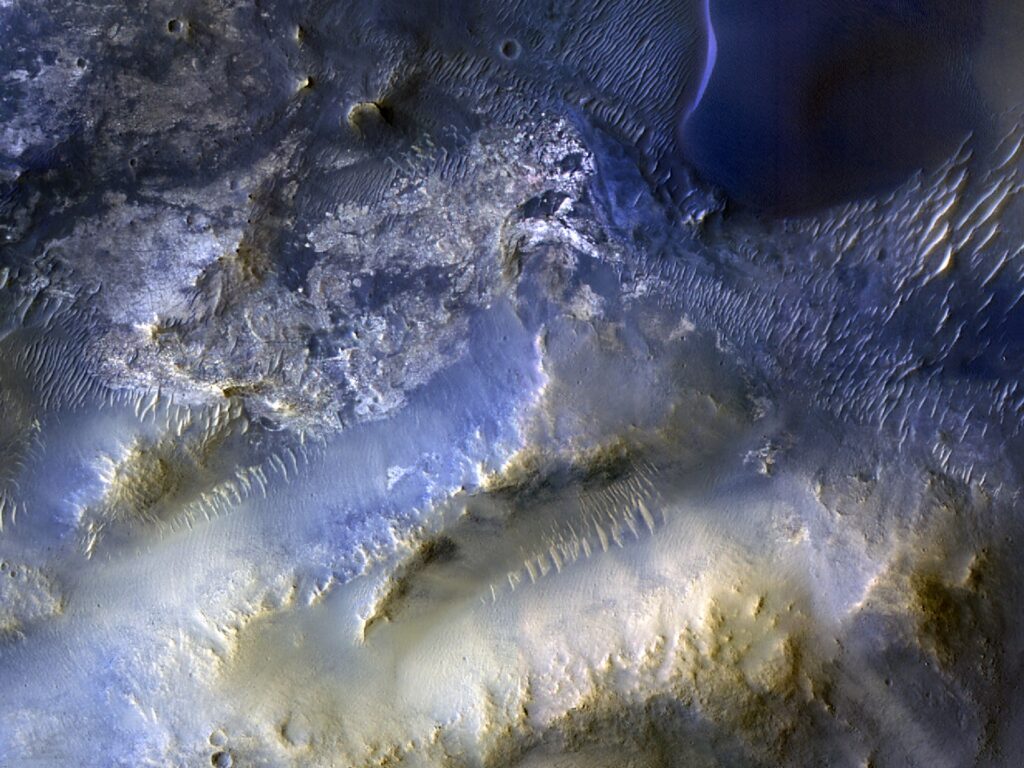
NASA’s Mars Reconnaissance Orbiter (MRO), a stalwart of space exploration for nearly two decades, has achieved a remarkable milestone by capturing its 100,000th image of the Martian surface. The image, taken by the High Resolution Imaging Science Experiment (HiRISE) camera on October 7, showcases the stunning mesas and dunes of the Syrtis Major region, located approximately 50 miles southeast of Jezero Crater, currently being explored by NASA’s Perseverance rover.
This significant achievement underscores the vital role that HiRISE plays in enhancing our understanding of Mars. The camera provides high-resolution images of various Martian features, including impact craters, sand dunes, and ice deposits, which are crucial for identifying potential landing sites and preparing for future human missions to the Red Planet.
Unveiling Mars Through HiRISE
HiRISE has been instrumental in revealing the dynamic nature of the Martian landscape. According to Leslie Tamppari, MRO’s project scientist at NASA’s Jet Propulsion Laboratory in Southern California, the camera has not only highlighted the differences between the Martian and Earth surfaces but also documented how the Martian terrain evolves over time.
“HiRISE hasn’t just discovered how different the Martian surface is from Earth, it’s also shown us how that surface changes over time,” said Leslie Tamppari. “We’ve seen dune fields marching along with the wind and avalanches careening down steep slopes.”
The 100,000th image was suggested by a high school student via the HiWish site, a platform that allows the public to propose areas of Mars for study. This initiative reflects HiRISE’s commitment to engaging the broader science community and the public in Mars exploration.
From Data to Discovery
The University of Arizona in Tucson operates the HiRISE camera, which was constructed by Ball Aerospace & Technologies Corp. in Boulder, Colorado. The team at the university also creates 3D models from HiRISE imagery, enabling virtual flyover experiences that bring Mars closer to those on Earth.
“Rapid data releases, as well as imaging targets suggested by the broader science community and public, have been a hallmark of HiRISE,” said Shane Byrne, the camera’s principal investigator at the University of Arizona. “One hundred thousand images just like this one have made Mars more familiar and accessible for everyone.”
This collaborative approach has been pivotal in advancing our understanding of Mars, making the planet more accessible to scientists and enthusiasts alike. The images captured by HiRISE have not only contributed to scientific research but have also inspired the public’s imagination, fostering a sense of connection with our neighboring planet.
The Broader Impact of Mars Reconnaissance Orbiter
Managed by NASA’s Jet Propulsion Laboratory in Southern California, the Mars Reconnaissance Orbiter is a key component of NASA’s Mars Exploration Program. Built by Lockheed Martin Space in Denver, the orbiter continues to support NASA’s mission to explore and understand Mars.
Since its launch, MRO has provided invaluable data that has informed numerous Mars missions, including the selection of landing sites for rovers and landers. The orbiter’s suite of scientific instruments, including HiRISE, has enabled researchers to study Mars in unprecedented detail, shedding light on the planet’s geology, climate, and potential for past life.
As NASA looks toward future human missions to Mars, the insights gained from MRO and HiRISE will be crucial in ensuring the success and safety of these endeavors. The continued exploration of Mars promises to unlock further mysteries of the Red Planet, paving the way for humanity’s next giant leap in space exploration.
With the 100,000th image now part of its legacy, the Mars Reconnaissance Orbiter continues to serve as a beacon of discovery, guiding our quest to understand the universe beyond our home planet.