
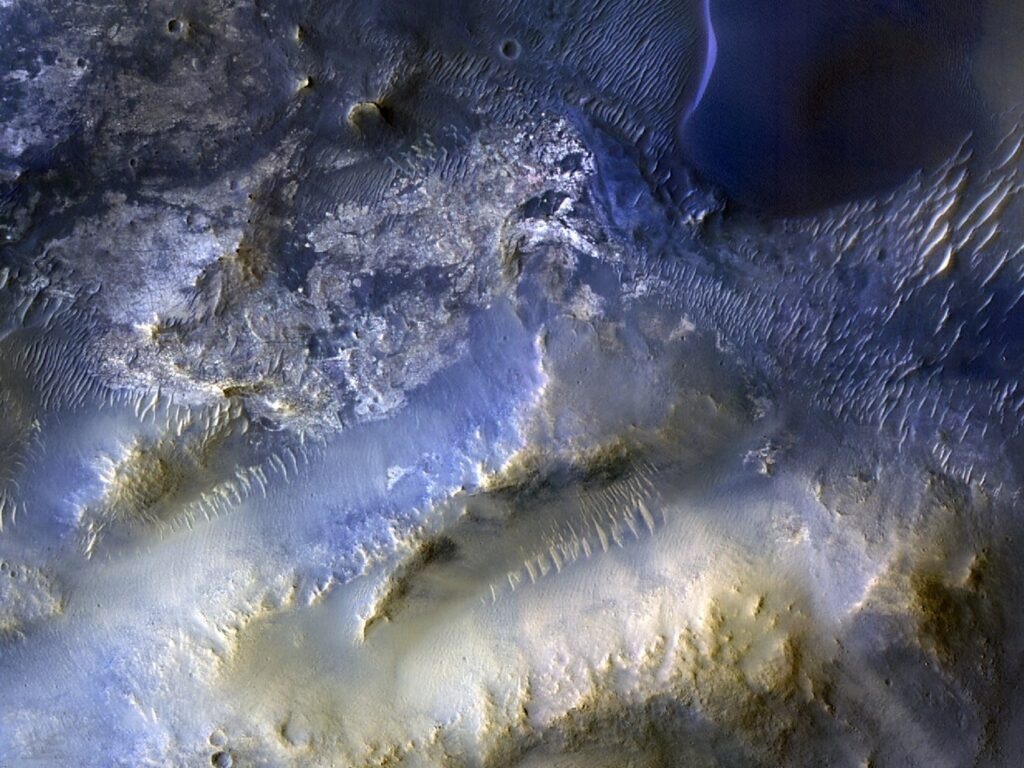
After nearly two decades of orbiting the Red Planet, NASA’s Mars Reconnaissance Orbiter (MRO) has achieved a significant milestone by capturing its 100,000th image of Mars’ surface. This remarkable image was taken by the High Resolution Imaging Science Experiment (HiRISE) camera, a crucial instrument for the mission that provides detailed views of Martian features such as impact craters, sand dunes, and ice deposits. These images are instrumental in enhancing our understanding of Mars and preparing for future human missions.
Captured on October 7, the milestone image reveals mesas and dunes within Syrtis Major, a region situated approximately 50 miles southeast of Jezero Crater. This area is of particular interest as NASA’s Perseverance rover is currently exploring it. Scientists are analyzing the image to gain insights into the origins of the windblown sand that accumulates in the landscape, forming the region’s distinctive dunes.
HiRISE: A Window into Mars’ Dynamic Surface
The HiRISE camera has not only uncovered the differences between the Martian surface and Earth but has also documented how Mars’ surface evolves over time. According to Leslie Tamppari, MRO’s project scientist at NASA’s Jet Propulsion Laboratory in Southern California, “HiRISE hasn’t just discovered how different the Martian surface is from Earth, it’s also shown us how that surface changes over time.” The camera has captured dynamic processes such as dune fields shifting with the wind and avalanches cascading down steep slopes.
The 100,000th image’s subject was suggested by a high school student through the HiWish site, a platform that allows the public to propose areas of Mars for study. The University of Arizona in Tucson operates the HiRISE camera and creates 3D models of its imagery, enabling virtual flyover experiences for viewers.
Public Engagement and Scientific Collaboration
HiRISE’s approach to rapid data release and its openness to imaging targets suggested by both the scientific community and the public have been pivotal to its success. Shane Byrne, the camera’s principal investigator at the University of Arizona, highlighted this collaborative spirit: “Rapid data releases, as well as imaging targets suggested by the broader science community and public, have been a hallmark of HiRISE.” He added, “One hundred thousand images just like this one have made Mars more familiar and accessible for everyone.”
This public engagement initiative has not only democratized access to Mars exploration but has also enriched scientific research by incorporating diverse perspectives and interests.
Implications for Future Mars Missions
The achievement of capturing 100,000 images is not just a testament to HiRISE’s capabilities but also a crucial step forward in preparing for future missions to Mars, including potential human exploration. The data collected by HiRISE supports mission planning by identifying safe landing sites and understanding the Martian environment.
As NASA continues to plan for human missions to Mars, the insights gained from HiRISE’s imagery will be invaluable in ensuring the safety and success of these endeavors. The ongoing analysis of images like the 100,000th capture will contribute to our understanding of Martian geology and climate, informing both robotic and human exploration strategies.
Looking Ahead: The Next Frontier
As the Mars Reconnaissance Orbiter continues its mission, the HiRISE camera will undoubtedly capture many more images, each contributing to our growing knowledge of the Red Planet. This milestone serves as a reminder of the remarkable achievements in space exploration and the potential for future discoveries.
With each image, scientists and the public alike are offered a glimpse into the mysteries of Mars, bringing us closer to unraveling the secrets of our neighboring planet. As we look ahead, the continued collaboration between scientists and the public will be key to unlocking the full potential of Mars exploration.