



In a groundbreaking discovery, an international team of astronomers utilizing NASA’s Imaging X-ray Polarimetry Explorer (IXPE) has pinpointed the origin of X-rays in the jet of a supermassive black hole. This significant breakthrough, published in The Astrophysical Journal Letters on November 11, resolves a long-standing enigma in X-ray astronomy.
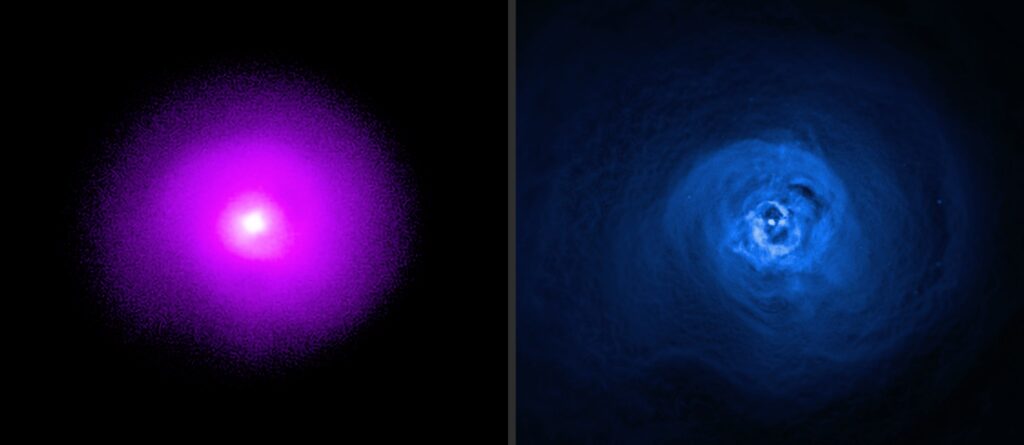
The IXPE mission focused its observations on the Perseus Cluster, the most luminous galaxy cluster observable in X-rays, dedicating over 600 hours across a 60-day period from January to March. This marks IXPE’s longest observation of a single target and its inaugural study of a galaxy cluster.
Unveiling the Secrets of 3C 84
Central to the study was 3C 84, a massive active galaxy at the heart of the Perseus Cluster. Known for its brightness and proximity, 3C 84 is a frequent subject of X-ray astronomy. The cluster’s immense mass harbors a vast reservoir of X-ray emitting gas, comparable in temperature to the Sun’s core.
To unravel the complex signals in the IXPE data, scientists employed multiple X-ray telescopes, including NASA’s Chandra X-ray Observatory. These observations were further supplemented with data from the Nuclear Spectroscopic Telescope Array (NuSTAR) and the Neil Gehrels Swift Observatory.
Polarization: A Key to Understanding
Polarization measurements from IXPE offer insights into the orientation and alignment of emitted X-ray light waves. The degree of polarization increases with the synchronization of X-ray waves.
“While measuring the polarization of 3C 84 was one of the key science goals, we are still searching for additional polarization signals in this galaxy cluster that could be signatures of more exotic physics,” said Steven Ehlert, project scientist for IXPE.
According to the study’s lead author, Ioannis Liodakis, the team confirmed that X-rays from 3C 84 originate from inverse Compton scattering, where light gains energy by bouncing off particles. This allowed researchers to identify the properties of “seed photons,” or the lower-energy radiation undergoing this energizing process.
Distinguishing Between Scenarios
The research explored two potential origins for the seed photons. The first, synchrotron self-Compton, suggests that lower-energy radiation originates from the same jet as the high-energy particles. The alternative, external Compton, posits that seed photons come from unrelated background radiation sources.
“The synchrotron self-Compton and external Compton scenarios have very different predictions for their X-ray polarization,” explained Frederic Marin, an astrophysicist and co-author of the study. “Any detection of X-ray polarization from 3C 84 almost decisively rules out the possibility of external Compton as the emission mechanism.”
Throughout the observation campaign, optical and radio telescopes worldwide focused on 3C 84 to further differentiate these scenarios. IXPE measured a net polarization of 4% in the X-ray spectrum, with similar values in optical and radio data, supporting the synchrotron self-Compton model.
Collaborative Efforts and Future Research
Sudip Chakraborty, a co-author on the paper, emphasized the necessity of combining IXPE’s polarization data with Chandra, NuSTAR, and Swift to confirm that the polarization measurement was specific to 3C 84.
Scientists continue to analyze IXPE’s data from various locations within the Perseus Cluster, seeking different signals that might reveal more about the universe’s most enigmatic objects.
The IXPE Mission: A Collaborative Endeavor
NASA’s IXPE mission, a collaboration with the Italian Space Agency and partners from 12 countries, is led by NASA’s Marshall Space Flight Center in Huntsville, Alabama. BAE Systems, Inc., and the University of Colorado’s Laboratory for Atmospheric and Space Physics manage spacecraft operations.
This mission continues to provide unprecedented data, enabling groundbreaking discoveries about celestial objects across the universe. As researchers delve deeper into IXPE’s findings, the potential for further revelations about black holes and their mysterious jets remains vast.