




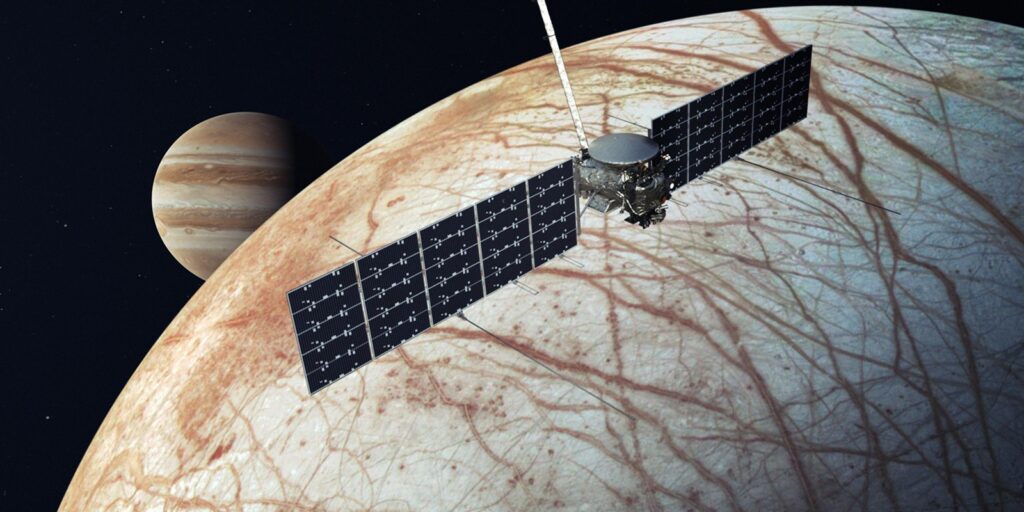
NASA’s ambitious Europa Clipper mission, currently en route to Jupiter, has successfully demonstrated a critical component of its scientific arsenal during a recent flyby of Mars. On March 1, 2025, the spacecraft activated its ice-penetrating radar, known as REASON, to test its functionality in real space conditions. This milestone is crucial as the mission aims to answer a profound question: Does Jupiter’s moon Europa harbor a hidden ocean capable of supporting life?
The radar test, conducted as the spacecraft used Mars’ gravity to adjust its trajectory, generated approximately 60 gigabytes of data. This data confirmed the radar’s performance and provided engineers and scientists with valuable experience in processing signals before the spacecraft reaches Europa. The test was a significant step, as replicating such radar echoes on Earth would require an impractically large space, making Mars an ideal testing ground.
A Test Drive at Mars
The Europa Clipper’s flyby of Mars was not just a routine maneuver. During the pass, the spacecraft engaged its REASON radar for about 40 minutes, sending and receiving radio waves while moving from approximately 5,000 kilometers to 884 kilometers above the Martian surface. This exercise was crucial to ensure the radar’s readiness for its primary mission.
NASA’s decision to conduct this test at Mars highlights the agency’s meticulous planning. Mars, a well-studied planet, provided a familiar environment to validate the radar’s capabilities, ensuring fewer surprises when the spacecraft reaches Europa. The test’s success underscores the importance of thorough preparation in space exploration, where a single error could jeopardize years of planning and billions of dollars in investment.
Exploring Europa’s Hidden Ocean
Europa, an icy moon of Jupiter, is believed to conceal a salty ocean beneath its frozen crust. The Europa Clipper mission is not designed to detect life directly but to assess whether Europa has the conditions necessary to support life. This involves investigating the moon’s ocean, chemistry, and signs of internal activity.
The REASON radar is central to this mission. By measuring ice thickness and identifying structures within the ice, the radar can pinpoint areas where water might be closer to the surface or where the ocean interacts with the crust. Other instruments aboard the spacecraft will analyze Europa’s surface composition and search for signs of recent geological activity. If water vapor plumes are detected, close flybys could reveal their origins.
The Long Journey to Jupiter
Launched on October 14, 2024, the Europa Clipper is set to travel approximately 2.9 billion kilometers to reach the Jupiter system by 2030. The spacecraft will utilize another gravity assist at Earth in December 2026 to gain the necessary energy for its journey, reducing the need for excessive fuel.
Upon arrival, the Europa Clipper will orbit Jupiter and conduct around 49 close flybys of Europa, collecting detailed data over time. Some passes will bring the spacecraft as close as 25 kilometers above the moon’s surface, enabling high-resolution radar imaging, chemical analysis, and mapping.
Beyond the Space Enthusiasts
The successful radar test at Mars is more than a technical triumph; it represents a significant step in understanding icy worlds. By confirming the radar’s functionality, the mission lays the groundwork for exploring Europa’s potential habitability. If the mission uncovers thin ice, ocean-surface exchange, and the right chemical conditions, it could pave the way for future missions, such as a lander or sample-return mission.
Even if Europa is not currently habitable, the mission’s findings will enhance our understanding of icy worlds and their potential to harbor life. This knowledge could help identify similar hidden oceans elsewhere in the Solar System, expanding our search for extraterrestrial life.
Looking Ahead
As the Europa Clipper continues its journey, scientists will analyze the Mars radar data, ensuring the spacecraft’s systems remain in optimal condition. The mission’s next significant milestone will be its Earth flyby in 2026, followed by its anticipated arrival at Jupiter in 2030.
The Europa Clipper mission exemplifies the meticulous planning and execution required in space exploration. By addressing potential issues early and leveraging planetary flybys, NASA is poised to unlock the secrets of Europa and, potentially, the broader universe.