




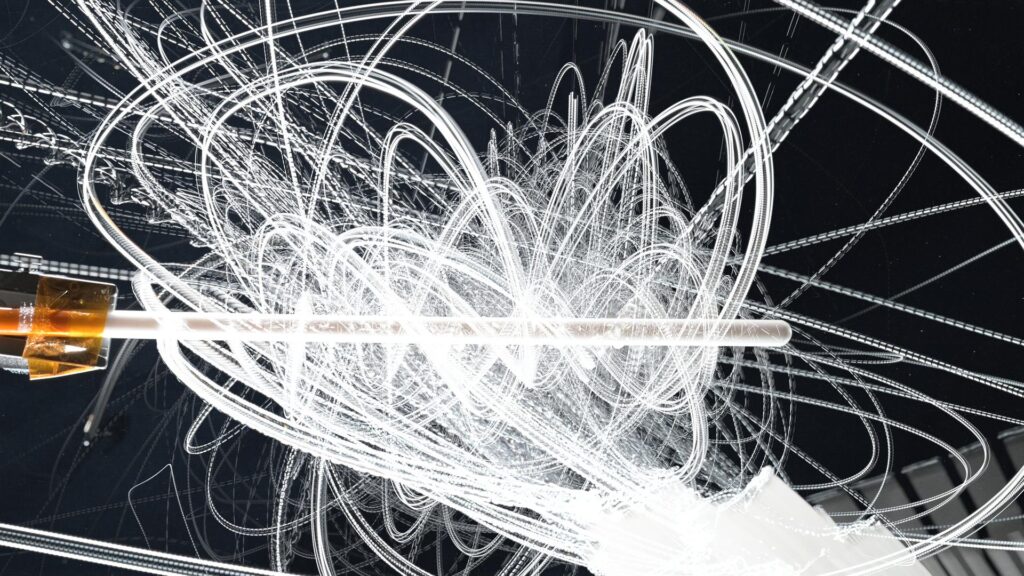
NASA astronaut Don Pettit has once again captivated the scientific community with his latest experiment aboard the International Space Station (ISS). On February 19, 2025, Pettit demonstrated the intriguing properties of electrostatic forces using charged water droplets and a Teflon knitting needle. This experiment not only showcases the unique attraction-repulsion dynamics of Teflon and charged droplets but also draws parallels to the behavior of charged particles from the Sun interacting with Earth’s magnetic field.
The demonstration, captured in a series of overlapping frames, highlights the potential of what Pettit refers to as the “science of opportunity.” This concept involves leveraging the unique conditions of space to conduct experiments that would be challenging or impossible on Earth. The experiment’s visual spectacle is reminiscent of the aurora borealis, where highly energetic particles from space collide with atoms and molecules in the Earth’s atmosphere, creating stunning natural light displays.
Understanding Electrostatic Forces in Space
Electrostatic forces are fundamental interactions between charged particles. In Pettit’s experiment, the charged water droplets and the Teflon needle create a microcosm of larger cosmic phenomena. Teflon, known for its non-stick properties, also exhibits unique electrostatic characteristics, making it an ideal material for such experiments.
The experiment serves as a simplified model for understanding how charged solar particles interact with Earth’s magnetic field. These interactions are crucial for understanding space weather, which can impact satellite operations, GPS systems, and even power grids on Earth.
The Science of Opportunity
Pettit’s “science of opportunity” approach emphasizes the importance of utilizing the ISS’s microgravity environment to explore scientific questions that remain elusive on Earth. This method not only advances our understanding of fundamental physics but also inspires innovative approaches to problem-solving in space exploration.
According to Pettit, the ISS provides a unique platform for experimentation, where the absence of gravity allows for the observation of phenomena in their purest forms. This perspective encourages scientists to think creatively and pursue experiments that push the boundaries of traditional scientific inquiry.
Implications for Future Research
The implications of Pettit’s experiment extend beyond the realm of basic science. Understanding electrostatic forces and their applications could lead to advancements in materials science, energy storage, and even space propulsion systems. The insights gained from such experiments could inform the design of more efficient spacecraft and contribute to the development of new technologies for space exploration.
Moreover, as space agencies and private companies continue to expand their presence in space, the need for innovative solutions to complex challenges becomes increasingly critical. Experiments like Pettit’s demonstrate the potential for creative problem-solving and underscore the importance of continued investment in space research.
Looking Ahead
The success of Pettit’s experiment highlights the ongoing value of the ISS as a research platform. As scientists continue to explore the “science of opportunity,” the potential for groundbreaking discoveries remains vast. Future experiments may build on Pettit’s work, exploring new materials and forces in the unique environment of space.
As we look to the future, the lessons learned from these experiments will undoubtedly shape the next generation of space exploration and technology. The continued collaboration between international space agencies and the innovative spirit of astronauts like Don Pettit will drive the advancement of our understanding of the universe and our place within it.
Image credit: NASA/Don Pettit