




NASA’s Johnson Space Center in Houston concluded 2025 with significant advancements in human spaceflight, research, and exploration. From preparing for the Artemis II mission to conducting science aboard the International Space Station (ISS), Johnson teams laid the groundwork for future missions to the Moon and Mars.
Artemis II Preparations and Innovations
As NASA gears up for the crewed Artemis II mission, a 10-day journey around the Moon scheduled for early 2026, Johnson’s teams have been hard at work ensuring the Orion spacecraft’s readiness. The mission will include NASA astronauts Reid Wiseman, Victor Glover, Christina Koch, and CSA astronaut Jeremy Hansen.
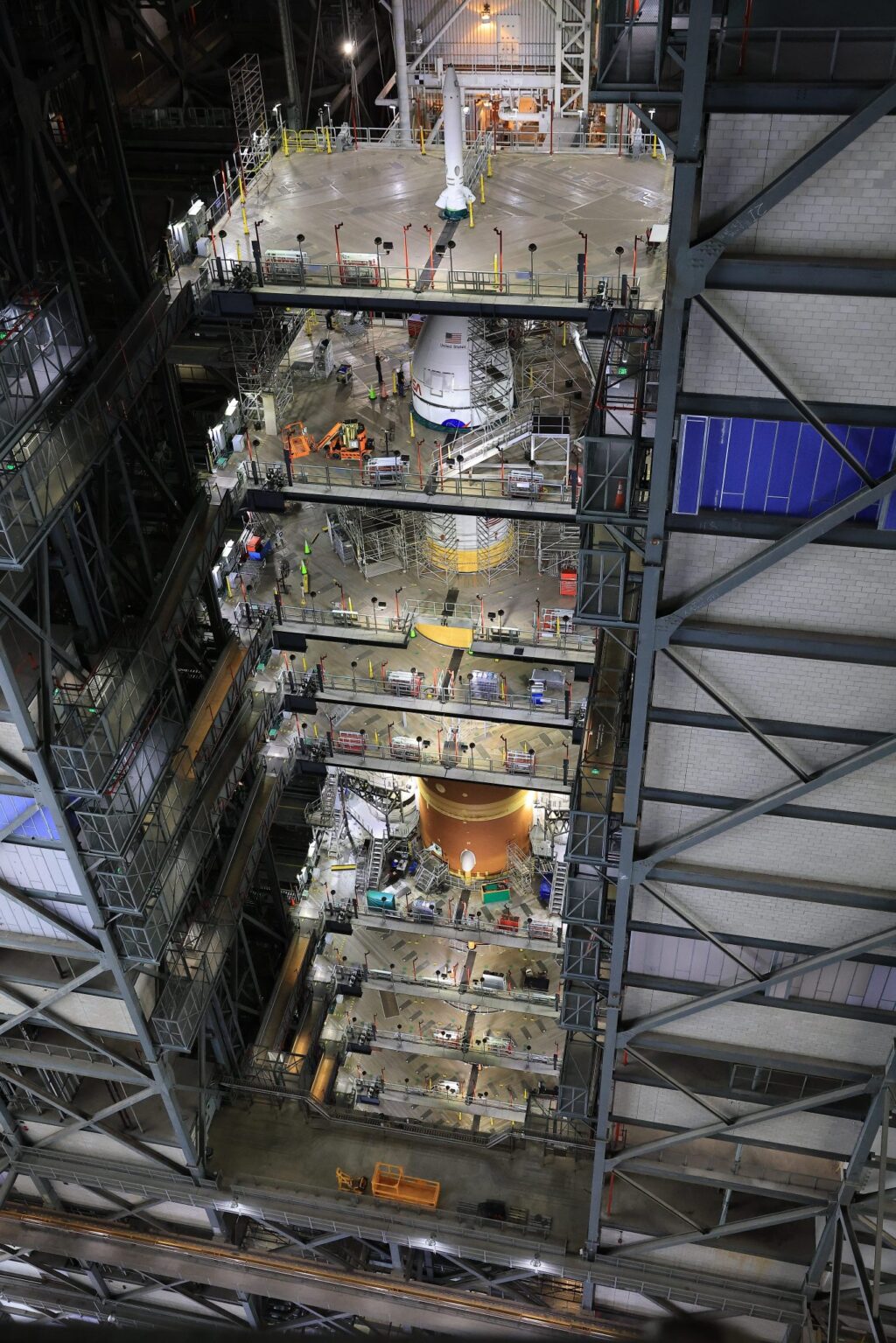
In October, the Orion spacecraft was successfully stacked atop NASA’s Space Launch System (SLS) rocket at Kennedy Space Center in Florida. This critical milestone was followed by rigorous testing of communication systems between SLS and Orion, confirming the functionality of interfaces between the rocket, spacecraft, and ground systems.
Additionally, the Orion Mission Evaluation Room was unveiled inside NASA’s Mission Control Center in Houston. This facility will support Artemis II by enabling real-time monitoring of Orion’s systems and assessing vehicle performance throughout the mission, enhancing flight operations beyond low Earth orbit.
These achievements were facilitated by various Johnson teams, including the Orion Program, Flight Operations Directorate, Systems Engineering and Integration Office, and others, in collaboration with NASA centers and industry partners.
Gateway Lunar Space Station and ISS Milestones
The Gateway Program, in partnership with international and industry collaborators, made strides toward establishing humanity’s first lunar space station. A significant milestone was reached with the successful initial power-on of the Gateway’s powerhouse.
NASA celebrated 25 years of continuous human presence aboard the ISS on November 2, 2025. The space station has evolved from a framework of modules into a hub for international cooperation, advanced research, and technology demonstrations, laying the groundwork for NASA’s future explorations.
“The ISS has hosted more than 4,000 experiments from over 5,000 researchers in 110 countries, symbolizing global collaboration,” NASA stated.
Record-breaking spacewalks also marked the year, with astronauts Nick Hague, Suni Williams, and Butch Wilmore completing key maintenance tasks. Williams set a new record for cumulative spacewalking time by a woman, reaching 62 hours and 6 minutes.
Expeditions and Lunar Firsts
NASA’s SpaceX Crew-10 arrived at the ISS on March 15 and returned on August 9, featuring astronauts from NASA, JAXA, and Roscosmos. Meanwhile, NASA astronaut Jonny Kim embarked on his first ISS mission aboard Soyuz MS-27, with Expedition 73 commencing after astronaut Don Pettit’s departure.
In lunar exploration, Firefly Aerospace’s Blue Ghost Mission 1 delivered NASA instruments to the Moon, landing near Mons Latreille in Mare Crisium. Intuitive Machines’ IM-2 mission also achieved a historic landing near the lunar South Pole.
These lunar milestones are part of NASA’s Commercial Lunar Payload Services and Artemis campaigns, addressing challenges like lunar dust mitigation and resource utilization.
Technological Advancements and Outreach
NASA’s Near-Earth Object Surveyor, the first space-based telescope for planetary defense, completed thermal vacuum testing at Johnson’s Space Environment Simulation Laboratory. Set to launch by late 2027, it aims to detect asteroids and comets that may threaten Earth.
In a unique outreach effort, NASA showcased its Artemis exhibit at the Houston AutoBoative Show, offering visitors insights into the technologies for lunar exploration. Attendees engaged with mission roadmaps and tested their skills in a virtual lunar rover simulator.
Additionally, NASA and Axiom Space conducted the first dual spacesuit run at the Neutral Buoyancy Laboratory, testing the Axiom Extravehicular Mobility Unit for Artemis III lunar missions.
Recognitions and International Collaborations
The OSIRIS-REx team received the Agency Group Achievement Award for their work on acquiring and preserving asteroid samples from Bennu. This mission represents NASA’s first successful asteroid sample return, providing valuable insights into the solar system’s origins.
The Axiom Mission 4 crew returned after an 18-day mission aboard the ISS, marking the first space station flight for India, Poland, and Hungary. Led by former NASA astronaut Peggy Whitson, the mission included astronauts from ISRO, ESA, and HUNOR.
Finally, a piece of NASA Johnson’s Mars hardware, the SHERLOC calibration target, was displayed at the Smithsonian National Air and Space Museum, highlighting the intersection of geology and space exploration.
These achievements underscore NASA Johnson’s pivotal role in advancing human space exploration and international cooperation, setting the stage for future endeavors on the Moon and Mars.