


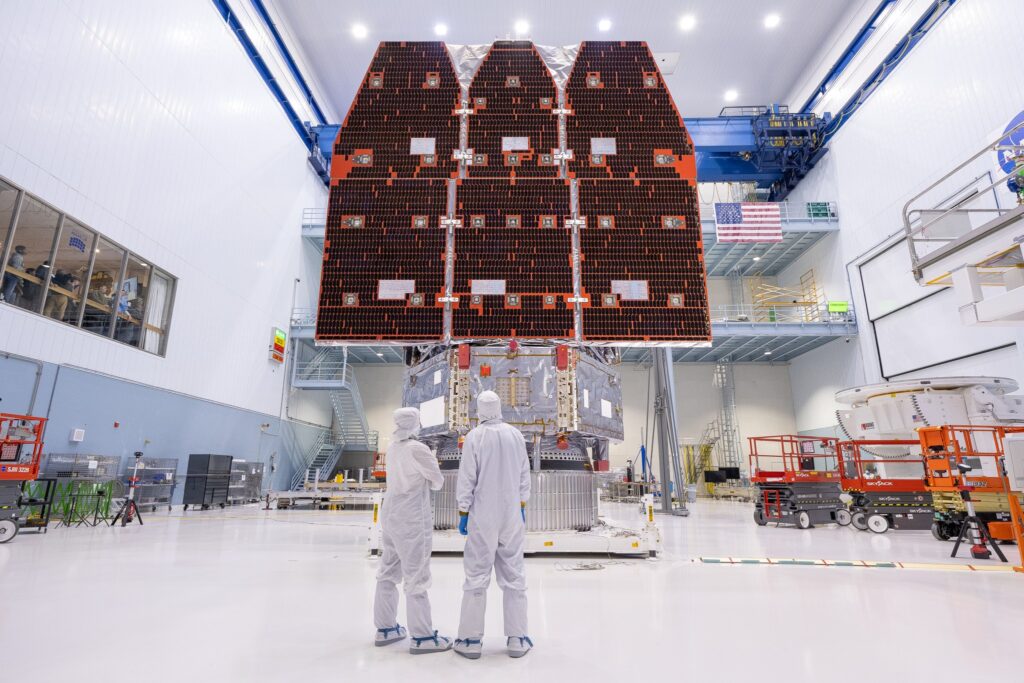
NASA has reached a significant milestone in its quest to explore the cosmos with the completion of the Nancy Grace Roman Space Telescope. On November 25, technicians at the Goddard Space Flight Center in Greenbelt, Maryland, successfully joined the inner and outer components of the telescope in the largest clean room available at the facility.
“Completing the Roman observatory brings us to a defining moment for the agency,” stated NASA Associate Administrator Amit Kshatriya. “Transformative science depends on disciplined engineering, and this team has delivered—piece by piece, test by test—an observatory that will expand our understanding of the universe.”
Final Preparations and Launch Timeline
Following its assembly, the Nancy Grace Roman Space Telescope will undergo final testing before being transported to NASA’s Kennedy Space Center in Florida. Launch preparations are scheduled for the summer of 2026, with a potential launch date as early as fall 2026. The telescope is slated to be launched by a SpaceX Falcon Heavy rocket, which will send it to its destination approximately one million miles from Earth.
Julie McEnery, Roman’s senior project scientist at NASA Goddard, expressed excitement about the mission’s potential, stating, “With Roman’s construction complete, we are poised at the brink of unfathomable scientific discovery. In the mission’s first five years, it’s expected to unveil more than 100,000 distant worlds, hundreds of millions of stars, and billions of galaxies.”
Scientific Capabilities and Instruments
The Roman Space Telescope is equipped with two primary instruments: the Wide Field Instrument and the Coronagraph Instrument. The Wide Field Instrument is a 288-megapixel camera designed to capture expansive images of the cosmos, covering areas larger than the apparent size of a full moon. This instrument will enable the collection of data hundreds of times faster than the Hubble Space Telescope, amassing up to 20,000 terabytes over its five-year mission.
The Coronagraph Instrument is a technology demonstration aimed at directly imaging planets around other stars by blocking the glare from those stars. This will allow scientists to observe the faint light from planets in orbit, potentially revealing older, colder worlds that have been elusive until now.
“The question of ‘Are we alone?’ is a big one, and it’s an equally big task to build tools that can help us answer it,” said Feng Zhao, the Roman Coronagraph Instrument manager at NASA’s Jet Propulsion Laboratory.
Exploring the Universe’s Mysteries
Roman’s mission is not just about capturing stunning images but also about answering fundamental questions about the universe. The telescope will conduct three core surveys, accounting for 75% of its primary mission. These include the High-Latitude Wide-Area Survey, the High-Latitude Time-Domain Survey, and the Galactic Bulge Time-Domain Survey.
The High-Latitude Wide-Area Survey will explore over a billion galaxies, providing insights into dark matter and the formation of galaxies. Meanwhile, the High-Latitude Time-Domain Survey will observe the same region of space repeatedly, creating a dynamic view of the universe that could reveal new phenomena.
Roman’s Galactic Bulge Time-Domain Survey will focus on the Milky Way’s core, searching for microlensing events that could indicate the presence of planets in the habitable zone of stars. This survey could also uncover rogue planets and isolated black holes.
“The sheer volume of the data Roman will return is mind-boggling and key to a host of exciting investigations,” said Dominic Benford, Roman’s program scientist at NASA Headquarters.
Legacy and Future Prospects
The Nancy Grace Roman Space Telescope is named after NASA’s first chief astronomer, Dr. Nancy Grace Roman, who was instrumental in advocating for space-based telescopes. Her legacy lives on through this mission, which aims to make cosmic vistas accessible to all.
“The mission will acquire enormous quantities of astronomical imagery that will permit scientists to make groundbreaking discoveries for decades to come,” said Jackie Townsend, Roman’s deputy project manager at NASA Goddard.
As the Roman Space Telescope moves closer to its launch, the scientific community eagerly anticipates the wealth of data it will provide. With its comprehensive surveys and advanced instruments, Roman is set to revolutionize our understanding of the universe and potentially answer some of the most profound questions about our existence.