




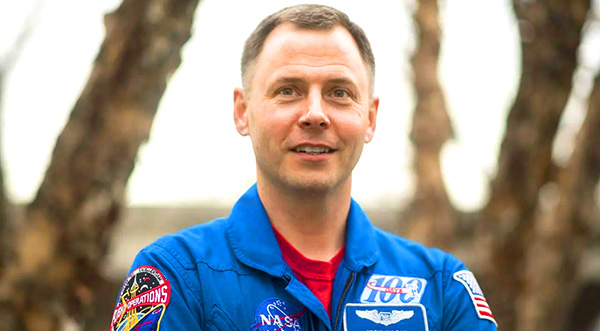
NASA astronaut Brig. Gen. Nick Hague has officially retired from the agency, capping off an illustrious career marked by two spaceflight missions, 374 days in space, and multiple spacewalks that advanced the International Space Station’s capabilities. Despite his departure from NASA, Hague will continue to serve in a leadership role within the U.S. Space Force.
Hague’s journey into space began with his launch aboard the Soyuz MS-12 spacecraft in March 2019 from the Baikonur Cosmodrome in Kazakhstan. During this first long-duration mission, he served as a flight engineer for Expeditions 59/60, spending 203 days in orbit. His contributions included three spacewalks dedicated to upgrading the station’s power systems and supporting its ongoing maintenance.
From Launch Anomalies to Successful Missions
Originally slated to fly in 2018 as part of the Soyuz MS-10 crew, Hague faced a significant challenge when the mission experienced a launch anomaly shortly after liftoff. Demonstrating remarkable resilience, Hague and his crewmate executed a high-G ballistic abort and landed safely. This setback did not deter him; Hague returned to flight status within months and successfully completed his 2019 mission.
Hague’s second spaceflight came during NASA’s SpaceX Crew-9 mission in September 2024. Launching alongside Roscosmos cosmonaut Aleksandr Gorbunov, this mission was notable for being the first human spaceflight from Space Launch Complex 40 at Cape Canaveral Space Force Station in Florida. It also marked a historic moment as the first time a Space Force Guardian launched into space.
Contributions Beyond the Stars
During his time with NASA, Hague conducted a total of four spacewalks, amassing 25 hours and 56 minutes outside the station. His efforts were lauded by Vanessa Wyche, director of NASA’s Johnson Space Center, who stated,
“Nick’s determination and dedication to human space exploration are truly phenomenal. His leadership and commitment to mission excellence have supported progress aboard the International Space Station and prepared us for future missions as we continue to explore farther into the solar system.”
Beyond his spaceflights, Hague played significant roles in technical and leadership capacities within NASA. He was instrumental in the development of future spacecraft operations, astronaut training, and human spaceflight safety initiatives, drawing on his firsthand experience during the MS-10 launch abort.
Continuing Service in the U.S. Space Force
A native of Hoxie, Kansas, Hague is a brigadier general in the U.S. Space Force. In his new role, he will be responsible for the development and implementation of policy for all U.S. Space Force global operations, sustainment, training, and readiness. His educational background includes a bachelor’s degree in astronautical engineering from the U.S. Air Force Academy and a master’s degree from the Massachusetts Institute of Technology.
Before joining NASA in 2013, Hague served in various developmental and test engineer roles, supporting advanced Air Force technologies and operations both domestically and internationally. Reflecting on his career, Hague expressed gratitude for his experiences and optimism for the future of space exploration.
“It has been an honor to serve as a NASA astronaut,” Hague remarked.
“Working alongside incredible teams, on the ground and in space, has been the privilege of a lifetime. The International Space Station represents the very best of what humanity can accomplish when we work together. I am grateful to have contributed to that mission, and I look forward to watching NASA, our partners, and the next generation of explorers push even farther as we return to the Moon and journey on to Mars.”
Hague’s transition from NASA to the U.S. Space Force underscores the growing synergy between civil and military space operations, as both sectors aim to bolster their capabilities in an increasingly competitive space environment. His leadership is expected to play a pivotal role in shaping the future of U.S. space endeavors.