



Nestled in the Mojave Desert, NASA’s Armstrong Flight Research Center at Edwards Air Force Base, California, continues to push the boundaries of flight technology, advancing the agency’s aeronautics mission. This historic site, where Chuck Yeager famously broke the sound barrier, is now at the forefront of developing high-speed, autonomous, and electrified aircraft. Armstrong’s contributions are integral to NASA’s broader mission of innovation and collaboration, leveraging its uniquely capable location.
The story of NASA Armstrong began in 1947 when 13 engineers and technicians from the National Advisory Committee for Aeronautics, NASA’s predecessor, arrived at Muroc Army Airfield—now Edwards Air Force Base. Their mission was to prepare for the first supersonic research flights of the X-1 rocket plane. The Bell X-1 became the first aircraft to fly faster than the speed of sound in level flight, a historic milestone that marked the dawn of a new era in aviation and helped establish Edwards as a cornerstone of NASA’s flight research enterprise.
Why Edwards Air Force Base?
NASA Armstrong’s strategic location at Edwards Air Force Base provides unmatched access to the largest secure flight test range in the nation, equipped with specialized testing instrumentation. The base spans approximately 470 square miles, including the 44-square-mile surface of Rogers Dry Lake. This extensive restricted airspace enables safe, complex flight-testing scenarios for NASA teams across multiple programs.
Almost from the start of aeronautical advancements, the region’s natural geography played a critical role. In 1937, nearly all of the U.S. Army Air Corp’s fleet conducted maneuvers above Rogers Dry Lake—a vast, flat expanse formed by ancient geological processes that serves as a unique emergency landing site. Its hard-packed surface and wide-open area provide a natural safety net for experimental aircraft, offering a margin of safety that’s critical during high-risk missions.
With the U.S. involvement in World War II, the area’s importance grew, bringing additional resources, new facilities, and a focus on research and experimentation with new aircraft designs. Today, the airspace above the region includes the Bell X-1 Supersonic Corridor, a designated section of restricted airspace within the Edwards test range. This corridor provides a safe, controlled environment for supersonic and transonic flight testing, enabling precision maneuvers at high speeds over the Mojave Desert.
A Culture of Innovation
NASA’s X-plane legacy is deeply rooted in its history. From the X-1 to the X-59, NASA has developed dozens of X-planes, many flight-tested at Edwards with contributions by Armstrong and other NASA centers. These experimental aircraft were designed to push the boundaries of flight and test new technologies. At Edwards, NASA teams have tested everything from lifting body designs—critical for spacecraft and reentry research—to digital fly-by-wire systems, which have become standard in commercial aviation.
This culture of innovation continues today as NASA’s aeronautics team, leveraging Armstrong’s flight research expertise, advances advanced air mobility, electrified propulsion, and autonomous flight systems. The center’s location and infrastructure enable rapid prototyping and testing, accelerating NASA’s ability to mature next-generation aviation technologies.
Partnerships with the U.S. Air Force further strengthen NASA’s capabilities. Shared resources, coordinated airspace management, and joint operations allow NASA researchers to conduct complex missions with support and safety protocols, while collaborating across NASA centers and industry.
Supporting a Broad Mission Portfolio
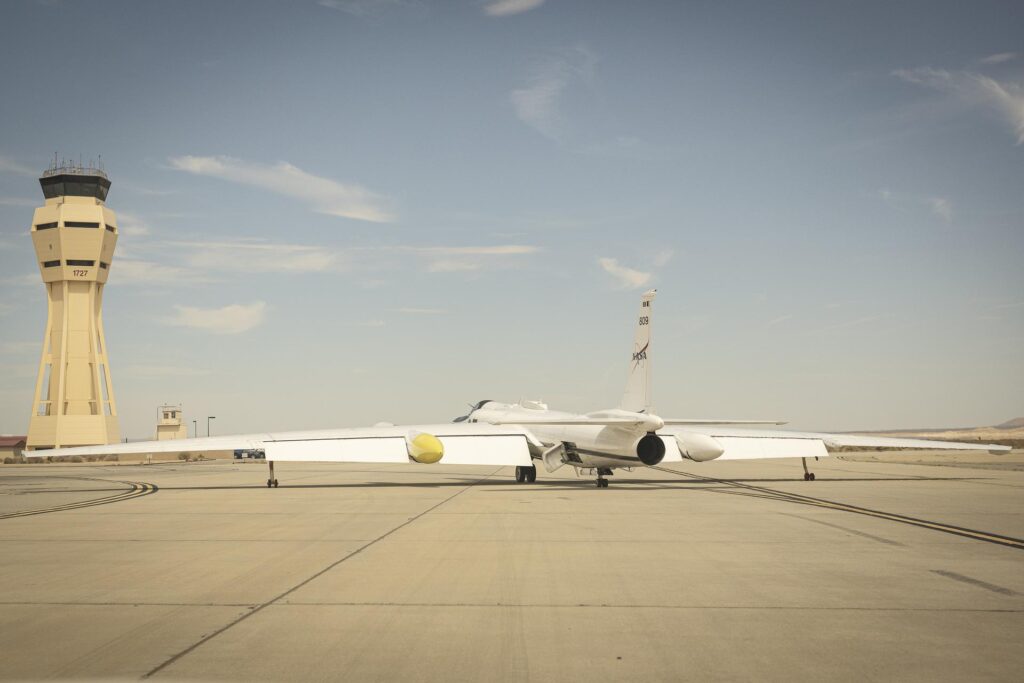
While Armstrong is best known for experimental aircraft, NASA’s work at Edwards supports a diverse mission portfolio. The center supports Earth science missions, airborne sensor testing, and planetary exploration. Its aircraft, including the ER-2 and Gulfstream, carry instruments that study climate, weather, and atmospheric composition, contributing vital data to NASA’s science goals in partnership with agency science teams.
Edwards’ location and infrastructure enable these missions by providing access to high-altitude corridors, stable flying conditions, and the ability to integrate new technologies quickly. Whether it’s testing sensors for Mars exploration or flying over hurricanes to collect data, NASA’s airborne science, supported by Armstrong’s flight operations, advances agency priorities.
Milestones That Matter
NASA’s flight research heritage at Edwards includes milestones that have shaped aviation history:
- 1947: Chuck Yeager breaks the sound barrier in the Bell X-1.
- 1960s-70s: Lifting body aircraft tested at Edwards lay the groundwork for the space shuttle. NASA tested the Lunar Landing Research Vehicle at Edwards in the mid-1960s to develop techniques later used by Apollo astronauts.
- 1980s: Digital fly-by-wire systems validated at NASA Armstrong become standard in commercial aviation.
- 2000s and beyond: Two successful flights of a scramjet-powered airplane, the X-43A, at hypersonic speeds—greater than Mach 5, or five times the speed of sound. Autonomous aircraft and drones tested for Earth science and defense applications. The X-59 prepares to demonstrate quiet supersonic flight over land, potentially reshaping commercial aviation.
Each of these achievements reflects NASA collaboration, drawing on location, infrastructure, and culture to deliver agency impact. As aviation enters a new era of fuel savings, autonomy, and accessibility, NASA’s aeronautics team, through flight research at Armstrong and elsewhere, remains steady to test the technologies that will define the future of flight.
Looking Ahead
With growing interest in advanced air mobility, high-speed flight research, and new aircraft technologies, NASA’s integrated approach is more critical than ever. NASA Armstrong’s flight test discipline and safety frameworks contribute to agency-wide risk management and systems engineering, supporting NASA’s top priorities—from commercial supersonic technologies to the safety practices that underpin human spaceflight.
The future of aviation is being shaped in the Mojave Desert, where NASA’s Armstrong Flight Research Center continues to lead the way, ensuring that the skies remain a domain of exploration and innovation.