



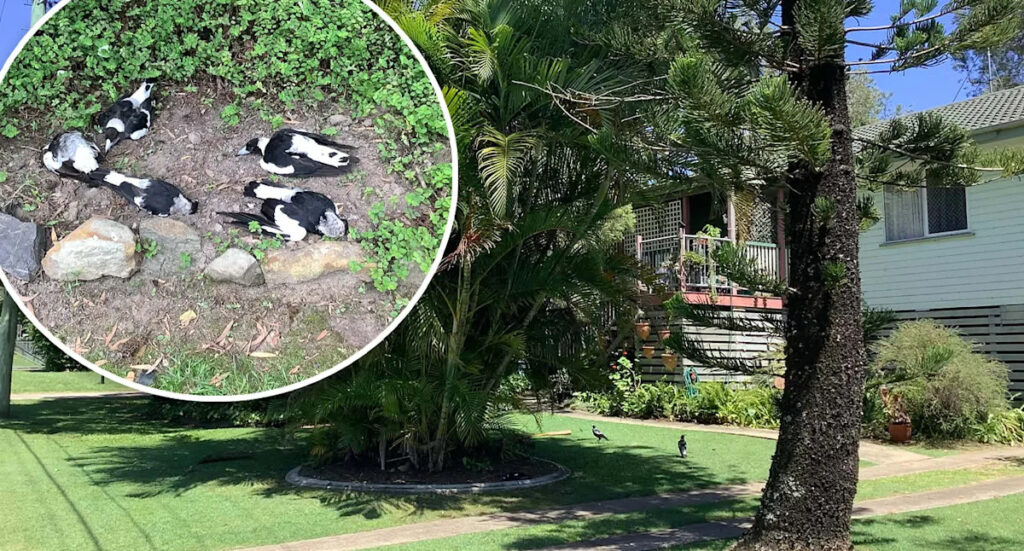
A heartbroken resident in Inala, a suburb in Brisbane’s southwest, is seeking answers after discovering more than 30 magpies dead in her garden. The alarming phenomenon began earlier this month when Kylie, who lives with her mother, found four deceased birds on their property. Despite reaching out to local and state authorities, including the council and the RSPCA, she was informed that little could be done as the birds were already dead, with initial suspicions pointing to heatstroke as the cause.
The situation has since worsened, with Kylie reporting a total of 33 dead or dying magpies in her yard. “I don’t know what’s going on. One minute they’re healthy, and the next minute they’re just dropping,” she told Yahoo News Australia. “It’s awful to watch. I held one in my arms last Saturday because I just didn’t want him to die all alone. He suffocated to death in my arms.”
Escalating Crisis in Inala
The bizarre deaths have not been confined to Kylie’s property. Each day, she finds more magpies not only in her garden but also on nearby footpaths and neighbors’ properties. “It just keeps escalating,” she said. On a particularly dire Sunday, Kylie collected 11 dead magpies in the morning, with another eight succumbing throughout the day. The RSPCA Queensland has since intervened, collecting some of the deceased birds for further examination.
According to Kylie, the magpies initially lose their ability to fly, fall from trees, and then exhibit severe symptoms such as inability to walk, hold their heads up, and gasping for air before dying. Heartbreaking footage shared by Kylie shows the birds struggling to breathe, highlighting the urgency of the situation.
Authorities Launch Investigation
A spokesperson for RSPCA Queensland confirmed they have taken several birds into care following reports of the incident. “The cause of this incident is currently under investigation, and we are working closely with the relevant authorities,” they stated. The Department of Primary Industries is also involved, working with the RSPCA to conduct disease exclusion testing on the birds.
While the exact cause remains undetermined, the public is urged to report any unusual bird deaths or signs of Highly Pathogenic Avian Influenza (HPAI) to the Emergency Animal Disease Hotline at 1800 675 888. The RSPCA advises that clusters of five or more sick or dead wild birds should be reported immediately, especially if they are seabirds, waterbirds, shorebirds, birds of prey, or exhibit symptoms consistent with avian influenza.
Signs of Avian Influenza
- Lack of coordination, tremors, or swimming in circles
- Twisted necks or unusual posture
- Inability to stand or fly
- Diarrhoea
- Difficulty breathing, coughing, or sneezing
- Swelling around the head, neck, or eyes
- Cloudy or discoloured eyes
Preventive Measures and Public Guidance
The RSPCA emphasizes the importance of avoiding contact with sick or dead wildlife and ensuring pets do not interact with affected animals. Observers are encouraged to document their findings, including location details, and report them to authorities. “Even if testing does not occur, every report contributes valuable information for disease monitoring and management,” an RSPCA spokesperson explained.
The Department of Environment, Tourism, Science and Innovation (DETSI) has acknowledged the incident and urges the public to report wildlife deaths to 1300 130 372 or [email protected]. Handling deceased birds is discouraged due to potential health risks.
Broader Implications and Historical Context
Meanwhile, a similar mystery illness affecting magpies has been reported in Western Australia, where entire “tribes” of these iconic birds have vanished from suburbs. This issue, initially identified seven years ago, has seen a recent surge in cases. The disease bears similarities to botulism and other illnesses affecting birds and flying foxes in the eastern states, though experts suspect a different pathogen may be responsible in Western Australia.
A team led by Dr. Bethany Jackson, a wildlife health expert at Murdoch University, is investigating the cause of this mysterious illness. As authorities continue their investigations, the situation in Brisbane serves as a stark reminder of the fragile balance within urban ecosystems and the critical role of wildlife health monitoring.
For those with information or experiencing similar issues, contact [email protected].