


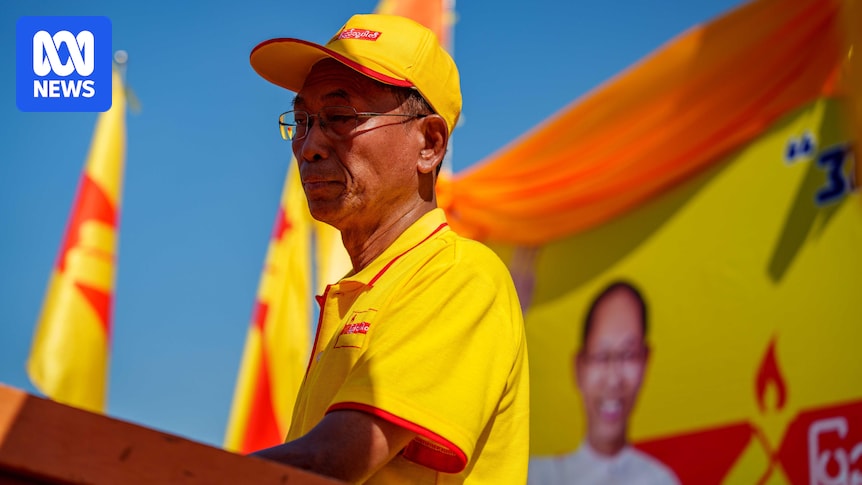
Standing on a stage flanked by his party’s signature red and yellow flags, Ko Ko Gyi made his case to a crowd of some 150 supporters. “In our country, there is a word that many people are afraid to use — the word is ‘revolution’,” he said. The crowd, dressed in matching yellow shirts and hats handed out by the People’s Party, listened quietly. In a country where revolutions have claimed tens of thousands of lives, the ‘R’ word caught their attention.
But Ko Ko Gyi, 64, is not calling for a revolt on the streets. He’s calling on the people of Myanmar to revolt at the ballot box. Five years after the military toppled a democratically elected government, imprisoned its leaders, and triggered a civil war, the country is preparing to hold national elections beginning on December 28. The junta claims the polls will return the South-East Asian nation to civilian rule, but the election has been widely dismissed by Western governments and civil rights groups as a sham, designed to keep the generals in power through their surrogate political parties.
Divided Opinions on Myanmar’s Electoral Process
Calls for a boycott have reverberated throughout the country. However, the election has received unexpected support from Ko Ko Gyi, a candidate for the People’s Party and one of Myanmar’s most respected pro-democracy activists. “If the people do not vote in the elections, the elections won’t stop,” he told the ABC, after speaking at a political rally on the outskirts of Myanmar’s largest city, Yangon. “This is not the best choice, but this is the pragmatic way forward,” he said.
Ko Ko Gyi’s support for the election has surprised and divided the pro-democracy movement. While attending Yangon University, he led the 1988 student uprising against the military dictatorship. Since then, he has been dogged about his activism, spending over 17 years behind bars between 1989 and 2012 after being jailed multiple times. But following the 2021 coup, he stunned many by publicly engaging with the junta and meeting with the military’s Commander-in-Chief, Min Aung Hlaing.
“We cannot watch our country collapse,” he said. “Right now, all the power is in the hands of the commander-in-chief. After the election, at least power will be shared between the legislative, executive and the judiciary branches. Then our elected representatives will have a chance to talk or to complain about the situation.”
Criticism and Concerns Over Election Legitimacy
Ko Ko Gyi described his approach as “pragmatic”, but many of his peers in the pro-democracy movement believe it is naive. Even as the military touts the upcoming polls to foreign governments and journalists, it continues to imprison political leaders from the government it deposed, including Nobel Laureate Aung San Suu Kyi, who led the National League for Democracy (NLD) party. She is one of around 22,600 political prisoners currently in detention in Myanmar, according to the Assistance Association for Political Prisoners.
In August, UN investigators said summary executions and the “systematic torture” of detainees, including burning of genitals, gang-rape, beatings, and electrocution, were part of “a pattern of atrocities” across the country.
“Everyone knows it — this is a sham election. Don’t trick yourself,” said Naw Susanna Hla Hla Soe, who was elected to parliament in 2015 and 2020 on the NLD’s ticket. She managed to escape Yangon following the coup as her peers and party leaders were being rounded up by authorities, and now serves as the Minister of Women, Youths and Children Affairs in the National Unity Government (NUG), a government-in-exile formed by ousted lawmakers resisting the 2021 coup.
“The people of Myanmar, they want democracy, they want freedom. They want development and prosperity,” she told the ABC. “This is a trap. It will only pull people into another era of dictatorship,” she said.
The Ongoing Civil War and Its Impact
Yet, the most damning indictment of the elections remains the brutal civil war that engulfed much of the country since the military seized power. Independent conflict monitor, ACLED, estimates that at least 80,000 have been killed in conflict-related violence since 2021. Some 3.6 million people have been displaced from their homes because of relentless air and drone strikes carried out by the junta as it tries to claw back territory from the thousands of ethnic armies and militia groups now fighting across the country.
Any hope that the upcoming elections will put an end to the conflict has dissipated with aerial strikes jumping by around 30 percent compared to last year, according to ACLED.
Just this month, the military’s indiscriminate bombardments leveled a 300-bed hospital in Rakhine State, killing at least 30 people, in what the World Health Organization estimated is the 67th attack on a health facility in Myanmar this year.
The Role of Social Media and Public Sentiment
Despite the regime’s success in blocking social media and stifling the local press, word of the military’s brutality has spread to urban centers like Yangon, creating an atmosphere of fear and intimidation ahead of the polls. The ABC attempted to interview a number of voters on camera about the elections, but most people were too scared to speak publicly.
A young woman who we’ll call ‘Joy’ asked us if she could speak frankly. “I think I will have to go and vote. I don’t think it will be OK not to vote,” she said. “I have a younger brother at home whose age is within the age limit for conscription. I’m afraid that something bad might happen if I don’t vote.”
‘Ko Kyaw Swear’, not his real name, agreed to speak to us anonymously and only over the phone. “In the cities and urban areas, it may seem normal in Myanmar. But even in some places in Yangon, they are arresting people at night,” he said. “I think the military is trying to do this election because they want to pretend like they are fair. They are trying to cover up their brutality, and everybody knows this is a sham election.”
The upcoming elections in Myanmar are fraught with tension and skepticism. As the nation stands at a crossroads, the world watches closely to see whether these elections will mark a step towards democracy or further entrench military rule.