

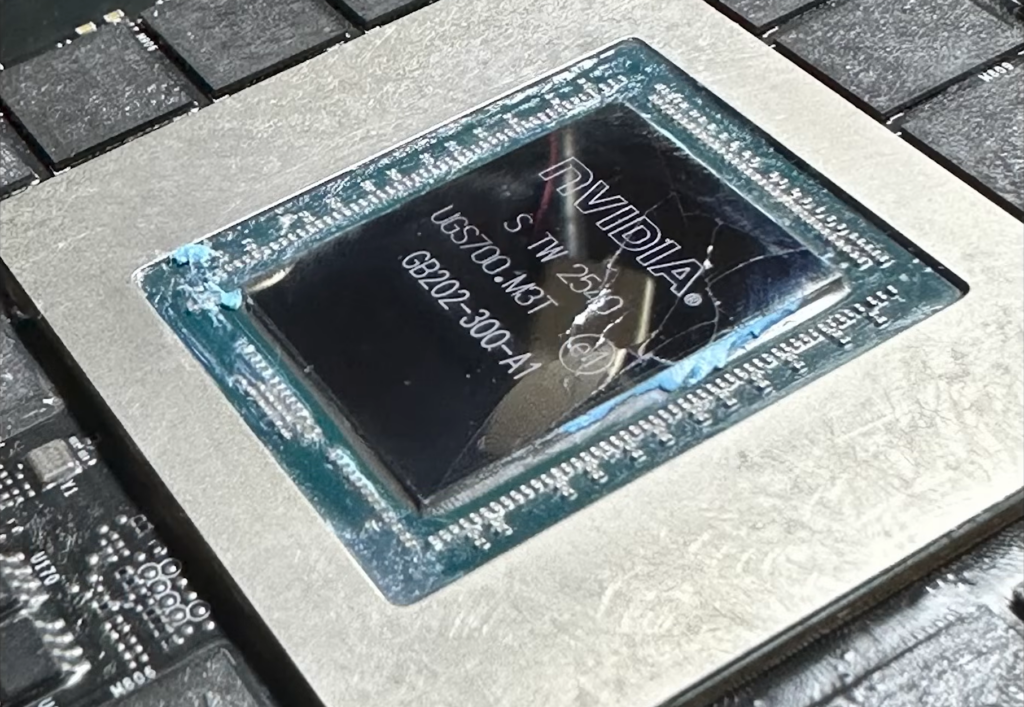
MSI’s GeForce RTX 5090 Lightning Z, a graphics card with a staggering $5,090 price tag, is designed not for the average gamer but for those who push hardware to its limits. This elite card, aimed at extreme overclockers, recently met its match during a high-stakes experiment. YouTuber Alva Jonathan, known for his expertise in overclocking, witnessed the card’s GPU core crack due to thermal shock during a 2,500W BIOS test, effectively rendering one of the samples inoperable.
Jonathan’s involvement with the RTX 5090 Lightning Z began in August 2025 when MSI Taiwan reached out for his consultation on the card’s development. Initially, he received two early PCB samples without coolers, eventually followed by three retail units. In his quest to test the limits of the card, Jonathan crafted a custom cooling solution before advancing to liquid nitrogen (LN2) cooling.
Engineering Marvel or Overclocking Nightmare?
The RTX 5090 Lightning Z distinguishes itself from standard models with its unique design and features tailored for competitive overclocking. Key specifications include:
- Dual 12V-2×6 power connectors
- Up to 1,000W total power limit (600W per connector)
- 40-phase VRM for high current delivery
- A dedicated 2,500W XOC BIOS for competitive overclocking
- An integrated 8-inch display for telemetry readouts
Jonathan embarked on his overclocking journey with what could be seen as a conservative approach for such hardware: 3.25 GHz at 1.05V, drawing over 700W. In 3DMark Port Royal, the Lightning Z scored an impressive 43,112 points, surpassing MSI’s RTX 5090 Suprim Liquid, which typically scores between 40,000 and 41,000 points, and the standard RTX 5090, which averages around 36,000 to 37,000 points.
Pushing the Limits with Liquid Nitrogen
To further push the card’s capabilities, Jonathan collaborated with ARX (arxidmedia) and transitioned to LN2 cooling. Despite the extreme cooling, maintaining a stable operating temperature proved challenging. The heatsink, in contact with the core, registered -40°C, yet the GPU itself reached temperatures as high as 9°C under load. At 1.12V and 3.42 GHz, power consumption soared past 1,000W.
The operating window under LN2 was narrow, between 0°C and 15°C. During one test, temperatures spiked to 21°C, causing the system to crash. Some benchmarks, however, were more forgiving. In GPUPI, Jonathan achieved a brief 3.6 GHz at around 0°C. The team stabilized at 3.5 GHz, breaking the HWBot world record for GPU compute performance in Geekbench 5 with a score of 683,433, a record that still stands.
The Catastrophic Turn
The turning point came when the team switched to the 2,500W XOC BIOS. Unfortunately, they were using an earlier revision that applied excessive voltage too quickly. At 1.2V, which is manageable under LN2 but risky at ambient temperatures around 25°C, one of the GPUs suffered a catastrophic failure. The core visibly cracked, likely due to thermal shock, as one part of the die remained extremely cold while another developed a hotspot, creating a temperature imbalance the silicon could not withstand.
Roughly $5,000 was lost in a single moment. The rest of the board components remain intact, meaning the card could theoretically be revived with a donor core.
Despite securing the Geekbench 5 world record, Jonathan did not manage to break other targets, including 3DMark Solar Bay Extreme. He still has four additional samples for continued testing and plans to improve cooler mounting. He also indicated that he may revert to a more stable retail BIOS for future attempts.
Implications and Future Prospects
This incident underscores the risks inherent in extreme overclocking, where the pursuit of performance can lead to costly failures. The RTX 5090 Lightning Z’s design, while impressive, highlights the fine line between innovation and the physical limits of technology. As Jonathan continues his experiments, the overclocking community will be keenly watching for further developments and potential breakthroughs.
The event also raises questions about the reliability and safety of pushing hardware beyond its intended limits. As manufacturers like MSI continue to cater to the niche market of extreme overclockers, the balance between performance and stability remains a critical consideration.
Looking ahead, Jonathan’s ongoing tests with the remaining samples may provide further insights into the card’s capabilities and limitations. Whether the RTX 5090 Lightning Z can consistently deliver record-breaking performance without sacrificing reliability will be a key focus for both enthusiasts and industry observers alike.