



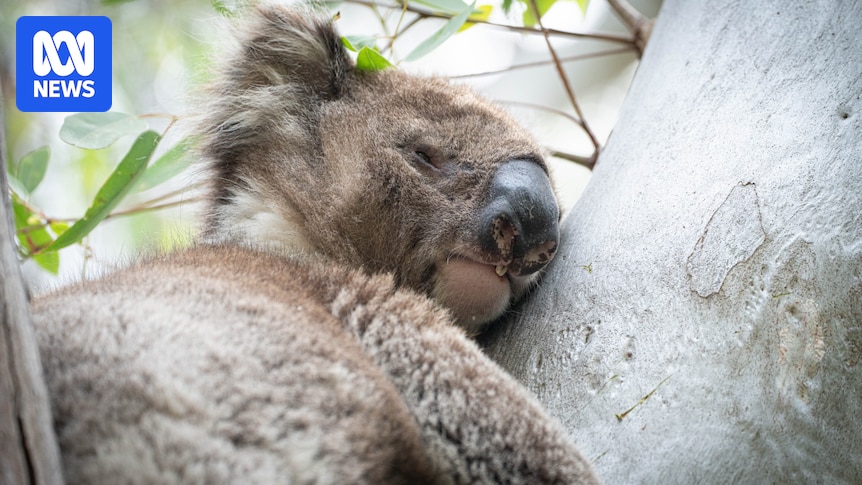
The koala population in Adelaide’s Mount Lofty Ranges has reached an unsustainable level, posing a significant risk of starvation and ecological imbalance, according to a recent study. Conducted by the University of Technology Sydney (UTS) and the Australian Museum, the research highlights the potential for severe consequences if current trends continue.
The Mount Lofty Ranges, nestled in the Adelaide Hills, is home to approximately 10 percent of Australia’s total koala population. The study projects a further increase of 17 to 25 percent over the next 25 years, exacerbating the already high koala densities in the region. Dr. Frédérik Saltré, a senior lecturer at UTS, warns that this growth will strain food supplies, vegetation, and natural habitats.
“We’re reaching a point where nothing’s going to be sustainable for them. We’re going to have koalas starving to death,” Dr. Saltré said.
Environmental Impact and Fire Risk
The implications of unchecked koala population growth extend beyond the animals themselves. The study warns of potential local die-offs of eucalyptus trees, which are vital not only to koalas but also to other species such as possums and birds. These die-offs could lead to an accumulation of dead material, increasing the risk of more frequent and intense bushfires.
“We are in control … there’s a lot of things on the planet that’s happening that we can’t necessarily control, and we can regulate in the case of the koala,” Dr. Saltré added.
Proposed Solutions: Fertility Control
To address the burgeoning koala population, researchers from UTS, the University of Wollongong, and Flinders University propose sterilizing approximately 22 percent of female koalas annually in density hotspots. This strategy, derived from spatial modeling and citizen science initiatives, is estimated to cost $34 million over 25 years. However, securing funding from the South Australian government remains uncertain.
South Australia’s Environment Minister, Lucy Hood, stated, “The Department [of Environment and Water] continues to monitor the populations but there is no current plan for those types of management tools at present.”
Ethical Considerations
Flinders University Professor Corey Bradshaw advocates for hormonal fertility control as the most ethical method of population management, contrasting it with more controversial measures such as culling or translocation.
“Clearly, when you mention things like culling and koalas together in the same sentence, it becomes immediately not acceptable for most people,” Professor Bradshaw said.
Translocation, while less contentious, often fails due to the stress it places on the animals. “Koalas don’t really like to be translocated. They don’t handle captivity that well when they’re taking long distances. I mean, there was some mortalities,” Professor Bradshaw explained.
Historical Context and Broader Implications
Koalas are not native to the Mount Lofty Ranges or Kangaroo Island, having been introduced after hunting for the fur trade threatened their survival in the 1920s. Despite this, they play a crucial role in Australia’s ecosystem and cultural identity.
“Having koalas in Australia is a given,” Dr. Saltré emphasized.
Previous efforts on Kangaroo Island in 1997 saw the sterilization of 12,500 koalas and the relocation of 3,800 to the state’s southeast. The Olsen government at the time considered various strategies, including culling, translocation, and even the introduction of diseases like chlamydia.
Professor Bradshaw notes that Australia has one of the highest mammal extinction rates globally, underscoring the importance of careful management. “There’s a lot of mystery about what the future holds for koalas, but if we don’t act now, I think the overall health of our forests will probably decline a little bit more than we otherwise expect,” he warned.
“We have a real opportunity in South Australia to do the right thing: keep the koala from going extinct,” Professor Bradshaw concluded.
The study’s findings present a clear call to action for policymakers and conservationists alike. As the Mount Lofty Ranges face an uncertain future, the decisions made today will determine the ecological and cultural landscape of tomorrow.