

In a dramatic turn of events, Morocco was declared the winner of the Africa Cup of Nations (AFCON) on Tuesday after appeals judges overturned Senegal’s victory in the contentious final held in January. The Confederation of African Football (CAF) announced that its appeal board ruled Senegal had “forfeited the Final,” thus converting their 1-0 extra-time win into a 3-0 default victory for host nation Morocco.
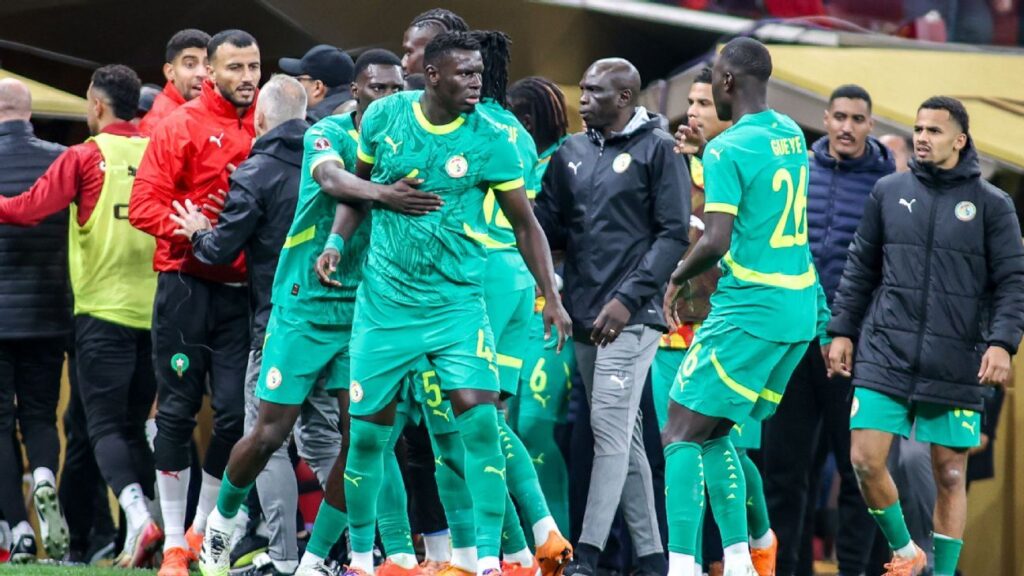
The decision comes after a chaotic final on January 18 in Rabat, where Senegal’s players, led by coach Pape Thiaw, walked off the field in protest during stoppage time. The protest was sparked by a penalty awarded to Morocco, which was poised to decide the match. Fans attempted to storm the field during the 15-minute hiatus. When play resumed, Morocco’s Brahim Díaz took the penalty with a controversial “Panenka” shot, which was saved by Senegal’s goalkeeper Édouard Mendy. Senegal then scored the only goal in extra time, seemingly securing their victory.
Controversy and Appeal
The tension in the stadium was palpable, exacerbated by Senegal being denied a goal just before the penalty was awarded to Morocco. In the second minute of stoppage time, Senegal’s apparent lead was nullified due to a foul by Abdoulaye Seck on Morocco’s Achraf Hakimi, despite TV replays showing minimal contact.
Initially, CAF imposed fines exceeding $1 million and issued bans for players and officials from both teams but did not alter the match result. However, the appeal board’s recent decision cited article 82 of the tournament regulations, which states that a team that withdraws or refuses to play without the referee’s authorization is considered a loser and eliminated from the competition.
“If, for any reason whatsoever, a team withdraws from the competition or does not report for a match, or refuses to play or leaves the ground before the regular end of the match without the authorization of the referee, it shall be considered loser and shall be eliminated for good from the current competition.”
Reactions and Future Implications
The ruling has sparked a wave of reactions. Senegal defender Moussa Niakhaté shared an image on Instagram holding the trophy with the caption in French, “Come and get it! They’re crazy!” Similarly, left-back El Hadji Malick Diouf expressed his disbelief, stating, “It’s not what I expected … this thing isn’t going anywhere.”
The Royal Moroccan Football Federation (FRMF) issued a statement emphasizing their commitment to the competition’s regulations and expressing gratitude to all participating nations. “The Federation reaffirms its commitment to respecting the rules, ensuring clarity in the competitive framework, and maintaining stability within African competitions,” it read.
This decision awards Morocco its first African title since 1976, while denying Senegal a second title, which would have been their second in three editions after winning in 2021. The case may proceed to the Court of Arbitration for Sport (CAS) in Lausanne, Switzerland, but any verdict could take about a year, long after both teams participate in the 2026 World Cup.
Looking Ahead to the World Cup
Senegal is set to face France, Norway, and a playoff bracket winner, potentially Iraq, in the upcoming World Cup. Their matches against France and Norway will take place at MetLife Stadium near New York. Meanwhile, Morocco will compete against Brazil, Scotland, and Haiti, with their opening game against Brazil also at MetLife Stadium.
Morocco’s recent success comes after a historic performance at the 2022 World Cup in Qatar, where they became the first African team to reach the semifinals. However, their coach Walid Regragui resigned two weeks ago following criticism for not securing the AFCON title, stating, “the team needs a new lease of life before the World Cup.”
As Morocco prepares to head to the United States as African champions, the implications of the overturned AFCON final continue to reverberate throughout the football community, highlighting the complexities and controversies that often accompany high-stakes international competitions.