




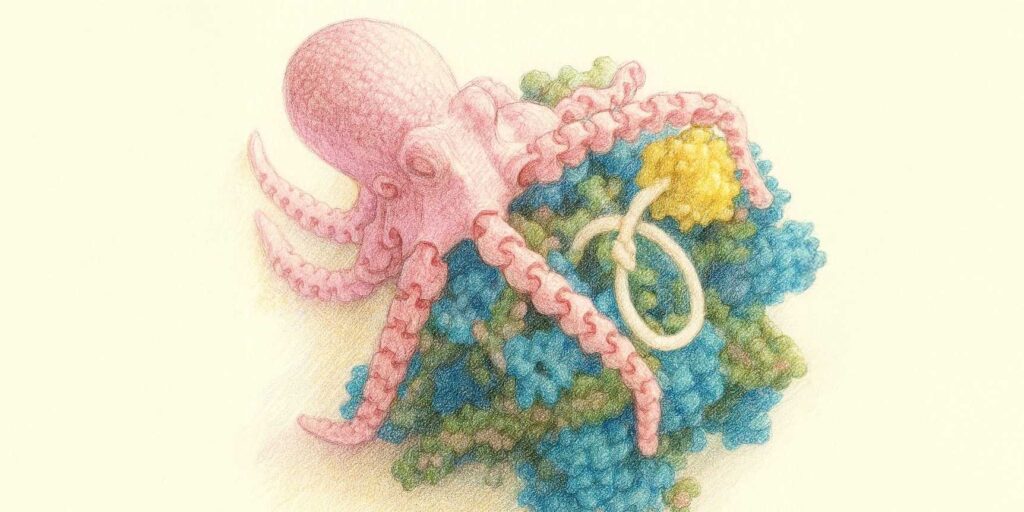
The protein factories in our cells, known as ribosomes, play a pivotal role in linking amino acids together during a process called translation, forming a growing peptide chain that eventually folds into a functional protein. However, the journey from a nascent protein to a fully functional one involves precise processing and transportation within the cell. As soon as a protein emerges from the ribosome, it undergoes initial modifications by enzymes that remove its initial amino acid, attach small chemical groups, or determine its cellular destination. These crucial activities occur during translation and require a coordinator.
This coordinator is a protein complex known as the nascent polypeptide-associated complex (NAC). Without NAC, these early modifications become inefficient or erroneous. Since its discovery around 30 years ago, NAC’s functions have remained somewhat enigmatic. Recent research from the laboratory of ETH biologist Nenad Ban sheds light on how NAC regulates protein maturation by recruiting specific enzymes precisely when and where they are needed.
The Role of NAC in Protein Processing
NAC is strategically positioned at the point where newly synthesized polypeptide chains emerge from the ribosome, making it ideally suited to coordinate the earliest processing steps. In a new study published in Science Advances, Ban and his colleagues from the Universities of Konstanz, Germany, and Caltech have uncovered a previously unknown function of NAC: ensuring the correct chemical modification of histones H4 and H2A during their synthesis.
Histones are small, abundant proteins that must be produced rapidly when cells prepare for division. They assemble into nucleosomes, around which DNA is wrapped and compacted. Proper chemical modification of these proteins is crucial for chromosome function, and errors in this process can contribute to diseases such as cancer.
Capturing Enzymes at the Right Moment
The study reveals that NAC brings two enzymes to the ribosome to first remove the initial amino acid from the histone protein and then modify the newly exposed end with an acetyl chemical group. Given the rapid assembly of histones, these processing steps must occur in the correct sequence and almost instantaneously.
“For histones, the time window for modifications is incredibly tight because their protein chains are very short,” explains first author Denis Yudin, a doctoral student in Nenad Ban’s lab. “NAC ensures that the right enzyme is at the right place at exactly the right time.”
Implications for Cancer Research and Therapy
Other studies indicate that the enzyme NatD, which modifies histone proteins with an acetyl group, is frequently overproduced in certain types of cancer, altering gene regulation and promoting tumor growth. NAC’s control over the access of NatD to the ribosome could provide new insights into tumor biology.
Detailed structural information about NAC and the enzymes it recruits, including how NatD binds to one of NAC’s flexible arms, could pave the way for new therapeutic strategies. These strategies might include drugs that block NatD’s interaction surface or prevent its recruitment to translating ribosomes. Other diseases resulting from faulty processing during translation could also benefit from these findings.
A New Perspective on Protein Biosynthesis
“The new findings change our view of protein synthesis,” explains Ban. “They show how coordinated and dynamic the processes at the ribosome are, and how a small complex at the tunnel exit sets the pace for a large fraction of protein production in our cells.”
The insights imply that future research efforts to understand protein formation must consider NAC’s function. “They also point to a larger field of research emerging in my lab: the question of how NAC integrates co-translational targeting, enzymatic modification, protein folding, and assembly into a coordinated system,” Ban adds.
“By selectively opening or closing access to the ribosome depending on the type of protein being synthesized, NAC acts like a remarkably precise sorter that nonetheless fully obeys the principles of thermodynamics,” says the ETH professor.
As research continues to unravel the complexities of NAC, its role as a molecular gatekeeper in protein synthesis becomes increasingly evident. The findings not only enhance our understanding of cellular processes but also hold promise for developing innovative treatments for diseases linked to protein synthesis errors.