



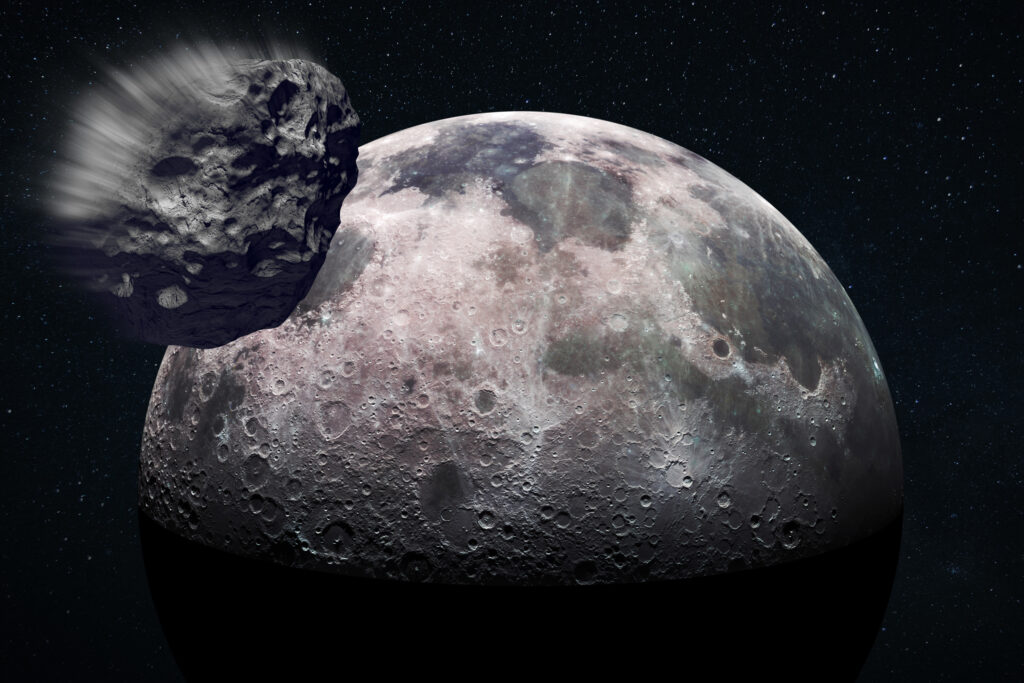
When people think of asteroids, they often imagine rare, catastrophic impacts like those depicted in blockbuster movies such as “Armageddon.” However, the asteroids most likely to affect modern society are much smaller. While kilometer-scale impacts occur only every tens of millions of years, decameter-scale (building-sized) objects strike Earth far more frequently: roughly every couple of decades. As astronomers develop new methods to detect and track these smaller asteroids, planetary defense becomes increasingly crucial for protecting the space-based infrastructure that supports modern life, from GPS navigation to global communications.
The good news for us earthlings is that a team of MIT researchers is on this space-case. Associate Professor Julien de Wit, Research Scientist Artem Burdanov, and their colleagues have developed a new asteroid-detection method that could track potential asteroid impactors and help protect our planet. They have applied this technique to the James Webb Space Telescope (JWST), demonstrating that JWST can detect and characterize decameter-scale asteroids all the way out to the main belt, a crucial step in fortifying our planetary safety and security. De Wit and his colleagues recently co-led with Andrew Rivkin PhD ’91 new observations of an asteroid called 2024 YR4, which made headlines last year when it was first discovered. They determined that the asteroid will not collide with the Moon, which could have had impacts on Earth’s critical satellite systems.
Redefining Planetary Defense
De Wit, Burdanov, Assistant Professor Richard Teague, and Research Scientist Saverio Cambioni spoke to MIT News about the importance of planetary defense and how MIT astronomers are helping to lead the charge to ensure our planet’s safety.
What is Planetary Defense and How is the Field Changing?
Burdanov explained that planetary defense is a field of science and engineering focused on preventing asteroids and comets from hitting the Earth. Traditionally, the field focused on much larger asteroids, but thanks to new observational capabilities, it is expanding to include monitoring much smaller asteroids that could also have an impact.
De Wit added, “When people think about asteroids, they tend to think of impacts along the lines of these rare, civilization-ending ‘dinosaur killer’ asteroids—objects that are scientifically fascinating but, happily, statistically unlikely on human timescales. But as soon as you move to smaller asteroids, there are so many of them that you’re looking at impacts happening every few decades or less. That becomes much more relevant on human timescales.”
Now that society increasingly relies on space-based infrastructure for communication, navigation technologies like GPS, and satellite-based security systems, different populations of smaller asteroids could have significant consequences. These smaller asteroids may lead to zero direct human casualties but could severely impact our space infrastructure. Because they are smaller, they require different technologies to monitor and understand them. At MIT, researchers are working to redefine planetary defense to focus on these smaller asteroids that could have real consequences. In essence, planetary defense is no longer just about avoiding extinction-level events; it is about protecting the systems we depend on in the near term.
The Role of the James Webb Space Telescope
Why are Observations with Telescopes like JWST So Important?
Teague emphasized that we are entering a time where large-scale sky surveys will produce an incredible amount of data. MIT is developing a framework to sift through that data quickly and efficiently, using resources like the MIT Haystack and Wallace Observatories to follow up on potential threats as quickly as possible and determine whether they could be problematic.
“We’ve been doing trial observations to try and piece together how fast we can do this. The challenging thing is that the smaller objects we’ve been talking about, the decameter ones, are really hard to detect from the ground. They’re just so small, and so that’s why we really need to use space-based facilities like JWST to help keep our planet safe,” Teague explained. “JWST is just incomparable for detecting these very small, faint objects. A lot of our work at MIT is trying to understand how to build that entire pipeline—from detection to risk assessment to mitigation—under one roof to make it as efficient as possible.”
According to Cambioni, an “asteroid revolution” is on the horizon. In addition to JWST’s capabilities, the new Vera Rubin Observatory in Chile could increase the detection of known small objects in space by a factor of 10. However, this observatory may lose many objects it detects, which is where MIT’s work comes in to follow and map these objects as soon as possible. Cambioni noted that Vera Rubin only looks at reflected light and doesn’t provide a precise estimate of an asteroid’s size, highlighting a fundamental problem in asteroid science: the gap between detection and characterization.
Looking Forward
As MIT continues to pioneer advancements in asteroid detection and characterization, the future of planetary defense looks promising. The integration of cutting-edge technology and collaborative expertise at MIT is setting a new standard for how the world approaches the protection of our planet from cosmic threats. With the potential for increased detection capabilities and more efficient data processing, the hope is that humanity will be better prepared to handle the challenges posed by smaller asteroids, ensuring the safety of our vital space-based infrastructure.
The move represents a significant step forward in planetary defense, emphasizing the need for continued innovation and collaboration in the field. As the world becomes more interconnected and reliant on space technology, the importance of safeguarding our cosmic neighborhood becomes ever more critical.