


Paul Deacon jokes he “still has nightmares” about it every time he walks the dog. But Michael Maguire’s pre-season training sessions in 2010 were no joke, and the ones at Haigh Hall, just around the corner from where Deacon lives, were particularly infamous.
Pat Richards, the Tigers’ 2005 premiership hero who also played 244 games for Wigan between 2006 and 2013, remembers the very first session he had under Maguire at Haigh Hall. It was the start of the 2010 pre-season. Maguire, who did his coaching apprenticeship under Craig Bellamy in Melbourne, was taking over from former Great Britain coach Brian Noble.
The Warriors players knew that he’d been the assistant coach at the Storm, but outside of that? “I suppose no one really knew who Madge was,” Richards said, while Sean O’Loughlin, whose legendary career at Wigan spanned more than 450 games and 19 years, admitted Maguire was “a bit of an unknown to us”.
The Grueling Pre-Season
What they ended up getting was a pre-season which Deacon described as “horrific”. “It was probably the hardest thing I’ve ever done without a shadow of a doubt,” he said. Deacon recalled doing eight weight sessions a week and running “I don’t know how many kilometres a week as well”.
But he can remember the exact number of kilometres — five — he and the rest of the Wigan players were made to run through the forests surrounding Haigh Hall during that first training session under Maguire. He remembers how many minutes they had to rest too. Only five. And once those five minutes were over? Another five kilometres.
“Madge was there watching us hiding in the bushes and things like that,” Richards laughed. “The boys were absolutely cooked.”
After those extra five kilometres were done, they then went straight into a wrestling session. “I just remember from the very first session that we did, everyone just realised that a level had just gone up and it’s either you go along with it or you get left behind,” Richards said.
The Cultural Shift
Maguire was Wigan’s 11th coach since the switch to a summer Super League in 1996, which also marked the end of a dominant stretch which saw the Warriors win the Challenge Cup every season from 1988 to 1995 while also doubling up with the past six Championships. Archrivals St Helens had usurped Wigan, who since 1996 won the Super League and Challenge Cup just once while losing three grand finals and two Challenge Cup finals.
The ultimate humiliation came in 2005 when St Helens won the Challenge Cup quarter-final against Wigan 75-0. “That was unheard of, like absolutely unheard of,” said James Graham, who played 238 games for St Helens. “They changed coaches, they brought in big name players but they just couldn’t seem to turn it around and then they go and sign this relatively unknown coach from Australia.”
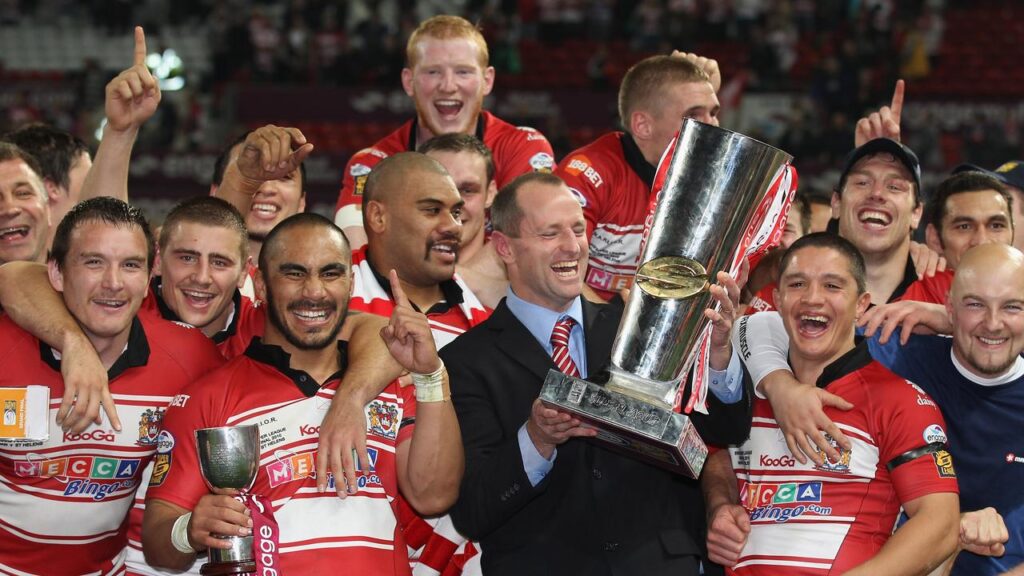
Within a year, that relatively unknown coach from Australia was at the centre of a sea of red, lifting the trophy at Old Trafford after taking Wigan to its first Super League title since 1998. “The turnaround was incredible really,” Graham said. But his impact was felt far beyond the four walls inside DW Stadium and now, as Maguire prepares to break another long-standing premiership drought, foxsports.com.au spoke to Wigan legends and his former right-hand man to understand the magic behind Maguire as a coach.
“He changed the culture of the club without a shadow of a doubt,” Deacon said. “The work ethic, the mindset, he transformed Wigan and in my opinion he transformed the game over here as well in England.”
The Power of Commitment
Ask Deacon for stories from his time playing under Maguire and he will tell you he could “go on and on”. But there is one that he said “will stay with me forever”. It was a wretched Wigan winter and Deacon couldn’t get his car out of the driveway. So, Sam Tomkins came to give him a lift. They then stopped to pick up Cameron Phelps, who also happened to live only a few minutes away.
But they didn’t end up making it to training that day. At least, in Tomkins’ car they didn’t. You see, they were going down the road and then the car suddenly started to skid in the snow, crashing into a garden wall. So, they knocked on the door and sorted it all out with the owner before calling Maguire to let him know they wouldn’t be able to make it to training.
“No word of a lie,” Deacon said. “He came around and picked us up and took us to training. There was no missing training with Madge.”
That may seem extreme. Sure, there are bound to be some excuses that simply aren’t good enough. But being in a car accident? Deacon said it was the one story that best “summed” Maguire up and in a lot of ways, you can see why. Yes, Maguire was intense. A “a strict disciplinarian” as Kris Radlinski, Wigan CEO and then Maguire’s right-hand man, put it.
Transforming Wigan and the Game
When Maguire was officially appointed head coach of Wigan in October 2009, he was taking over a team that had for too long suffered in the shadows of St Helens. Not that it had always been that way. Quite the opposite, in fact. There was once a period in the early 1990s when the Warriors were the kings of British rugby league, conjuring one of the most remarkable runs the sport had seen with eight consecutive Challenge Cup wins.
Tomkins, who scored a late try in 2010 to snuff out a late Hull KR comeback as the Warriors won the League Leaders’ Shield — their first trophy since 2002, hardly had any memories of such dominance. After all, he was only 13 when Wigan beat Saints in the 2002 Challenge Cup final.
“He really brought that defensive attitude to that Wigan side,” Graham said. “I remember there were a couple of what people would consider real first grade players for them that weren’t playing. The talk was they didn’t meet the defensive standard. It was too attack-focused. He was uncompromising, which is a big call to come over as an Australian and set that standard with some big-name players.”
But it was all about setting a culture, which is a word that is so commonly thrown around in the sports lexicon nowadays that it starts to lose all meaning, or at least lose its gravity. Culture wasn’t just some buzzword at Wigan, though. It meant something. It looked like something.
“Culture’s not always like fluffy and nice, sometimes the culture needs to change to, ‘Actually we need to work harder’, and he definitely brought that to Wigan,” Deacon said.
The Wrestling Revolution
Coming from the Storm coaching staff, Maguire brought with him an emphasis on the art of wrestling. Wrestling had always been a part of the game according to O’Loughlin, but it was something the players did only once a week and typically during the pre-season. Under Maguire, however, O’Loughlin recalls a two-week period where they barely touched the ball.
“We just did weights and wrestled,” he said.
The result wasn’t always the most attractive brand of football but it produced results, with Wigan making the fewest errors and missing the fewest tackles of any Super League team in their 2010 premiership-winning season under Maguire. Graham, who was playing for St Helens at the time, called Wigan “far and away the most drilled side” in the wrestling department while Deacon said the ruck in the Super League “changed” after Maguire left.
“Coming over here (from England to the NRL) you could close your eyes and you could know when you were involved in a Melbourne tackle,” Graham added. “The attention to detail, the positions that they put you in. More often than not you end up on your back which creates more time for them and less time for you. It was very much the same sort of feeling when you came up around a Madge Maguire Wigan side.”
Wigan won 11 of its first 12 games under Maguire to open the Super League season, demolishing the Crusaders 38-6 to open the year before following it up with a 32-6 win over Hull KR.
“I don’t think they knew what hit them in regards to the contact level and the wrestle,” Deacon said. “He brought in a style of football that blew the comp away his first year,” added O’Loughlin.
The Emotional Impact
By the end of the season, the Warriors were just one game away from their first trip to Old Trafford since 2003 and as was the case last week at Suncorp Stadium, standing in their way was the competition juggernaut. The three-time defending Super League champion Leeds Rhinos. It was going to require something special from Maguire, and what he did next stood in stark contrast to the intense disciplinarian he is so often painted as.
“When you see grown men in tears… it’s a pretty powerful sight,” Radlinski said.
The Warriors had been in this same position before. Three times to be exact, and twice against the same opponent. All three times they had fallen short. After the most recent of those losses, a 14-10 defeat to St Helens in 2009, Maguire’s predecessor Brian Noble confirmed what was at the time one of rugby league’s worst-kept secrets.
The loss would not only end Wigan’s season but also Noble’s 34 years at DW Stadium. His replacement had already been picked out too, with a press conference called for the following week to unveil the low-profile Maguire as the man to restore Wigan to its previous heights.
He did just that in the regular season but by the time finals rolled around, it looked like the Warriors were going to fall at the same, all-too-familiar hurdle. Wigan lost to Leeds 27-26 in the qualifying playoff and, in the process, had surrendered home ground advantage for the semi-final rematch with the Rhinos.
Maguire could have gone back to the training paddock; back to the forests surrounding Haigh Hall and back to the persistent pursuit of perfection. But he didn’t need to. His work was already done. What this team needed wasn’t more kilometres or more push-ups. Instead, all they needed was to understand why.
Why they were here and why this wasn’t going to be like the last three years. So, Maguire took them to Edge Hall Road, the training ground in nearby Orrell which was initially built to serve the local rugby union team in 1950 before later being used for training and Wigan Academy games in the late 2000s.
“There was an old changing room,” Radlinski recalled. “It was cold and damp and nobody wanted to go in there.”
So, naturally that is where Maguire held the team meeting at the start of the week. But this wasn’t like any other team meeting. He had each of the players telling each other how much it would mean to win and then when they were finished, Maguire had them write their biggest dream on a piece of paper.
All those pieces of paper, along with the hopes and dreams they carried, were then burned and put in a little silver box. Then, the night before the semi-final at Leeds, Radlinski managed to talk the groundsman into letting him and the team onto the field at Headingley Stadium, where they opened the silver box with all the ashes.
“And every player got a handful and sprinkled it on Headingley,” Radlinski said. “This was all Madge’s brainchild, his storytelling of committing to each other and it had a profound impact on the group and the lads still talk about this meeting. When you see grown men in tears saying how much it means to them, it’s a pretty powerful sight.”
The following day Wigan ended Leeds’ hopes of a fourth-straight Super League title with a 26-6 victory, qualifying for the club’s first grand final since 2003. “Madge is really good the bigger the game is,” Richards said. “He knows how to really bring the emotion into the game and work out why you’re playing the game and who for. You just feel unbeatable when you’re in an environment like that.”
And unbeatable the Warriors were, crushing archrivals St Helens the following week to claim their first Super League title in 12 years. It capped off a fairytale first season for the team under Maguire. He had already been named Coach of the Year. Richards, meanwhile, was the Man of Steel and Tomkins — dazzling as the yellow boots he famously wore — was crowned Young Player of the Year.
“You couldn’t have asked for anything better from the players,” Maguire said after the game. “The commitment they have put in right throughout the year and what they showed tonight. It tells a story about the team.”
But it also told a story about the coach. A coach who was intense, who was tough, who was hard-nosed. That was just one side of Michael Maguire though. There was the Michael Maguire who was, as Deacon put it, “a different character when the work had been done”. The Michael Maguire who was a “good family man” and “loved a beer”.
“He’s a pretty stern figure,” added Radlinski. “And when you’re seeing some of his interviews he doesn’t give much away. But once you get to know him, I’ve had some of the absolute nights of my life with him because once you’re in his trusted circle then he’ll run through a brick wall for you.”
And by the end of his first season in charge, any of those players inside the “cold and damp” changing room at Edge Hall Road would have been willing to do the same.
Legacy and Future Prospects
Just six months later Maguire confirmed he would be leaving Wigan to coach the Rabbitohs and within a few years, he ended South Sydney’s 43-year premiership drought. Now, he has become the first coach to take the Broncos to a grand final in his maiden season in charge while he could become just the sixth coach to win a title with multiple NRL clubs.
Wigan, meanwhile, plays in the Super League grand final next week after booking its spot in the decider with a 18-6 win over Leigh Leopards on Saturday. It means there is still a very real chance that Deacon and O’Loughlin, who now work as assistant coaches at Wigan, could face their former mentor in the 2026 World Club Challenge.
Not that they need a reason to reminisce on all those memories — both and good — from playing under Maguire. While Maguire’s phone has probably been blowing up this week, there is one particular WhatsApp group chat that was being flooded with new messages. It was the one the Wigan players created in 2010 and Maguire is still in it.
“Someone tends to rip Piggy Riddell about army camp now and again,” O’Loughlin laughed.
But more recently there have been messages of support, along with plenty of stories re-told. “It must be really heartwarming for him,” Radlinski said. “As a coach who’s opted