




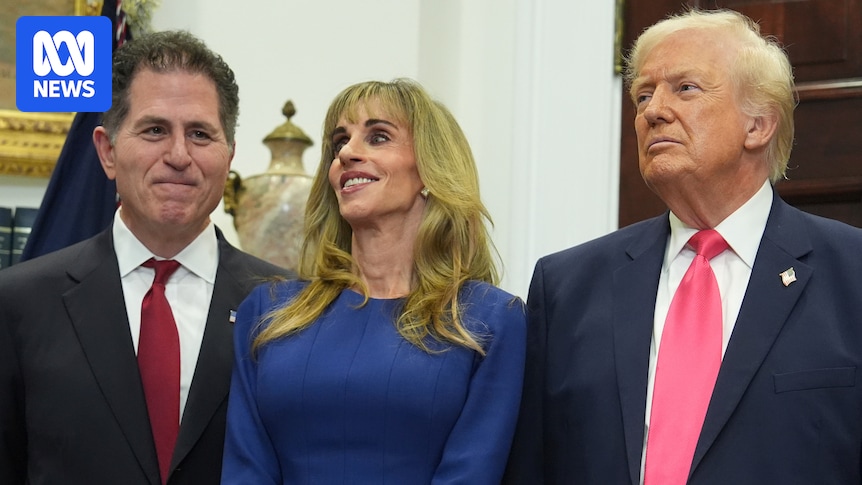
Tech billionaires Michael and Susan Dell have announced a groundbreaking donation of $9.5 billion to fund new investment accounts for children, known as “Trump accounts.” This substantial pledge will be distributed as individual investments of $250 to 25 million children, marking one of the largest single charitable commitments in recent decades.
The Dells’ donation comes as part of a broader initiative under the “One Big Beautiful Bill Act,” spearheaded by former President Donald Trump. This act aims to provide tax-deferred investment opportunities for children under 18, with funds earmarked for future use in education, housing, or entrepreneurship.
Understanding Trump Accounts
Trump accounts were established to allow parents to open tax-deferred investment accounts for their children. Contributions to these accounts are required to be invested in an index fund that mirrors the overall stock market. Once account holders reach the age of 18, they can access the funds to support significant life expenses such as education, a home deposit, or starting a business.
The U.S. Department of Treasury plans to seed these accounts with an initial $1,000 for American children born between January 1, 2025, and December 31, 2028. Assuming a 7% annual return, this initial government contribution is projected to grow to approximately $3,750 by the time it can be accessed.
The Trump Accounts, although legislated in July, are scheduled to officially launch on July 4, 2026.
The Dells’ Generous Contribution
Michael and Susan Dell’s donation is designed to complement the Trump accounts program by targeting a slightly older demographic. Their funds will be directed toward children aged 10 and under who reside in areas where the median family income is $150,000 or less, and who fall outside the government’s eligibility window for the initial seed money.
In a statement, Susan Dell expressed their enthusiasm, saying, “We’re thrilled to be spearheading this in the philanthropy sector and are so excited because we know that more people are going to jump on board because really, we can’t think of a better idea and better way to help America’s children.”
Reception and Criticism
Proponents of the Trump accounts argue that they democratize access to the stock market, potentially allowing even children from disadvantaged backgrounds to benefit from long-term investment growth. They believe that the program could counteract the rising popularity of socialism by providing more individuals with opportunities to build wealth.
However, critics have voiced concerns that the accounts may exacerbate existing economic disparities. Wealthier families capable of maximizing pre-tax contributions stand to gain the most, while those unable to contribute may see minimal benefits. Amy Matsui, vice-president of income security and childcare at the National Women’s Law Center, criticized the policy as “another tax shelter for the wealthiest,” arguing that it fails to address the immediate needs of struggling families.
“If the White House were serious about supporting families struggling with the costs of living, it would be advocating for investments in child care, an expanded Child Tax Credit, and undoing the historic cuts to SNAP and Medicaid,” Matsui stated.
These sentiments echo broader criticisms that the accounts do little to mitigate the impact of funding cuts to essential programs like food assistance and Medicaid, which have been implemented by the Trump administration.
The Philanthropic Legacy of the Dells
Michael Dell, the founder, chairman, and CEO of Dell Technologies, ranks as the 11th richest person globally, with a net worth estimated at $148 billion. Alongside his wife, Susan, the Dells have a long-standing history of philanthropy, having donated a lifetime total of $2.85 billion to various children’s causes as of 2024.
Their latest contribution places them among the ranks of other tech billionaires who have made significant charitable donations. Bill Gates and Melinda French Gates, for instance, have given $47.7 billion to charity, while MacKenzie Scott has donated $19.25 billion to non-profits focused on education, housing, and economic equity.
Meanwhile, Mark Zuckerberg and Priscilla Chan have shifted their philanthropic focus toward science and artificial intelligence, contributing a combined total of $5.1 billion over the years.
As the Dells’ donation sets a new benchmark in philanthropic giving, it remains to be seen how this initiative will influence future charitable endeavors and the broader landscape of wealth distribution in America.