

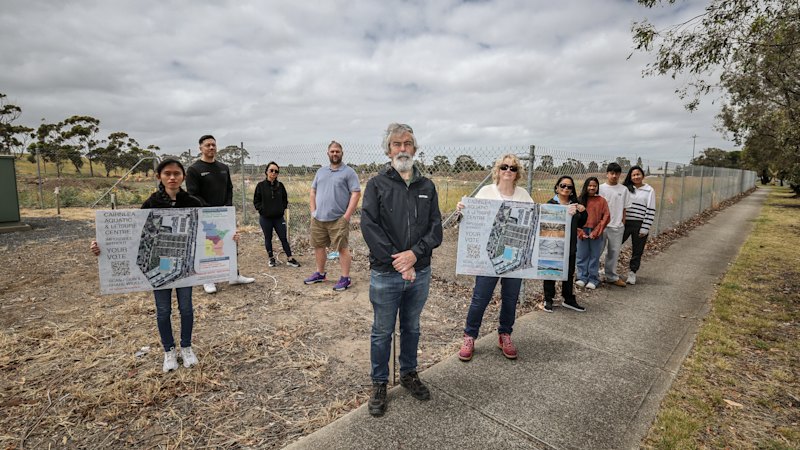
A proposed housing development in Melbourne’s west has sparked an uproar among local residents, who are urging the state government to reconsider plans for a 500-home estate near two gaming pubs. The development, slated for a 41-hectare site at the intersection of the Western Ring Road and Ballarat Road in Cairnlea, has attracted a petition with over 2,100 signatures.
Originally intended as a business precinct, the site is now earmarked for residential development by Development Victoria, which promises new playgrounds, green spaces, and some affordable housing options. However, the proximity to two pubs with electronic gaming machines has raised concerns among locals about the lack of other amenities.
Community Concerns Over Amenities and Infrastructure
Residents argue that the development lacks essential community facilities. Graeme Blore, a community advocate, emphasized the need for meaningful parks and social infrastructure, warning that without these, the area risks becoming a “dormitory suburb” with little to offer beyond housing.
“You can’t just put homes into an estate and call it an estate,” Blore said. “You have to provide meaningful parks, social, recreational and community facilities; otherwise, it’s simply another dormitory suburb with 500 doors.”
The draft plan for the development’s first stage is currently under review by Planning Minister Sonya Kilkenny, with land sales potentially starting this year and construction beginning between 2027 and 2028.
Petition for Recreational Facilities
The petitioners are advocating for an indoor multipurpose recreational facility, complete with a pool, parks, and sporting fields. The nearest public swimming pools are 25 to 45 minutes away by bus, and residents report that these facilities are often overcrowded and difficult to access due to unreliable public transport.
Blore, who lives near the proposed site, is not opposed to the housing but insists on the inclusion of sporting facilities to serve as a buffer between the homes and the pubs. He also calls for transparency regarding the housing layout and a commitment to substantial parkland.
“My great concern is … in the absence of basically anything else for the community, that people actually look at the pokies and go, ‘Might as well go there and have some fun – we’ll just have a flutter,'” he said.
Economic and Social Implications
Brimbank, the local council area, records the highest electronic gaming machine losses in Victoria, with over $98,000 lost daily at the two pubs near the site. Cairnlea resident Sara Roca expressed concerns about increased traffic and limited local amenities, noting that it already takes her over 20 minutes to leave the area during peak hours.
The area, once home to the Albion explosives factory, has been transformed into a residential zone with 3,100 homes, a shopping center, and open spaces. The new proposal targets the last available parcel of land in Cairnlea, which is the farthest from existing amenities.
Expert Opinions on Development Needs
Dr. Weijie Hu, a senior lecturer at Swinburne University specializing in affordable housing, highlighted the necessity for adequate facilities and public transport access in new developments. He stressed the importance of creating livable neighborhoods with sufficient social infrastructure to prevent reliance on gambling venues as social hubs.
“The thing is, we cannot just build houses; we also need to provide enough infrastructure and social facilities to make that neighborhood more livable,” Dr. Hu said. “If there is not enough open space or social infrastructures, many people will have to go to those gambling venues – that becomes their social venues.”
Local Government and Future Plans
In June 2025, the planning minister assumed responsibility for the development, a move intended to streamline housing approvals but which has concerned Brimbank Council. Mayor Virginia Tachos advocates for local control, emphasizing the council’s role in ensuring the development meets community needs.
The development plan has already been revised following community feedback, reducing the number of homes from over 800 to 500. Development Victoria is required to contribute financially to local infrastructure, and the planning strategy is being finalized to comply with council regulations.
Development Victoria’s acting executive general manager, Nemesia Kennett, assured that the community would be kept informed as the site is remediated, with plans to integrate a network of open spaces. A Victorian government spokesperson echoed the commitment to providing more housing close to jobs, schools, and essential services.
The campaign against the development has gained traction with support from Paul Hopper, founder of the West Party, who has funded advertising efforts. As the situation unfolds, residents and local officials continue to push for a development that aligns with the community’s vision and needs.