

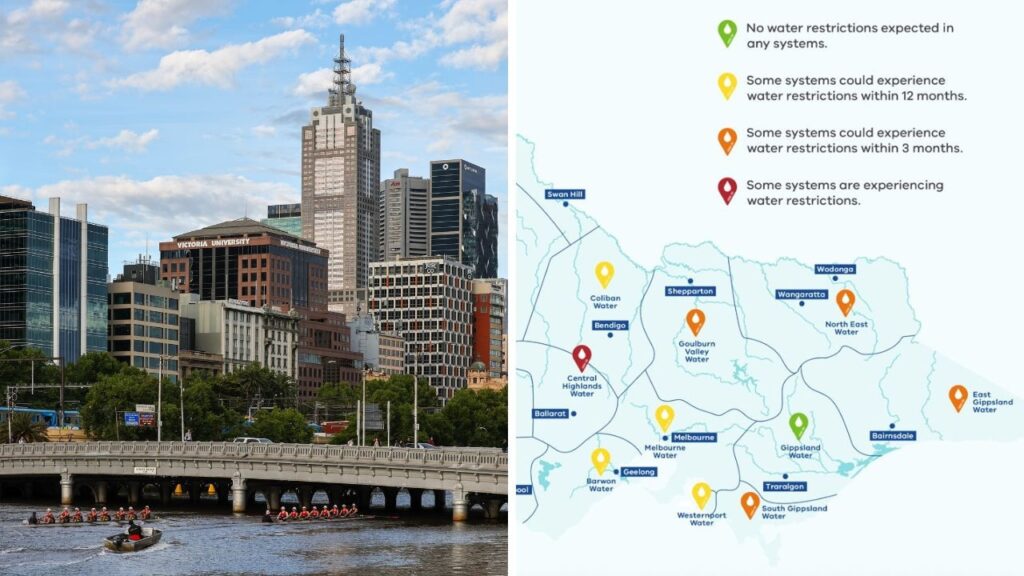
Melbourne is on the brink of a significant water crisis as population growth and the rise of data centers push the city’s water supply to its limits. According to the Victorian government’s Annual Water Outlook, much of the state experienced lower-than-average rainfall in 2025, leading to historically low water reserves. This month, major storage facilities across Victoria were only 61 percent full, a stark contrast to the 80 percent capacity recorded at the same time in 2024.
The situation is particularly dire in Melbourne, where water storage is at 76 percent capacity, trending 12 percent lower than last year. The government has ordered 50 billion liters of desalinated water from the Victorian Desalination Plant to mitigate the shortage. However, even with the desalination plant operating at full capacity, Melbourne and Geelong could face severe water restrictions in 2026 if dry weather persists.
Population Growth and Data Centers Intensify Demand
The water crisis is exacerbated by a surge in population and the expansion of data centers. Following a population decline during the COVID-19 pandemic, Victoria is rebounding with a net gain of 123,000 people in the year to June, primarily from overseas migration. Melbourne, now home to 5.4 million people, is growing faster than Sydney in percentage terms.
Compounding the issue is the proliferation of data centers, which are crucial for supporting artificial intelligence applications like ChatGPT. These centers consume vast amounts of water for cooling, with most of it evaporated in the process. While some facilities use closed-loop systems that do not rely on local water supplies, they remain the exception.
In July, Greater Western Water reviewed 19 data center applications that could collectively use almost 19 billion liters of water annually, equivalent to the usage of 330,000 Melburnians.
Saul Kavonic, head of energy research at MST Macquarie, commented on the situation, stating, “Policy makers appear to have not adequately planned for rising water demand from population growth, let alone new demand from data centers.”
Exploring Solutions to the Water Crisis
The Annual Water Outlook highlighted that Melbourne’s residents and businesses used 500 billion liters of water over the last financial year, while the city’s storages received only 305 billion liters of inflows. With daily water consumption rising to 169 liters per person, the highest since 2007, the pressure on water resources is mounting.
Water Minister Gayle Tierney has proposed a Water Security Plan, supported by an expert task force, to address the crisis. One option under consideration is an $840 million expansion of the Victorian Desalination Plant, which could add 50 billion liters to the system. However, the Allan government has yet to commit to this upgrade.
Oxford Economics Australia predicts the desalination plant expansion could start in 2030 and finish by 2034.
Alternative Approaches and Expert Opinions
Not everyone agrees that expanding desalination is the best solution. Tim Fletcher, a professor of urban ecohydrology at the University of Melbourne, advocates for more sustainable approaches. “There’s not a shortage of water, it’s just about using it effectively,” he said, emphasizing the potential of harnessing stormwater and wastewater.
Desalination is costly and energy-intensive, requiring significant electricity from an already strained grid. In contrast, stormwater management is cheaper and addresses issues like erosion and flooding. Fletcher suggests building data centers near recycled wastewater sources to reduce their water footprint.
“Political governments tend to have a preference for single, simple solutions where they can just sign off on a contract – but that’s certainly not the best approach here,” Fletcher noted.
Looking Ahead: The Path to Sustainability
The water crisis in Melbourne underscores the need for comprehensive planning and investment in sustainable water management. As the city continues to grow, balancing the demands of population, industry, and technology will be crucial to ensuring a stable water supply.
With the task force exploring various solutions, the focus remains on finding a viable path forward that addresses immediate needs while laying the groundwork for long-term sustainability. The decisions made today will shape Melbourne’s resilience to future water challenges and its ability to thrive in a rapidly changing world.