Melbourne’s City Square, long considered an eyesore, is set to reopen this Sunday after an extensive transformation, coinciding with the much-anticipated opening of the Metro Tunnel. This redevelopment aims to revitalize the public space, which has been closed for eight years, and turn it into a vibrant gathering spot for the city’s residents and visitors.
Craig Guthrie, principal landscape architect and urban designer for the Metro Tunnel project at Hassell, expressed optimism about the square’s new role. “There is the new station entry, quite a grand station entry, which you can already see now,” he stated. “The rest of the square will be a new community space for events, informal and formalized events, with lots of seating around the edge to look into.”
Revitalizing a Historic Space
The transformation of City Square involves significant changes, including the removal of the Burke and Wills statue, which is now in storage with plans to relocate it to the Royal Society of Victoria on La Trobe Street. This move signals a shift towards highlighting First Nations history within the square.
Guthrie noted, “The previous designs of the City Square have been very colonial, so this will be giving a completely fresh outlook about the history it’s expressing.”
Mel Dodd, dean of art, design, and architecture at Monash University, described the space as “a bit of a sad square” in its previous form. She hopes the influx of people using the Metro Tunnel will inject new life into the area. “Providing the function of a transport interchange gives it some functionality that I think civic spaces often need,” she explained.
Modern Design Meets Historical Context
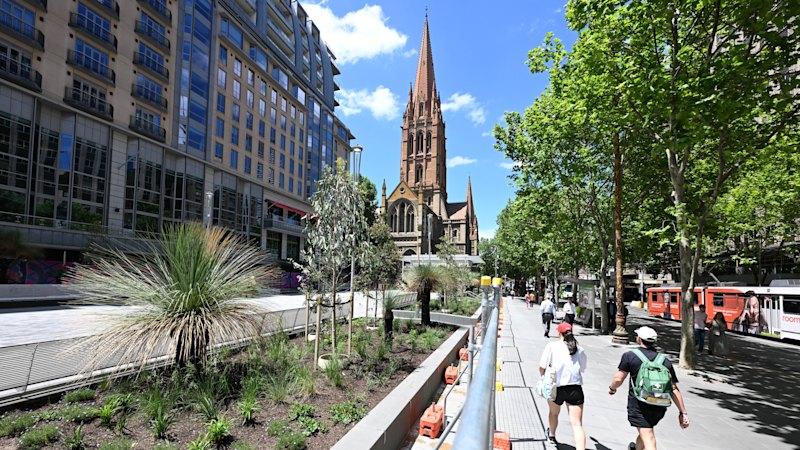
The newly unveiled City Square features a large canopy with a white slatted roof over the entrance to the new Town Hall station. Familiar elements like the Mockridge fountain have been replaced by a digital artwork that mimics cascading water with waves of digital lights. The statue of Burke and Wills, along with the Brunetti cafe, are no longer present.
Retail spaces along the Westin hotel remain boarded up, but the square now includes a smoking ceremony dish developed with Wurundjeri elder Aunty Joy Wandin Murphy. Around the station entrance, Wurundjeri text is carved into stone, with an English translation: Wominjeka Kirrip, Welcome Friends.
“It’s like a little lung for Swanston Street and Collins Street, it’s a gap, you can have a breather,” said Dodd. “It’s not rocket science. It’s just about people having a reason to dwell and to sit down and to enjoy a moment of respite in what is otherwise just an urban grid with trams and cars and so on.”
Community Engagement and Future Prospects
Southbank resident Tina Kuang, who has observed the construction over the years, expressed her amazement at the completed project. “I’m quite amazed, especially the modern building’s link with the church,” she remarked. “You see the history and the modern city combining.”
The square’s design includes a “square beneath a square” concept, with shops and food outlets like Brunetti Oro cafe, Sushi Jiro, McDonald’s, Starbucks, KFC, and an IGA supermarket housed in a two-tiered concourse. This setup is expected to draw significant foot traffic, enhancing the square’s role as a central hub.
A surprise concert featuring Jimmy Barnes, Kate Ceberano, and Ian Moss provided a sneak peek into the new space. Premier Jacinta Allan announced the event on social media, describing it as “live and free at Metro Tunnel’s new City Square.”
“It’s like the square now belongs to the Metro Tunnel, which shifts the whole hierarchy,” commented Rory Hyde from the University of Melbourne. “Does it just become a kind of foyer to the train, rather than a space of democracy or protest or speeches or coming together, which is what a really important city square should do.”
A New Chapter for City Square
Transport Minister Gabrielle Williams described the redevelopment as “a serious glow-up” for City Square, emphasizing its greener and more welcoming atmosphere. The square’s history is relatively recent, having been retrofitted into Melbourne’s urban landscape in 1968, after surveyor Robert Hoddle’s original 1837 design deliberately omitted a central square to avoid spaces for mass protest.
Opened by Queen Elizabeth II in 1980, the square has undergone various transformations, including a controversial reduction in size to discourage demonstrations. Despite past criticisms, the latest iteration of City Square aims to embrace its role as a community-focused space.
As Melbourne prepares for the official opening of the Metro Tunnel, the revamped City Square stands ready to welcome visitors, offering a blend of historical reflection and modern functionality. The next steps involve integrating the square into the daily life of the city, ensuring it serves as a vibrant and inclusive public realm.