



Janae Dingaoyo’s twin boys weighed barely a pound each when they were born at just 23 weeks—tiny, fragile, and struggling to breathe. But Janae and her husband, Jon, had a formidable advocate: the Duke Children’s Neonatal Intensive Care Unit.
Akenji was born first, one pound, four ounces; Asanti followed two minutes later and three ounces heavier. They would spend about six months in that NICU, a journey marked by progress and potholes alike. At two months, Asanti needed a delicate, non-invasive surgical procedure to close a hole in his heart. Later, both were successfully treated for a problematic eye disease.
Through it all, the team of nurses kept the Dingaoyos hopeful. “They treated our babies like they were their babies,” Janae said. “They gave us the motivation and confidence that we could do it.”
From Fragility to Flourishing
Now pushing two years old, the boys are thriving. Akenji is giggly and energetic with a mischievous grin. Asanti is more calm; he loves to cuddle and be tickled. And like most siblings, they get along. Sometimes.
“I’ll catch a small moment when they’re playing with a toy together or are chasing themselves up the hallway and it’s the cutest thing ever,” Janae said.
The announcement comes as Duke University continues to be a beacon of hope for families facing medical challenges. The institution’s commitment to cutting-edge research and patient care is evident in stories like that of Sabrina Lewandowski.
A New Lease on Life
At just 30 years old, Sabrina Lewandowski woke up with a severe headache caused by an aggressive brain cancer that should have killed her. Instead of sending her home without options, physicians at the Preston Robert Tisch Brain Tumor Center at Duke offered her a plan—and hope.
Under the care of neuro-oncologist Dr. Henry Friedman, Lewandowski received an experimental treatment that rotated different chemotherapy drugs instead of relying on one. This approach aimed to outsmart her fast-growing tumor. More than a year of this chemotherapy, combined with radiation, extended her life well beyond expectations.
Now, 23 years later, Lewandowski is alive and well, living in Raleigh with her husband and daughter. Her experience opened her eyes to the critical role of medical research, and she now volunteers with Angels Among Us, a fundraiser supporting brain tumor research at Duke. “I’m very blessed every day but I don’t want to think like I beat it, because I don’t know that I did,” she said. “But having a baby, getting married, being able to work, I’m very blessed and every day I appreciate it. Every single day.”
Vision Restored, Freedom Regained
For the first few years, retirement was everything Yvette Crawley had envisioned. But then, the world started going dark. She was diagnosed with macular telangiectasia type 2, or MacTel, a retinal disorder that causes slow vision deterioration. Crawley, who loves to hit the road camping with Triela, her Bichon/Yorkie mix, felt the walls closing in. She feared a future where she wouldn’t be able to drive, explore, and live fully.
There was no treatment until the FDA approved a new therapy in March 2025 after clinical trials that included Duke. Soon after, a Duke Eye Center team implanted a capsule about the size of a grain of rice into her eye that significantly slowed the degeneration. Crawley’s procedure was the first of its kind at an academic medical center, and the first in the state and region. And it changed her life.
“The ability to pivot, to make choices, to continue to grow regardless of what my age is—I do not want limitations,” she said. “I don’t want to not be able to go to exercise class or church or bible study because I can’t drive my car. This empowers me to make whatever choices I want in my retirement.”
Defying the Odds
Creed Kolasa was just six months old when diagnosed with Duchenne muscular dystrophy (DMD), an aggressive disease that leaves most children unable to walk by about age 12. Doctors offered Creed little hope. “They told me to just take him home and love him,” said Creed’s mother, Jessica. “They had no solutions.”
But Duke did. People with DMD have low amounts of a protein that holds muscle together in the body. Sometimes, they have none. A new treatment being developed promised to try and restore this protein. Creed joined a clinical trial and has thrived under the care of his team at Duke Children’s Hospital.
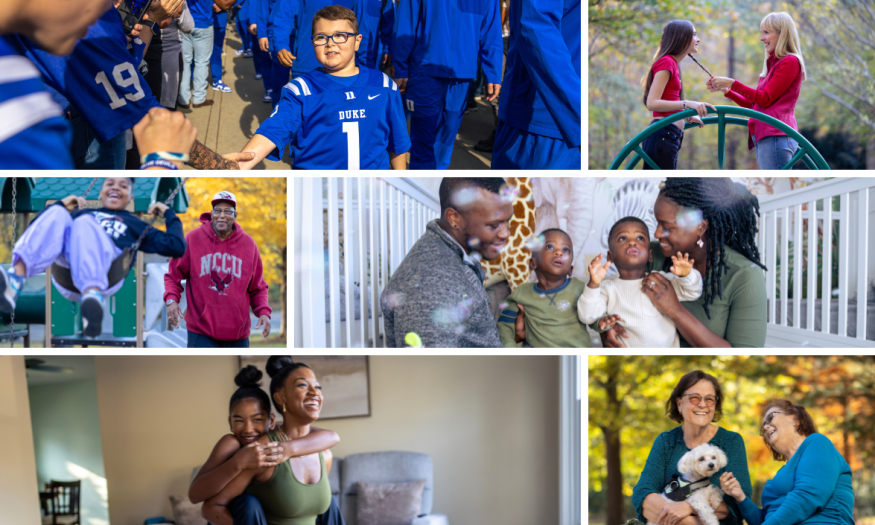
Creed is 13 now and doing great. He walks on his own, goes to school, plays video games, and loves to travel. He still receives the weekly drug infusions that have changed his life. The Kolasa family—Creed’s parents, three siblings, and dog Ranger—live in Fayetteville but often make the roughly two-hour drive north to Durham. Sometimes it’s for treatment; other times it’s to cheer on Duke football, which Creed became a part of as an honorary member.
“He’s very witty and funny,” Jessica Kolasa said. “He can light up a room. And he loves to talk smack about his sports teams.”
Innovative Treatments and New Beginnings
The chemo wasn’t working on Alfonzo Grafton’s lung cancer. He was fading. It took a Duke Cancer Institute clinical trial funded by the National Institutes of Health to turn things around. The medication targeted a protein that put the brakes on his body’s ability to fight the tumor.
He was the first of 60 patients to receive the drug, and it worked wonders. Grafton’s body reacted so positively to the medication that his doctor called him a “super responder.” “I felt like I was living again,” said Grafton, a Durham native thankful to be able to keep spending time with his family. “I had my life back.”
These stories underscore the transformative power of medical research and innovation at Duke University. As these individuals continue to thrive, their journeys offer hope and inspiration to countless others facing similar battles. The move represents a significant milestone in the ongoing quest to improve patient outcomes and quality of life through cutting-edge medical interventions.