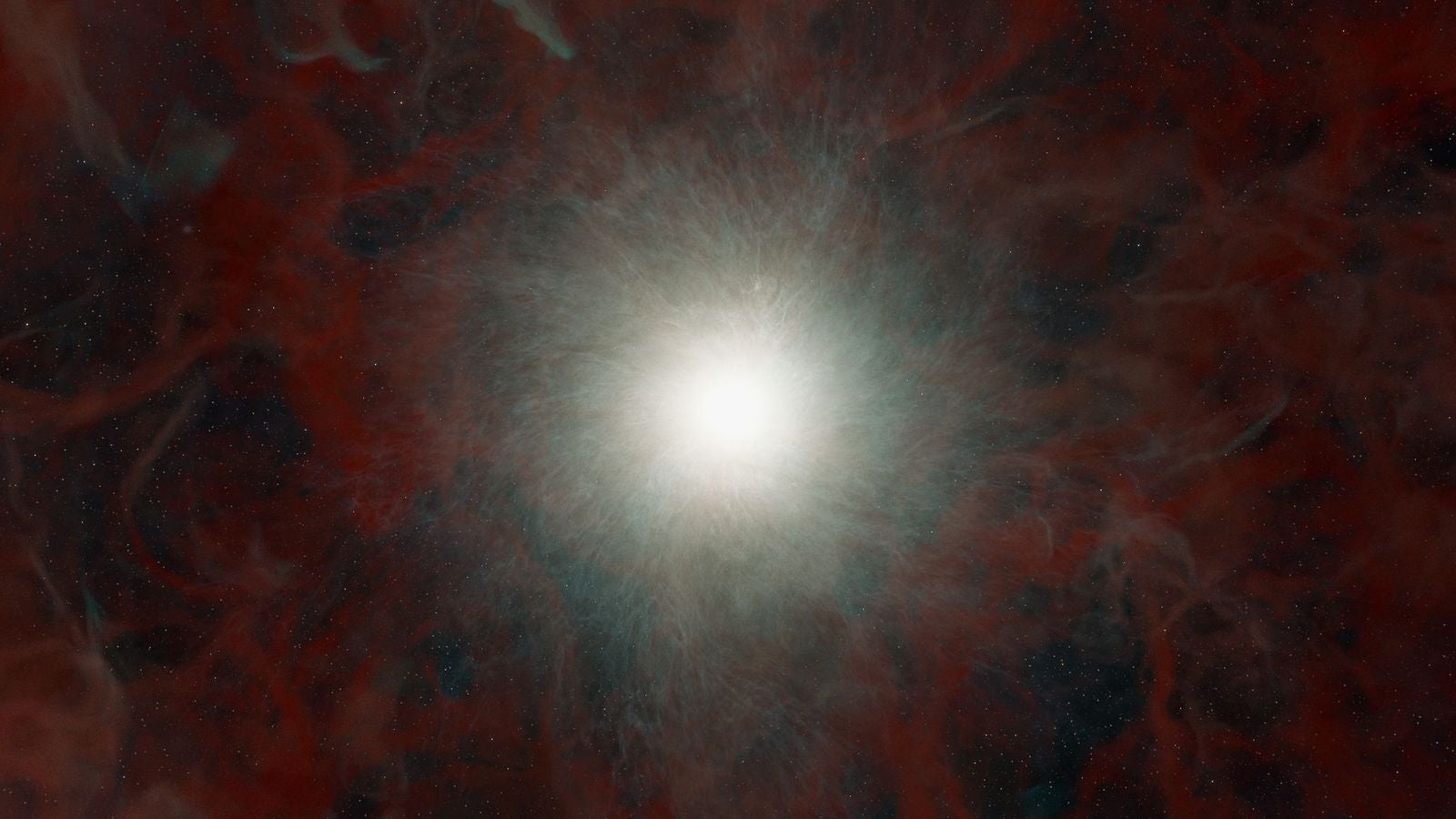




In a groundbreaking astronomical event, a massive star in the nearby Andromeda Galaxy has vanished, not in the fiery spectacle of a supernova, but quietly, leaving behind a black hole. The star, known as M31-2014-DS1, was once bright enough to be a standout feature of the galaxy, located approximately 2.5 million light-years away. This phenomenon was tracked by Kishalay De from the Simons Foundation’s Flatiron Institute, utilizing data from NASA’s NEOWISE mission and a plethora of ground and space telescopes. Their findings, published on February 12 in the journal Science, reveal a new perspective on stellar evolution.
The disappearance of M31-2014-DS1 was not immediate. In 2014, the star experienced a 50 percent increase in mid-infrared brightness over two years, only to fade below its original brightness by 2016. By 2023, it had effectively vanished from visible light. This unusual sequence of events suggests the star’s core collapsed into a black hole without the typical supernova explosion.
The Vanishing Act of M31-2014-DS1
Optical surveys conducted between 2016 and 2019 showed the star dimming by a factor of about 10,000. Follow-up imaging in 2023 with the MMT Observatory failed to detect the star in optical wavelengths. Data from the Hubble Space Telescope in 2022 showed no sign of the star in one optical filter, with only a faint presence in the near-infrared. Observations with the Infrared Telescope Facility and the Keck telescopes confirmed a dim red remnant in near-infrared bands.
Currently, the star is visible only in mid-infrared light, glowing at about one-tenth of its former brightness. Kishalay De remarked, “This star used to be one of the most luminous stars in the Andromeda Galaxy, and now it was nowhere to be seen.”
When a Supernova Fails
Typically, massive stars end their life cycles with a supernova, an explosion that occurs when the star’s core collapses after exhausting its nuclear fuel. However, in the case of M31-2014-DS1, no such explosion was detected. The star’s energy output decreased steadily, with no compensatory increase in infrared emission, indicating that nuclear fusion had ceased.
The researchers concluded that M31-2014-DS1 experienced a “failed supernova,” where most of the star’s mass collapsed into a black hole. Andrea Antoni, a Flatiron Research Fellow and co-author, explained, “The accretion rate — the rate of material falling in — is much slower than if the star imploded directly in.” This slower process results in a prolonged dimming period, making the event observable over decades.
A Dusty Shroud and Broader Implications
Archival data indicated that the star was a supergiant, with a luminosity about 100,000 times that of the Sun and an effective temperature near 4,500 kelvin. Surrounded by a dusty shell, the collapse resulted in only a small fraction of the outer envelope being ejected. The weak shock energies observed were significantly lower than those typical of supernova explosions.
The material that escaped cooled and formed dust, with models suggesting about 0.1 solar masses of gas were ejected. This process, shaped by convection within the star, involved turbulent motion carrying angular momentum, causing some material to orbit the black hole before accreting.
The research team also revisited NGC 6946-BH1, another disappearing star, finding similar patterns of core collapse without a supernova. These findings suggest that such events might be more common than previously thought, challenging existing models of stellar evolution.
Practical Implications of the Research
This discovery enhances our understanding of how black holes form from massive stars. Not all stars end in a bright explosion; some fade quietly, leaving behind a black hole and a faint dust glow. This knowledge impacts how astronomers estimate black hole populations and models of chemical enrichment in galaxies.
Long-term infrared monitoring, especially with advanced telescopes, could uncover more of these silent stellar endings. Each discovery adds a piece to the puzzle of stellar evolution, a field that continues to intrigue scientists.
The research findings are available online in the journal Science, offering a detailed account of this remarkable astronomical event.