



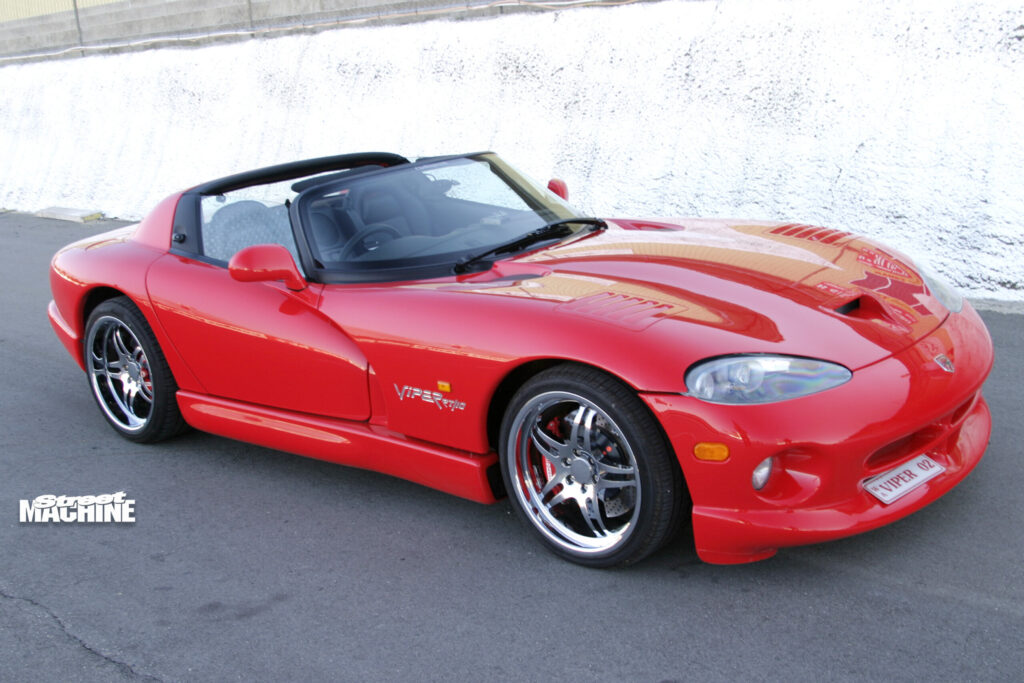
In the world of high-performance sports cars, the Dodge Viper stands as an icon of raw power and sleek design. First introduced in the early 1990s, the Viper quickly became a symbol of American automotive engineering prowess. For Mark McKay, a passionate car enthusiast, owning a 2002 Dodge Viper RT/10 wasn’t just about having a powerful machine; it was about pushing the limits of performance. His journey to transform his Viper into a 1000hp beast is a testament to innovation and dedication.
Mark McKay acquired his rare Australian-delivered Viper in 2003, and almost immediately, he began exploring ways to enhance its already formidable capabilities. The standard Viper, with its 488 cubic inches of aluminum V10 engine, delivers an impressive 450hp. However, for McKay and many other Viper owners, the pursuit of power is never-ending. With a plethora of aftermarket options available, the transformation of McKay’s Viper was inevitable.
The Transformation Begins
To undertake such a significant build, McKay enlisted the expertise of Mark Else from Mark’s Workshop in Western Australia. Else is no stranger to high-performance modifications, having previously worked on twin supercharged SS Holden utes. The project was not a simple bolt-on job; it required meticulous planning and execution.
One of the first challenges was managing the heat generated by the increased power output. The Viper’s engine bay, known for its limited space, posed a significant obstacle. To address this, a triple-flow four-row radiator was installed, necessitating the relocation of the engine oil cooler. A custom-made oil cooler with its own thermo fans was fitted under the rear of the car to ensure optimal cooling.
Boosting Performance
To achieve the desired 1000hp, McKay’s Viper needed more than just cooling enhancements. The solution came in the form of a Paxton Novi-2000 centrifugal blower, which was reverse-mounted at the front of the engine. This setup allowed for a forward-facing intake, channeling 11psi of high-density air through a custom intercooler into the standard intake manifold. The result was an astounding 821hp at the rear wheels on pump gas, bringing the flywheel output tantalizingly close to the 1000hp mark.
However, achieving this level of performance required further modifications. The original US-built short block was not optimized for the power McKay desired. Else identified issues with the combustion chamber shape, which compromised tuning. By replacing the dished pistons with custom JE 10:1 compression flat-top pistons, the engine’s combustion efficiency improved significantly.
Driving Experience and Modifications
With great power comes the need for control. McKay’s Viper is equipped with Pirelli P-Zero Rosso 355/25 ZR 19 tires on 13-inch wide wheels, providing the necessary grip to harness the car’s immense power. The front tires, wider than most rear tires, are mounted on 10-inch wide Complete Custom Wheels, ensuring stability and control.
Despite the modifications, the Viper’s T-56 six-speed transmission remains unchanged, aside from a Mopar Performance short shifter and a six-puck brass button clutch. The driveline, however, features 1400hp-capable Unitrax half shafts and a cryogenically treated 4.55:1 ratio differential to handle the increased power.
“I’ve been in a lot of extremely fast street cars but I haven’t been in a street-tyred car that pulls as hard as this one,” says Mark Else, highlighting the Viper’s exceptional performance.
A Legacy of Power
The Dodge Viper’s journey from concept to icon began at the 1989 North American International Auto Show. Initially planned as a low-production model, the Viper’s success exceeded expectations, captivating enthusiasts with its 400hp all-aluminum V10 engine. Over the years, the Viper evolved, with power increasing to 450hp by the mid-1990s and further enhancements in the 2000s.
Today, McKay’s 1000hp Viper stands as a testament to the enduring allure of the Viper brand. It represents not only the pinnacle of automotive engineering but also the passion and ingenuity of car enthusiasts like McKay and Else. As McKay plans to take his Viper to Barbagallo Raceway and Kwinana for track sprints and quarter-mile passes, the legacy of the Viper continues to grow.
For those who crave power and precision, the Viper remains an unmatched symbol of performance, embodying the spirit of innovation and the thrill of the open road.