




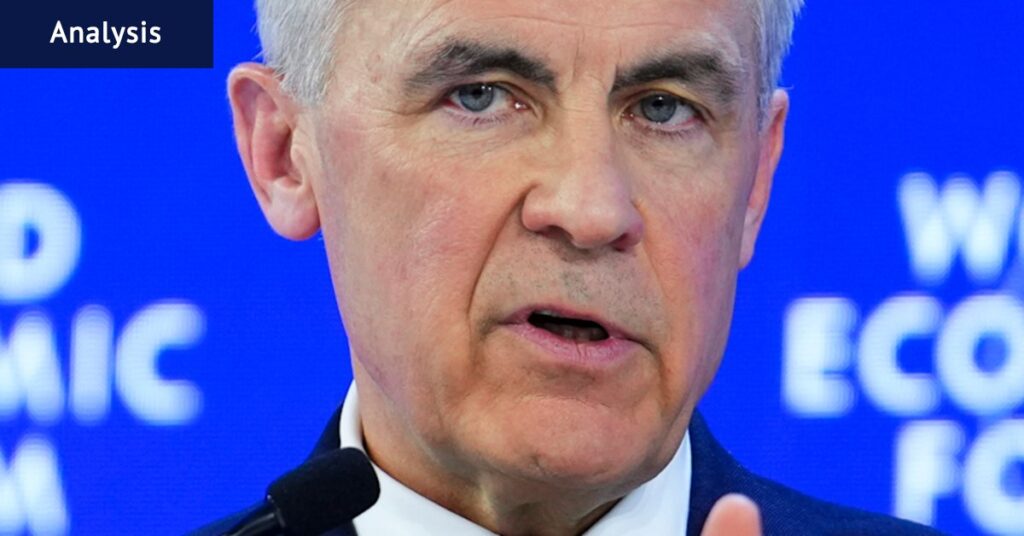
In a powerful address at the World Economic Forum in Davos, Mark Carney, former Governor of the Bank of Canada and the Bank of England, delivered a speech that has reverberated across the globe. On January 21, 2026, Carney called for a re-evaluation of the international order, urging middle powers to recognize the current geopolitical realities and adapt accordingly. His remarks, though centered on Canada, hold significant implications for countries like Australia.
Carney’s speech highlighted Canada’s strengths as an energy superpower with vast reserves of critical minerals, a highly educated population, and sophisticated pension funds. These attributes, he argued, position Canada as a key player capable of forming new alliances to replace the “rules-based international order” currently under strain.
Challenging the Status Quo
The announcement comes as global tensions rise, with traditional alliances being tested. Carney did not mention former U.S. President Donald Trump by name, but his criticism of economic coercion and the use of tariffs as leverage was unmistakable. He warned of a world where economic integration is weaponized, stating, “Great powers have begun using economic integration as weapons. Tariffs as leverage. Financial infrastructure as coercion.”
Carney’s message was clear: the world is experiencing a rupture, not a mere transition. He likened the current international order to a “polite fiction,” reminiscent of Vaclav Havel’s description of communism as “living within a lie.” This, Carney suggested, necessitates a candid acknowledgment of the geopolitical landscape.
Redefining Alliances
Meanwhile, Carney advocated for diversifying alliances and partnerships. He noted that Canada had recently signed 13 trade and security deals across four continents, including strategic partnerships with China and Qatar. This approach, which he termed “variable geometry,” involves forming coalitions based on shared values and interests rather than rigid adherence to outdated frameworks.
Carney’s vision for Canada includes a pragmatic recognition of global shifts. “We understand that this rupture calls for more than adaptation. It calls for honesty about the world as it is,” he declared, emphasizing the need for middle powers to act decisively in the face of changing dynamics.
Global Reactions and Implications
The speech has been hailed as a pivotal moment by international observers. George Magnus, an economist at Oxford University’s China Centre, described it as a “cometh the hour speech,” while Dutch historian Rutger Bregman called it “riveting, extraordinary and brutally honest.”
This development follows a period of introspection for many nations, including Australia, which finds itself at a crossroads. While the Australian government has criticized Trump’s tariffs and resisted economic coercion, it remains closely aligned with the U.S. This alignment contrasts with Carney’s call for a more diversified approach.
According to Justin Logan, director of defense and foreign policy studies at the Cato Institute, Canada’s pivot towards China is not without risks. He cautioned that Carney’s strategy might lead Canada into precarious waters, saying, “If Carney believes Canada’s security is shaped more by something called ‘the rules-based order’ than by geography, he may find that he’s just swum into the shark’s mouth.”
Looking Forward
The move represents a significant shift in how middle powers like Canada and potentially Australia might navigate the evolving global landscape. Carney’s defiant stance against coercion and his call for diversified alliances could serve as a blueprint for other nations seeking to assert their sovereignty in a multipolar world.
As the world grapples with these changes, the implications of Carney’s speech will likely continue to unfold. Nations will need to weigh their options carefully, balancing traditional alliances with new opportunities for collaboration. The challenge lies in navigating this complex terrain without compromising national interests or security.
In conclusion, Mark Carney’s address at Davos serves as a clarion call for a more flexible and realistic approach to international relations. As countries like Australia consider their own positions, the lessons from Carney’s speech may prove invaluable in shaping future strategies.