




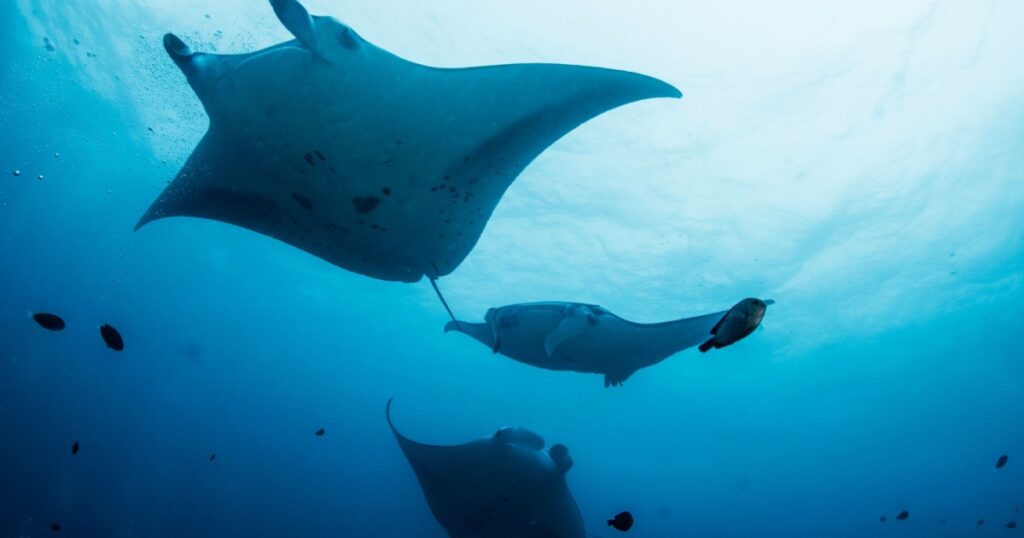
Manta rays, known for their graceful movements across vast ocean expanses, have been discovered to dive far deeper than previously recorded. A recent study revealed that these majestic creatures can reach depths of up to 1.2 kilometers (about 0.75 miles) beneath the ocean surface. This groundbreaking discovery was made by researchers who tagged 24 oceanic manta rays (Mobula birostris) across three diverse locations: Raja Ampat in eastern Indonesia, near Tumbes off northern Peru, and close to Whangara by northern New Zealand.
The research, published in the journal Frontiers in Marine Science, utilized a combination of tags that either detached and floated to the surface for collection or transmitted data via satellite. This approach provided an extensive dataset of 2,705 ‘tag-days,’ encompassing 46,945 individual dives by the rays. Among these, 79 dives exceeded depths of 500 meters (1,640 feet), with the deepest recorded dive reaching an astonishing 1,250 meters (4,101 feet).
Unraveling the Mysteries of Manta Ray Behavior
This significant finding challenges previous assumptions about the diving capabilities of manta rays. The study’s first author, Dr. Calvin Beale, a PhD candidate at Murdoch University, emphasized the importance of these deep dives. He stated,
“We show that, far offshore, oceanic manta rays are capable of diving to depths greater than 1,200 meters, far deeper than previously thought. These dives, which are linked with increased horizontal travel afterwards, may play an important role in helping mantas gather information about their environment and navigate across the open ocean.”
Interestingly, the rays do not simply plunge straight down during these dives. Instead, they descend in a ‘step-like’ pattern, swimming horizontally at various depths before continuing downward. This behavior is believed to help the rays acclimate to colder waters or recover from the exertion of swimming deeper.
Implications for Marine Ecology
The discovery of such deep diving behavior has broader implications for understanding manta ray ecology and their role in marine ecosystems. The rays’ ability to dive to great depths and then spend significant time at the surface suggests complex behavioral adaptations. Dr. Beale further explained,
“Understanding the nature and function of deep dives helps explain how animals cross vast, seemingly featureless oceans and connect ecosystems thousands of kilometers apart.”
Notably, all of the deepest dives were recorded near New Zealand, prompting questions about the environmental factors in that region that might encourage such behavior. Further research is needed to explore these dynamics and their potential impact on manta ray populations.
Looking Ahead: The Future of Manta Ray Research
This study opens new avenues for research into the life of manta rays and their interactions with the marine environment. Understanding the drivers behind their deep dives could provide insights into oceanic navigation and the ecological connections between distant marine habitats. As researchers continue to explore these depths, they hope to uncover more about how manta rays and other marine species adapt to the challenges of the open ocean.
The findings also highlight the importance of protecting marine environments that support such diverse and complex life forms. As human activities increasingly impact ocean ecosystems, studies like this underscore the need for conservation efforts that ensure the survival of species like the oceanic manta ray.
In conclusion, the revelation of manta rays’ deep diving capabilities not only expands our understanding of these creatures but also emphasizes the intricate and interconnected nature of marine life. As research continues, it will be crucial to monitor how these behaviors might change in response to environmental pressures and to develop strategies that support the resilience of ocean ecosystems.