




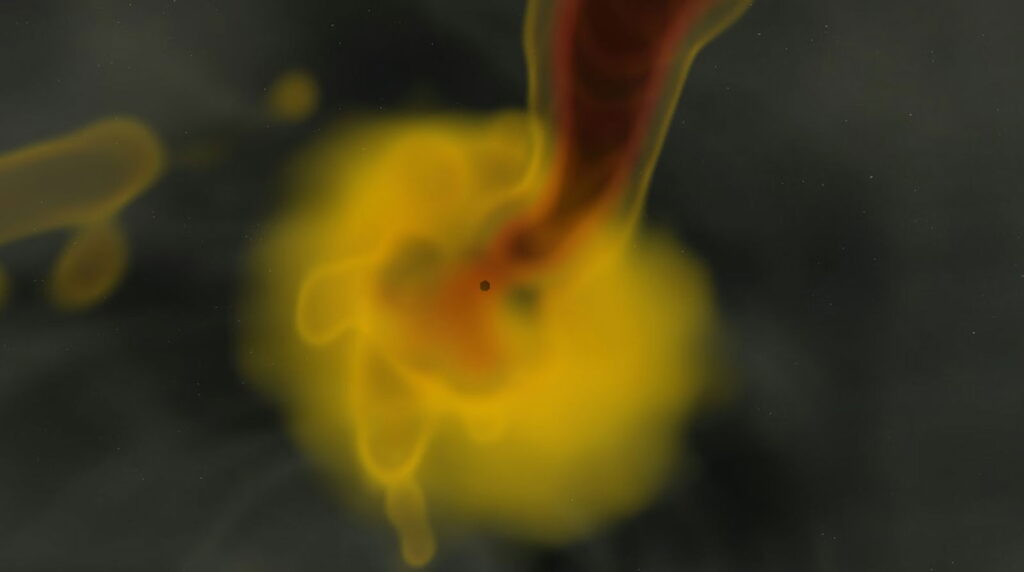
In 2023, the LIGO-Virgo-KAGRA (LVK) Collaboration detected gravitational waves from the largest black hole merger ever recorded, an event designated as GW231123. This groundbreaking discovery not only broke records but also challenged existing scientific models due to the unprecedented masses and spins of the black holes involved.
Now, in a pivotal study conducted by the Flatiron Institute, physicists are reshaping our understanding of black hole formation, particularly under the influence of magnetic fields. This research, published in The Astrophysical Journal Letters, offers new insights into how these cosmic giants come into being and ultimately meet their fate.
Solving the Mystery of Black Hole Formation
The team at the Flatiron Institute’s Center for Computational Astrophysics developed sophisticated computer simulations to trace the life cycles of stars and observe how their deaths lead to the formation of black holes. These simulations revealed that magnetic fields play a significantly more influential role than previously acknowledged.
“No one has considered these systems the way we did; previously, astronomers just took a shortcut and neglected the magnetic fields,” said lead author Ore Gottlieb, an astrophysicist at the CCA. “But once you consider magnetic fields, you can actually explain the origins of this unique event.”
Black Hole Problems: Understanding the Mass Gap
The core of the puzzle lies in the life cycle of massive stars. Typically, such stars collapse into black holes following a supernova, but only under specific conditions. Stars within a certain mass range undergo pair-instability supernovae, which completely destroy the star, leaving no remnants.
The black holes observed in GW231123 fall within this expected mass gap, which ranges from 70 to 140 solar masses. This anomaly prompted scientists to reconsider existing theories.
“As a result of these supernovae, we don’t expect black holes to form between roughly 70 to 140 times the mass of the sun,” Gottlieb says. “So it was puzzling to see black holes with masses inside this gap.”
One hypothesis suggested that two smaller black holes might have merged to form the larger one. However, both black holes in GW231123 exhibited extremely rapid spins, nearing the speed of light. Typically, a merger would result in a remnant with a moderated spin, making this scenario unlikely.
Simulating Black Hole Births: The Role of Magnetic Fields
The researchers conducted their simulations in two stages. Initially, they modeled the life of stars up to their final moments, focusing on stars with 250 solar masses, which would reduce to about 150 solar masses by the time they collapsed. At this mass, the resulting black hole would sit just above the upper boundary of the mass gap.
The second stage involved detailed modeling of the supernova remnants. Previous models assumed that all surrounding stellar material would be absorbed by the newly formed black hole. However, by incorporating magnetic fields—often overlooked in past simulations—the researchers demonstrated that this assumption was flawed.
Disappearing Mass and Rapid Spins
While non-rotating stars behave as expected, rapidly spinning stars present a different scenario. Their rotation forms a disk of stellar debris around the black hole, which accelerates as material falls inward. Eventually, the combination of the disk’s rotation and magnetic forces becomes strong enough to expel material outward at near light-speed.
“We found the presence of rotation and magnetic fields may fundamentally change the post-collapse evolution of the star, making black hole mass potentially significantly lower than the total mass of the collapsing star,” Gottlieb says.
This expulsion of mass allows a black hole to form within the mass gap while maintaining a rapid spin. The team also discovered a previously unrecognized relationship between a black hole’s mass and its spin.
Implications and Future Research
These findings open new avenues for understanding black hole formation and evolution. The researchers suggest that future observations of gamma-ray bursts could provide a promising opportunity to test their model, potentially expanding our knowledge of these powerful cosmic phenomena.
The paper, titled “Spinning into the Gap: Direct-horizon Collapse as the Origin of GW231123 from End-to-end General-relativistic Magnetohydrodynamic Simulations,” was published in The Astrophysical Journal Letters on November 10, 2025.
As the scientific community continues to explore these findings, the role of magnetic fields in cosmic events may become a pivotal area of study, challenging long-held assumptions and inspiring new research into the mysteries of the universe.