



Some of the most extreme explosions in the universe are Type I superluminous supernovae. These cosmic events have long puzzled scientists with their extraordinary brightness and enigmatic behavior. “They are one of the brightest explosions in the Universe,” says Joseph Farah, an astrophysicist at the University of California, Santa Barbara. For years, astrophysicists have sought to understand what makes superluminous supernovae so absurdly powerful. Now, it seems we may finally have some answers.
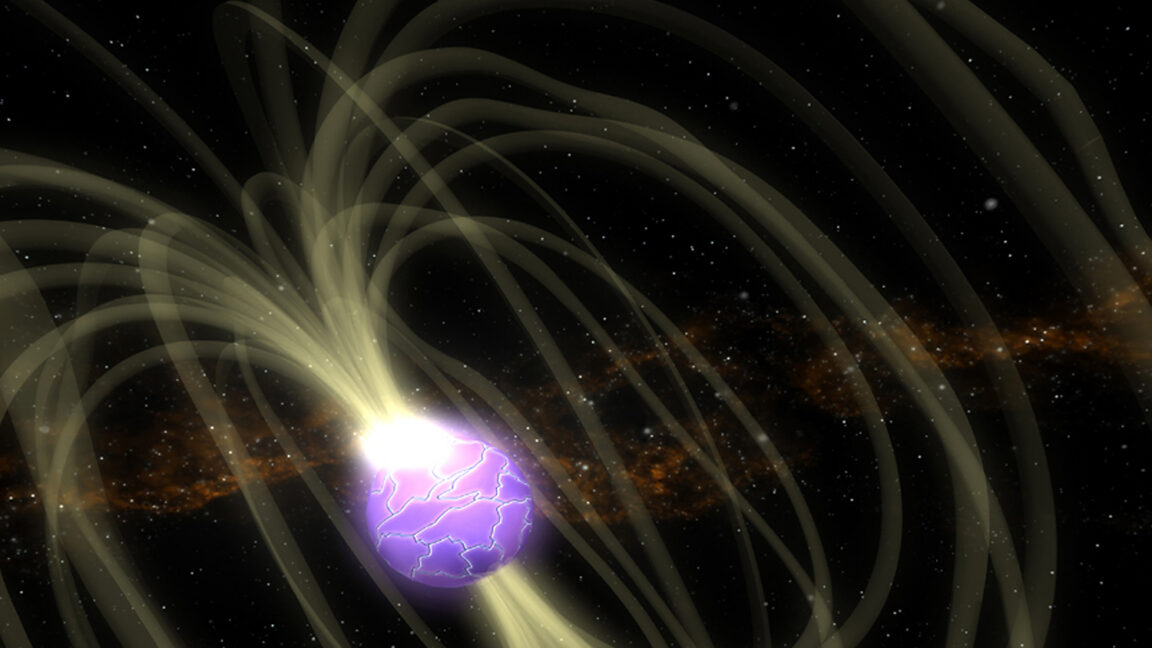
Farah and his colleagues have discovered that these events are most likely powered by magnetars, rapidly spinning neutron stars that warp the very fabric of space and time around them. This breakthrough could reshape our understanding of these cosmic phenomena.
The Power Within Magnetars
Magnetars have been a leading candidate for the engine behind superluminous supernovae. The theory suggests that these intensely magnetized stars are born from the collapsing core of the original progenitor star and emit energy via magnetic dipole radiation. “This core is roughly a one solar mass object that gets crushed down to the size of a city,” Farah explains. As its spin slows, a magnetar bleeds its rotational energy into the expanding material of the dead star, lighting it up.
However, this theory faced challenges. In a standard magnetar model, the light curve of the supernova should rise rapidly and then fade away evenly as the neutron star loses its rotational energy. “This way the light curve, in the prediction of this model, just goes up and then down quite smoothly,” Farah says. But observations of superluminous supernovae rarely show this smooth fade. Instead, they exhibit bumps, wiggles, and strange modulations, with the light curve flickering over months.
The Chirping Star Phenomenon
The solution to this flickering problem emerged when the Liverpool Gravitational Wave Optical Transient Observer collaboration detected an object designated SN 2024afav on December 12, 2024. Initially, the object appeared to be a standard superluminous supernova. “It was as bright and it had bumps in the light curve like many other objects of this kind,” Farah notes. But as telescopes continued to monitor it, the object began to exhibit an unprecedented behavior: it started to chirp.
In physics, a chirp refers to a signal with a frequency that steadily increases over time. In the case of SN 2024afav, its emissions were fluctuating, but the gaps between these fluctuations were shrinking. After observing a second and third bump with gaps reduced by roughly 35 percent, Farah and his team realized they could predict how much the gap would decrease next. Their predictions were confirmed when the fourth bump appeared exactly as expected, and the fifth bump narrowed the period reduction to about 29 percent.
“Random space rubble just doesn’t work that way,” Farah emphasizes, highlighting the precision of their predictions.
Twisted Space: The Lense-Thirring Effect
The team proposed a new model to describe this behavior, relying on the Lense-Thirring effect, also known as frame-dragging. Frame-dragging is a prediction of General Relativity, where a massive spinning object slightly drags the spacetime around it as it rotates. “We didn’t try this mechanism before because it had never been seen around a magnetar before,” Farah says. But when his team applied it, the model perfectly matched the observations.
To understand Farah’s Lense-Thirring solution, imagine a bowling ball spinning in a vat of molasses. As the ball rotates, friction drags the sticky fluid along, creating a swirling vortex. According to Einstein’s General Relativity, mass and energy can warp the fabric of spacetime, so if a sufficiently large mass is spinning rapidly, it drags the spacetime along in a similar manner. Around a newborn magnetar, spacetime is whipped into a violent, twisting frenzy.
When the progenitor star exploded to create SN 2024afav, it didn’t eject all of its material perfectly. Some of the stellar remnants fell back toward the newborn magnetar, forming a small accretion disk around it. Crucially, this disk was misaligned, tilted relative to the rotational axis of the magnetar. The Lense-Thirring effect forced this disk to wobble, or precess, around the magnetar’s spin axis like a top spinning ever more slowly.
The Shrinking Disk and Future Discoveries
The team proposes that the shrinking of the accretion disk is key to understanding the chirping phenomenon. The size of this disk isn’t static; it’s determined by the inward ram pressure from infalling matter and the outward radiation pressure from the magnetar. As the exploding star depletes its fallback material, the accretion rate drops, causing the disk to shrink and fall inward toward the magnetar. The closer it gets, the stronger the Lense-Thirring effect becomes, accelerating the precession and tightening the wobbles.
“Imagine a pirouetting figure skater pulling her arms in to accelerate the spinning movement,” Farah suggests, illustrating the process.
By measuring these chirps, Farah and his colleagues were able to deduce the properties of the magnetar powering SN 2024afav. They constrained its spin period to 4.2 milliseconds and precisely calculated its powerful magnetic field. The magnetar’s properties, derived solely from the chirping, matched those required to power the supernova’s brightness.
However, the work on the revised “magnetar+LT” model is just beginning. “This object is so rare and so new,” Farah admits. “We were scraping the bottom of the barrel for references that were even remotely related to the idea we were pitching here.”
Superluminous Siblings and Future Exploration
Farah’s team revisited archival data from other bumpy superluminous supernovae such as SN 2018kyt, SN 2019unb, and SN 2021mkr. They found that their “magnetar+LT” model explains the modulations in those events as well. A whole class of exploding stars that previously required multiple mutually exclusive physical explanations could be unified by a single, elegant model.
Yet, many questions remain unanswered. “How the accretion disk forms, how it blocks or modulates the light from the magnetar, how that light then gets to the ejecta, and finally how it gets to the observer,” Farah lists. “Basically every step along the way we made the best assumptions we could.”
To truly unravel these mysteries, Farah emphasizes the need for more discoveries like SN 2024afav. With new observatories like the Vera C. Rubin Observatory in Chile coming online, the future looks promising. “The Rubin Observatory is expected to discover dozens of these chirped supernovae,” Farah says. “We will be able to test our models against many different objects. There’s definitely room for development and growth. This is just the very beginning.”
Nature, 2026. DOI: 10.1038/s41586-026-10151-0