
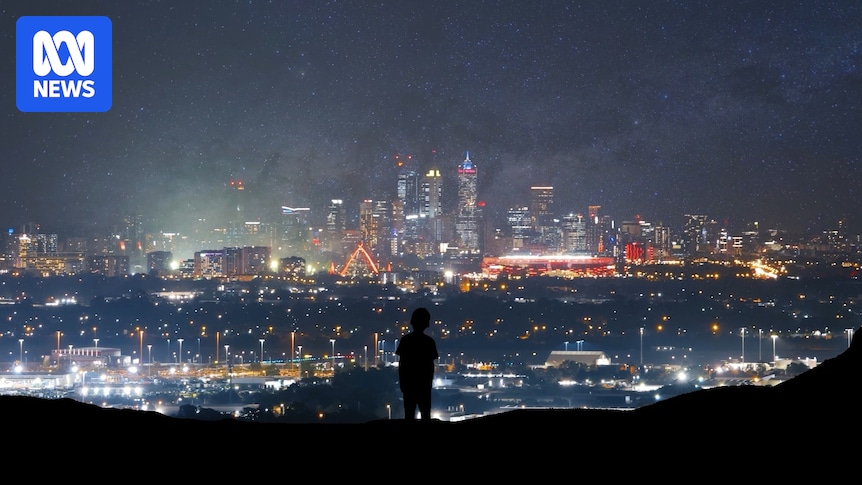
We are losing the stars. Not all at once, but quietly, one streetlight, one neon sign, one expanding suburb at a time. For most of human history, the night sky has been a shared inheritance, a source of stories, navigation, and wonder. But for many adults, the expansive skies of childhood that were bursting with starlight are no longer visible. Most of today’s children don’t even know what they’re missing.
Outback Australia remains one of the best places in the world to see the night sky in all its celestial glory. However, in much of Europe and North America, dark skies have almost vanished. More than a third of the Earth’s population — about 2.8 billion people — cannot see the Milky Way from where they live due to artificial light pollution. And when people can no longer look up and see the stars, something shifts.
The Human Connection to the Cosmos
Yet the universe leaves traces. As some look up, others look down. Under magnification, even the ashes of the dead can resemble distant galaxies, reminding us that we are made of the same elements as the stars. Mexican photographer and cinematographer Gabriela Reyes Fuchs has always been a visual person, looking at the world through a lens. On the day she returned to her father’s farm to lay him to rest, she felt compelled to take a small portion of his ashes to examine.
“I knew I needed to see his ashes under the microscope,” Ms. Reyes Fuchs says. “I didn’t question it. I just knew I had to do it.” What she discovered reshaped her understanding of life, death, and the universe. “When I first looked into the microscope, I discovered all these galaxies,” she recalls. Ms. Reyes Fuchs says that as she examined the images, the quote of planetary scientist Carl Sagan — ‘The cosmos is within us, we are made of star-stuff’ — took on a deeply personal meaning.
The science behind her observations makes intuitive sense, as the elements that make up the universe — nitrogen, carbon, oxygen, hydrogen, calcium, and phosphorus — also form the human body, transformed by heat and time. Viewed through a microscope, those elements reveal familiar structures, connecting both the intimate and the vast lights of the universe.
The Impact of Light Pollution
What does it mean for humanity, then, if our 21st-century lifestyle is dimming our view of the stars? Katherine Bennell-Pegg, the first astronaut to train under the Australian flag, often found herself in the garden, in the quiet of night, looking up at the brightly speckled sky. “As a kid, I used to lie on the dry grass in my backyard and gaze up at the stars in awe,” she said in her acceptance speech as the 2026 Australian of the Year.
Space archaeologist Alice Gorman agrees. “When you think about humans as a species, then effectively every person who has ever lived has, at some point, looked up to the sky, whether they look up at the moon or the stars, and they wonder what it’s all about … it’s a connection to the night sky,” she says. But as light pollution bleeds further into the darkness, more than a billion children are being deprived of the opportunity to marvel at the galaxies above them, and to let their imaginations soar.
In Australia, an estimated 75 percent of children — more than 3.2 million — live in urban areas where their view of the stars is being increasingly obscured by artificial light.
Melbourne high school teacher and astrophotographer Liam Murphy says many of his students are surprised to learn that the Milky Way is in the sky above them. “We’re doing our astronomy unit, and I start most of the lessons with the planetarium software up on the screen. We look at tonight’s sky [and] see what’s up,” he says. “I show the kids the picture of the Milky Way, and they’re like, ‘Well, where’s that?’. ‘Well, that’s in the sky.’ ‘No, it isn’t.’ ‘Yes, it is.’
Even when people think they are looking at stars, in many cases, they are seeing satellites. Next year it will be 70 years since the then-Soviet Union launched the first artificial satellite, Sputnik 1, into space. There are now about 12,000 satellites orbiting Earth, according to Australian-Canadian astrophysicist Brad Gibson. In less than a decade, that number is likely to balloon to about 100,000, making it even more difficult to determine if the lights we can glimpse in the night sky are actually stars.
Preserving the Night Sky
Renowned astrophotographer Alex Cherney says that as a child growing up in Ukraine, light pollution masked the existence of most stars. “Looking up in a built-up area in Eastern Europe, there is nothing special up there,” he says. “It just stopped me from being curious about it.” Now based in Melbourne, Mr. Cherney says his interest in the night sky was piqued when his young daughter asked him to help her find aliens.
“So, we went to Mornington Peninsula Astronomical Society in Victoria and looked at the night sky there,” Mr. Cherney says. “It’s affected by light pollution, but not as much as in suburban Melbourne, and we looked through the telescope at the Orion [Nebula] and the rings of Saturn.” They didn’t see any aliens, but that experience in 2007 ignited Mr. Cherney’s passion for the night sky.
“If you live in Melbourne, Sydney, Perth, you have to travel 200 kilometres … to get outside of the light pollution and actually see the stars as they’re meant to be,” he says.
Clinical psychologist Dr. Simonne Cohen has seen how a sense of wonder and calm in the presence of nature can improve mental wellbeing. She says young people, especially children, are growing up in a fast-paced, highly stimulating world filled with constant technology and instant rewards. While many cope well, others become overwhelmed, leading to increased psychological stress.
“There is more anxiety, more emotional meltdowns, kids are coming home from school and just melting down over the smallest thing,” Dr. Cohen says. “And that’s because there isn’t enough time in our day to just stop, pause, and reflect.” Spending time outdoors slows the nervous system and aids wellbeing in both children and adults, according to Dr. Cohen.
Looking to the Future
For centuries, parents have sung the nursery rhyme “Twinkle, Twinkle, Little Star,” written in 1806, to their children. The lyric, “How I wonder what you are,” instils a sense of curiosity and imagination that has been passed down through generations. And for some, like retired Royal Australian Navy veteran Brendan Naylor, the habit of stargazing has been carried into adulthood.
Mr. Naylor, who spent 13 years as a navigation officer, says navy crews are still taught to navigate by the stars. “From the very get-go, we get taught how to identify stars and how to take bearings and angles of the stars to work out where about in the world we are,” Mr. Naylor explains. But of all the evenings he spent at sea with a ceiling of stars above him, one particular night in 2015 has stayed with him.
For at least 65,000 years, Australia’s first peoples have been looking to the Sky Country for guidance. Dawn Hamlett, a Wajarri elder living in the Murchison region of Western Australia, says her ancestors would often travel at night, when the ground was cooler, and use the sky as a map. “They were the first astronomers. Well, I think they would have been. Because they depended on the stars,” she says.
One of the most important celestial markers is the Emu in the Sky, a well-known formation within the Milky Way. When it appears upright, it signals that emus have laid their eggs and they are ready to be gathered for food. Today, this story has become widely known, drawing tourists who venture out into the country to witness it for themselves.
Landscape and astrophotographer Greg Rowney agrees, saying light pollution north of Perth is affecting areas that were once dependable vantage points for dark-sky observation. “One of the places we often shoot, the Pinnacles, about two-and-a-half hours north of Perth, has changed noticeably as Perth’s northern outskirts and nearby towns expand,” he says.
This is why about 16 local governments in Western Australia have implemented lighting policies to help preserve dark-sky tourism. Wongan-Ballidu Shire President Mandy Stephenson says any lighting that the shire, located 175 kilometres north-east of Perth, approves must be dark-sky accredited. That means outdoor lighting must be certified by DarkSky International to minimise light pollution, reduce glare, and eliminate light creep.
The extent to which light pollution affects humans’ experiences with the night sky was laid bare, by accident, in one of the strangest social experiments in modern times. On January 17, 1994, a 6.7 magnitude earthquake struck Los Angeles and caused a major power blackout. Dr. Ed Krupp, director of the city’s Griffith Observatory, remembers the event well and says many residents were startled by what they saw in the night sky.
“Many people, at the quake, ran outside … and they encountered this dark sky which is unlike anything you ever get to see in Los Angeles,” Dr. Krupp says. “The sky was filled with stars … and it was those stars that really unsettled people. Since the mid-20th century, smog and light pollution have gradually swallowed the stars twinkling over Los Angeles.”
“We don’t know that we miss it until we get it again, and then [there’s] that reflection and perspective that comes [with looking at the stars] … that every generation before the 20th century was able to enjoy. Now we don’t even know there are stars out there to be seen.”
“The fact is, places where [dark skies] are preserved, like the outback, are more valuable now than they were before because they’ve got something that much of the planet no longer has.”
The Plane family from Perth knows the majesty of the outback sky at night. And they know its healing power. After a couple of years of tragedy, they seek solace under the inky expanse, looking to the stars that have long since died and whose light is only now reaching us. After mourning the sudden and unexpected death of one male relative, the family is again grieving after the loss of father and husband, Shane, who passed away from cancer on Christmas Day 2025.
A few weeks before Mr. Plane died, the family made a special trip to Gingin Observatory, about an hour’s drive north of Perth, to spend time together under the stars. Brad Plane says stargazing has always been part of their lives. “It’s very important to us as a family,” Brad says. Brad feels a connection when he raises his eyes to the night sky. He views shooting stars as signs from loved ones who have passed away.
“I know he [dad] will send us a lot of signs from the sky.” When artificial light falls away, something opens. Darkness becomes the moment where possibility appears, where we reconnect with the same sky our ancestors once used for direction and guidance. We look up to whisper to the loved ones we’ve lost. The distant glow of starlight, radiating for centuries through the darkness to reach us on Earth today, is where past and present meet.
To hold on to the night is not just to preserve awe and wonder, but to remember who we are.